


What is a gas pole saw, and when do you need one?
A gas pole saw is a small chainsaw head mounted on a long shaft and driven by a petrol engine, letting you cut branches up to roughly 15 feet overhead while standing safely on the ground. You need one when trees outgrow a manual pole pruner and a ladder would be dangerous.Gas versions trade the quiet and light weight of battery models for more cutting power and unlimited runtime, which pays off when you have many limbs or thicker wood to clear. They are heavier to hold aloft, so they suit larger properties rather than a single small tree.
A typical gas pole saw pairs a small engine, often in the 20-30cc range, with a bar of around 10-12 inches on the end of the pole, so it is really a compact chainsaw you operate at arm's length. Some are dedicated one-piece pole saws, while others are powerheads that also take hedge-trimmer, edger, and cultivator attachments.
How much reach do gas pole saws give you?
Most gas pole saws give a cutting reach of about 12 to 15 feet once you add your own height and arm extension, with fixed-length and telescoping shafts available. Add the branch's own height and you can safely tackle limbs that would otherwise need a climber.Reach is a trade-off, because a longer shaft touches higher wood but is heavier and harder to control, and a saw waving overhead quickly tires your arms and shoulders. The practical reach factors are listed below.
- Shaft length: fixed shafts are lighter, while telescoping shafts adjust but weigh more.
- Body height: your own height and arm span add several feet to the tool's own reach.
- Cutting angle: work at a slight offset, never directly overhead.
Which gas pole saws do reviewers rate?
Reviewers and owners consistently point to a handful of gas pole saws, led by professional power pruners and homeowner combi-tools. Based on manufacturer specs and aggregated owner feedback, the recognised names are listed below.| Model | Brand | Notes |
|---|---|---|
| Echo PPT-2620 | Echo | Professional power pruner with long reach and a strong owner reputation |
| Stihl HT 133 | Stihl | Professional telescoping pole pruner |
| Stihl HT 56 C-E | Stihl | Lighter homeowner pole pruner with easy starting |
| Husqvarna 525PT5S | Husqvarna | Professional-grade telescoping shaft |
| Poulan Pro PR28PS | Poulan Pro | Budget homeowner pole saw |
These sit alongside the many attachment-capable powerheads that take a pole-saw attachment, which can be more economical if you already own a compatible string trimmer or combi system.
How do you use a gas pole saw safely?
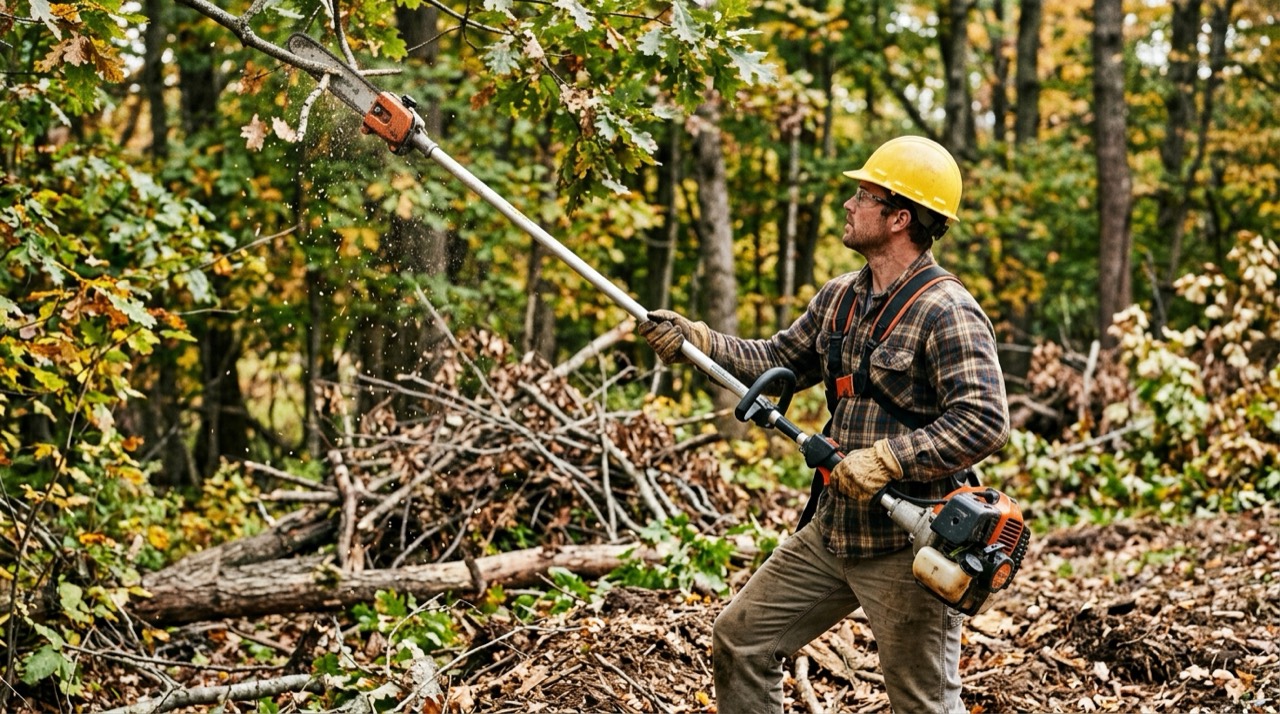
Using a gas pole saw safely starts with a helmet, eye and ear protection, and standing so falling limbs cannot land on you. Plan an escape path, keep bystanders well clear, and never cut a branch that is directly over your head.Overhead cutting is among the most dangerous yard tasks, because limbs fall unpredictably, the saw is hard to control at full extension, and fatigue sets in fast. The steps below reduce the risk.
- Wear a forestry helmet with face and hearing protection and stand clear of the drop zone.
- Undercut the branch first so it does not tear bark down the trunk.
- Let the saw's weight and sharp chain do the work, and do not force the cut.
- Stop and reposition rather than overreaching.
Any branch near power lines, any large limb over a structure, or work that needs you off the ground belongs to a trained arborist, and this is general guidance, not a substitute for professional training.
How does a gas pole saw differ from a top-handle chainsaw?
A gas pole saw is a small chainsaw on a long shaft you operate from the ground, while a top-handle chainsaw is a compact saw an arborist carries up into the tree itself. The pole saw keeps you on the ground, and the top-handle saw goes aloft with a trained climber.The distinction matters because the two tools solve overhead cutting in opposite ways. A pole saw extends your reach so your feet stay planted, which is far safer for a homeowner clearing high limbs. A top-handle saw is designed to be handled one-handed by a roped, trained arborist working in the canopy, and it is genuinely dangerous in untrained hands on a ladder or at height. For the vast majority of property owners, the pole saw is the correct choice for high branches, and any job that truly needs a climber with a top-handle saw is a job for a professional. Reaching from the ground with a pole saw removes the fall risk that makes tree work so hazardous, which is the whole point of the design.
What engine size and bar length do gas pole saws use?
Gas pole saws typically pair a small 20-30cc two-stroke engine with a bar of about 8 to 12 inches, sized so the tool stays light enough to hold overhead while still cutting limbs several inches thick. Bigger engines exist on professional units but add tiring weight at height.The small engine is a deliberate compromise: it must produce enough chain speed to cut cleanly yet stay light on the end of a long shaft, because every extra ounce is multiplied by the leverage of the pole. The short bar suits the branch diameters a pole saw is meant for, generally up to 6 to 8 inches, and a longer bar would only add weight and encourage cuts the tool should not attempt. Professional power pruners run slightly larger engines and telescoping shafts for reach and durability, while homeowner models keep the engine small and the shaft fixed to save weight and cost. When comparing models, weigh engine size and shaft length together against how long you can comfortably hold the running tool above your head, because fatigue, not raw power, is what limits most overhead work.
How do you maintain a gas pole saw?
Maintaining a gas pole saw combines normal chainsaw care with attention to the long shaft and drive: keep the small bar and chain sharp and oiled, run fresh two-stroke fuel, and check the shaft coupling and gearbox where fitted. The chain and oiler need the same routine as any gas saw.Follow this routine to keep a gas pole saw running well:
- Keep the chain sharp and correctly tensioned, since a dull chain on a small bar cuts slowly and strains the little engine; our chainsaw sharpening guide covers the technique.
- Fill the bar-oil reservoir every time you refuel, because a dry chain on a pole saw wears the bar fast and is hard to notice at height.
- Run fresh 50:1 fuel, or the ratio your saw specifies, and never leave stale fuel in the tank between jobs.
- Clean the air filter regularly, as pole-saw work showers sawdust and debris down onto the powerhead.
- On telescoping or attachment models, wipe and lightly grease the shaft coupling and check the gearbox oil per the manual.
A pole saw that is kept sharp, oiled, and fuelled fresh stays controllable overhead, which is a safety issue as much as a performance one.
What are the common mistakes when using a gas pole saw?
The most common gas pole saw mistakes are overreaching, cutting directly overhead, and standing in the drop zone, and each turns a routine trim into a serious hazard because the tool and the falling limb are both hard to predict at full extension. Most pole-saw injuries come from position, not the saw itself.The errors that cause the most trouble overhead are listed below.
- Cutting straight above your head: limbs fall unpredictably, so always work at a slight offset and step clear as the branch drops.
- Overreaching at full shaft length: an extended pole saw is heavy and slow to control, so reposition rather than stretching for one more branch.
- Skipping the undercut: failing to undercut a limb first tears bark down the trunk and can pinch the bar.
- Working tired: fatigue from holding the tool aloft is when control slips, so take frequent breaks.
- Ignoring power lines: any branch near a line is a job for the utility or a professional, never a homeowner pole saw.
Because these are position and judgement errors, wearing a forestry helmet with face and hearing protection and planning each cut matters more than the saw's specs.
Can a gas pole saw powerhead take other attachments?
Many gas pole saws are sold as attachment-capable powerheads, meaning the same engine unit accepts a pole-saw head plus hedge-trimmer, string-trimmer, edger, or cultivator attachments on a common shaft. Buying into one of these systems can be more economical than owning several separate tools.The appeal is one engine, one set of maintenance, and one fuel mix serving a whole range of yard jobs, which suits owners who already need a string trimmer or hedge trimmer and want to add occasional pole-saw reach. The trade-off is that a combi powerhead is a compromise: it may be heavier or less powerful than a dedicated pole saw, and swapping attachments takes time. Dedicated one-piece pole saws are lighter in the hand and better balanced for overhead work, so heavy pole-saw users often prefer them. If your pole-saw needs are occasional and you value versatility, an attachment system is sensible, while frequent high-limb cutting is better served by a dedicated gas pole saw. Either way, keep the cutting attachment sharp and match every attachment to the powerhead the manufacturer specifies.
Gas or battery pole saw, which suits your yard?
Choose a gas pole saw for large properties with many limbs or thicker wood, and a battery pole saw for a few light branches and quiet, low-maintenance work. Weight held overhead is the deciding factor for many buyers, and battery models are often lighter.If your trimming is occasional and light, a battery or even a manual pole pruner may serve better than a gas engine you have to fuel and maintain. For ground-level felling and firewood once branches are down, step back to a full-size saw from our gas chainsaw guide, and see the dedicated pole saw buying guide for the full range.