



What is a pruning saw, and when do you need one?
A pruning saw is a hand saw built for living, green wood, with coarse, widely set teeth that clear damp sawdust instead of clogging, sized for branches roughly 1 to 8 inches thick that are too big for hand pruners or loppers. You reach for one the moment a limb no longer fits a bypass tool’s jaws.
The tool fills a clear gap in the pruning kit. Hand pruners top out at about three-quarters of an inch, and loppers manage up to roughly two inches with effort, but a pruning saw keeps cutting where those tools stall and crush. Its teeth are aggressive and impulse-hardened on most modern models, and its blade is designed so wet fibres slide out of the gullets rather than packing solid the way a fine carpentry saw would in sappy wood.
What are the parts of a pruning saw?
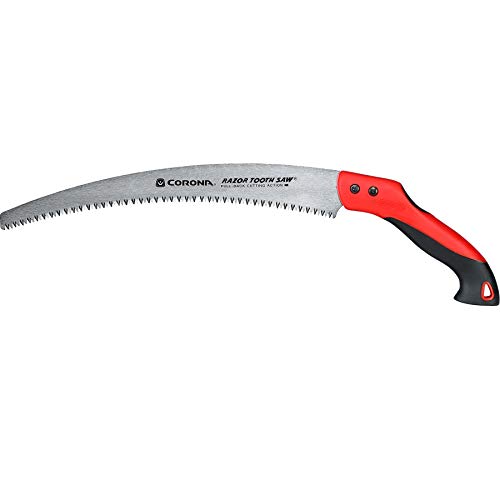
A pruning saw has a handful of working parts that decide how it cuts: the blade, the teeth and the gullets between them, the tooth set, the handle, and, on folding models, the locking pivot. Reading each part off a spec sheet is what lets you match a saw to your pruning.
The features that matter are set out below.
- Blade: curved or straight spring steel, usually taper-ground so the back is thinner than the toothed edge, which keeps it from binding in the kerf. Curved blades bite harder on the pull; straight blades suit flush and undercut work.
- Teeth and gullets: coarse teeth around 6 to 7 per inch, most often impulse-hardened so the tips stay sharp for years. The deep gullets between teeth carry wet sawdust out of the cut before it can pack solid.
- Tooth set: the teeth angle slightly left and right to cut a kerf wider than the blade, which is what stops a pruning saw jamming in green, springy wood.
- Handle: a rubberised or co-moulded grip shaped for a full-hand hold, sometimes with a pistol angle that lines the blade up with a downward pull.
- Locking pivot: on folding saws, a catch that locks the blade both open and closed, so it holds rigid in the cut and stows safely in a pocket or pack.
A blade that clogs, binds, or wanders in the cut almost always comes down to one of these being wrong for the wood, most often teeth that are too fine or a set that is too narrow. The best pruning saws roundup lists each model's blade length and tooth count so you can compare them directly.
Should you choose a folding or a fixed-blade pruning saw?
Choose a folding pruning saw for occasional garden work, portability, and safe storage, and a fixed-blade saw for frequent, heavy cutting where a rigid blade and a faster stroke matter. Folding saws trade a little rigidity for a blade that closes safely into the handle and rides in a pocket or pack.
Folding models such as the Silky Gomboy, Corona RazorTOOTH folding saw, and Bahco Laplander lock open with a positive catch and suit anyone pruning a few trees a year. Fixed-blade saws such as the Silky Zubat ride in a belt scabbard, flex less under load, and let arborists and orchardists work faster through a long day, at the cost of an exposed blade that always needs its sheath. The full shortlist for both styles sits in our best pruning saws roundup.
How long a blade and how coarse a tooth do you need?
Match blade length to branch size and tooth coarseness to how green the wood is. A 6- to 8-inch blade suits branches up to about 3 inches, a 9- to 13-inch blade handles 3- to 6-inch limbs, and 14 inches or more is for heavy wood; coarser teeth, meaning fewer teeth per inch, chew through green fibre faster.
A useful rule of thumb is that the blade should be roughly twice the diameter of the branch, so the stroke stays long and the teeth keep clearing. Fine-toothed saws made for dry construction lumber bog down and clog in living wood, which is why pruning saws run around 6 or 7 teeth per inch with deep gullets. The blade lengths and the branches they suit are set out below.
| Blade length | Typical saw | Best for |
|---|---|---|
| 6–8 in (150–200 mm) | Silky Pocketboy, Bahco Laplander | Twigs and branches up to ~3 in |
| 9–13 in (240–330 mm) | Silky Gomboy, Corona RazorTOOTH, Silky Zubat | Everyday limbs 3–6 in |
| 14–20 in (350–500 mm) | Silky Bigboy, Silky Katanaboy | Heavy limbs and small trunks |
Do pull-cut or push-cut pruning saws cut better?
Pull-cut, Japanese-style saws cut faster and straighter for most people because the blade stays in tension on the working stroke, so it can be thinner and sharper without buckling. Push-cut, Western-style saws cut on the push and suit those already used to them, but nearly every modern pruning saw, including Silky and Corona, cuts on the pull.
Pulling the blade keeps it taut, which lets makers grind a thinner blade with a narrower kerf, so you remove less wood and spend less effort per stroke. The teeth on these saws are usually impulse-hardened, staying sharp far longer than a filed edge but resisting resharpening. Push saws still have a place in the coarse, replaceable-blade bow saw, which is the cheaper choice for a pile of dead limbs.
How do you use a pruning saw the right way?
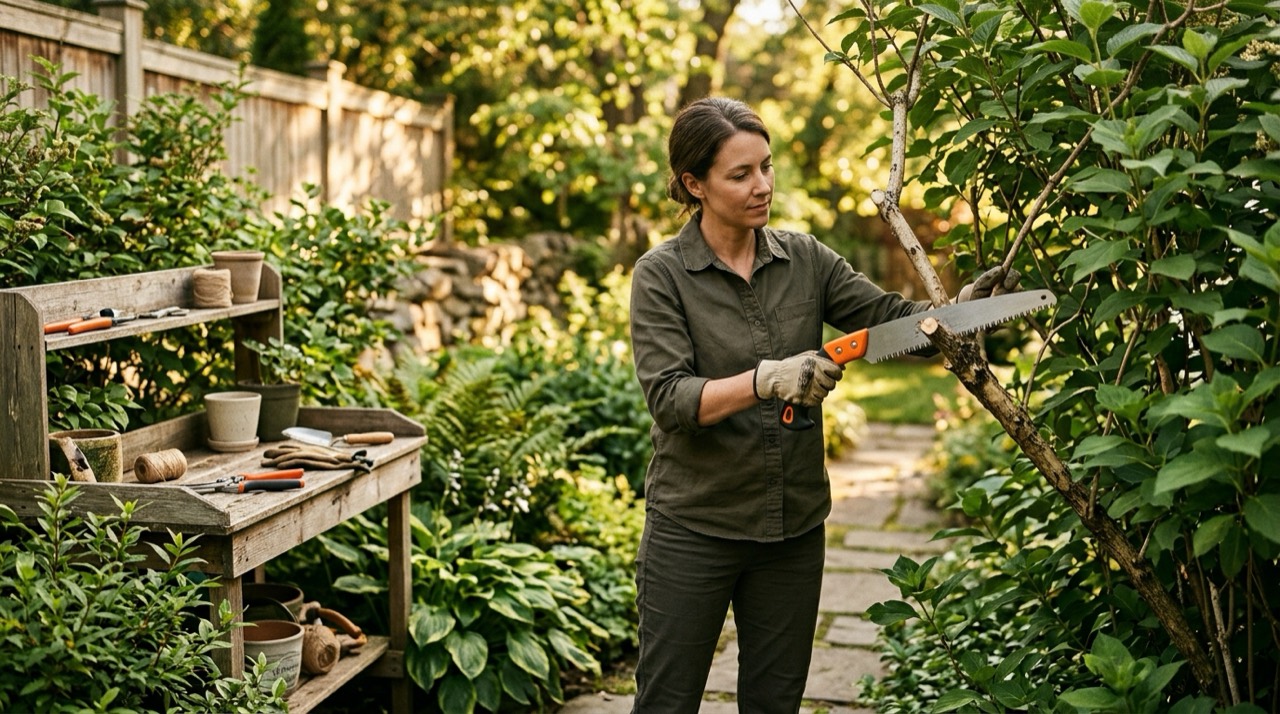
Use a pruning saw by letting the teeth do the work on the pull stroke, keeping the blade in a straight line, and starting the cut with a few gentle draws before settling into a long, steady rhythm. Forcing the saw or sawing too fast makes it jump and bind rather than cut faster.
The steps below give a clean, controlled cut on a limb within the saw's capacity.
- Clear an escape path and check nothing above will fall on you; plant both feet and hold the branch steady with your free hand well clear of the blade.
- Set the teeth against the wood on the start line and draw the saw back two or three times, lightly, to cut a shallow notch that keeps the blade from skating.
- Lengthen the stroke and pull through most of the blade each time, easing off on the push so the thin blade stays in tension and cannot buckle.
- Keep the blade square to the branch; if it starts to wander, stop and re-seat it rather than twisting it back on line.
- As the cut nears through, slow down and support the offcut so it does not tear the bark or trap the blade.
Let the saw's weight and sharpness carry the cut, because a pull-cut blade rewards a relaxed grip far more than muscle. If the blade binds partway, it usually means the branch is pinching the kerf under its own weight, which the three-cut method below prevents on anything heavy.
How do you cut a branch without tearing the bark?
Cut any branch thicker than about an inch with the three-cut method so the falling limb cannot peel bark down the trunk. Make an undercut about a foot out, a top cut just beyond it to drop the limb, then a final cut just outside the branch collar. Rushing straight to one cut is how bark tears.
The sequence protects both the tree and you, and works with the ordered steps below.
- Cut upward a third of the way through the underside of the branch, about 12 inches from the trunk.
- Cut down from the top an inch further out until the limb drops cleanly, the undercut stopping the tear.
- Remove the remaining stub with a final cut just outside the raised branch collar, never flush to the trunk.
Wear gloves and eye protection, keep both feet planted, and never saw above shoulder height off a ladder. Large, high, or leaning limbs, and any branch near power lines, belong to a trained arborist or a manual pole pruner; for repeated overhead work a powered pole saw is safer than reaching with a hand saw.
What mistakes do people make with a pruning saw?
The most common pruning-saw mistakes are cutting flush to the trunk, leaving long stubs, buying a blade too fine for green wood, and reaching overhead off a ladder. Each one either damages the tree, dulls the tool, or risks injury, and all are easily avoided.
The mistakes worth watching for are listed below.
- Cutting flush to the trunk, which removes the branch collar the tree needs to seal the wound. Cut just outside the collar instead.
- Leaving a long stub, which dies back and invites rot. Take the stub off cleanly with a final cut at the collar.
- Choosing a fine-toothed saw meant for dry lumber, which clogs instantly in living wood. A pruning saw runs coarse, around 6 to 7 teeth per inch.
- Skipping the undercut on a heavy limb, letting its weight peel bark down the trunk. The three-cut method exists for exactly this.
- Sawing above shoulder height from a ladder, the leading cause of pruning injuries. Use a manual pole pruner or a powered pole saw for height, or call a professional.
- Letting sap dry on the blade, which slows cutting and starts rust. A quick wipe after sappy jobs keeps the saw fast.
Avoiding these six turns pruning from a chore that harms the tree into a quick, clean job. For heavier cutting than a hand saw suits, a mini chainsaw handles repeated thick cuts, and loppers are faster on anything under two inches.
Which pruning saw matches your property?
Match the saw to your property and workload: a small suburban garden needs only a mid-size folding saw, an orchard or a large block justifies a faster fixed blade, and an acreage or a trail rewards a big two-handed folder. Buying more saw than the job needs just adds weight and cost.
The rough fit by property type is set out below.
| Property or use | Typical cutting | Sensible choice |
|---|---|---|
| Small suburban garden | A few limbs a year up to ~4 in | Mid-size folding saw (Gomboy, Corona, Fiskars) |
| Larger garden or small orchard | Regular pruning up to ~5 in | Quality folding saw, spare blade on hand |
| Frequent or professional pruning | Long days, limbs to 6 in | Fixed-blade saw with belt scabbard (Zubat) |
| Acreage, bush block, or trail | Big limbs, small trunks, clearing | Large two-handed folder (Katanaboy) |
| Camping and bushcraft | Occasional wood, packed light | Compact folder (Bahco Laplander) |
A homeowner who prunes a few fruit trees each winter is well served for a decade by one good folding saw and the odd replacement blade. Someone clearing storm damage on acreage, by contrast, will want the reach and speed of a longer blade, and may keep loppers and a bow saw alongside it for the lighter and the dead-wood cutting respectively. The best pruning saws roundup ranks specific models against these use cases.
Which pruning saw should you buy?
For most gardeners a folding Silky Gomboy 240 or a Corona RazorTOOTH folding saw covers everything up to about 5 inches, while arborists and heavy users prefer a rigid fixed-blade Silky Zubat, and occasional light pruners are well served by a Fiskars folding saw. Match the saw to how often and how hard you cut.
Our best pruning saws roundup ranks current models by use case, and the wider outdoor hand and cutting tools pillar covers the loppers and hand pruners that handle everything a saw is too big for. Keep a pair of work gloves with the saw so they are always to hand.