


What is a chainsaw mill, and what does it do?
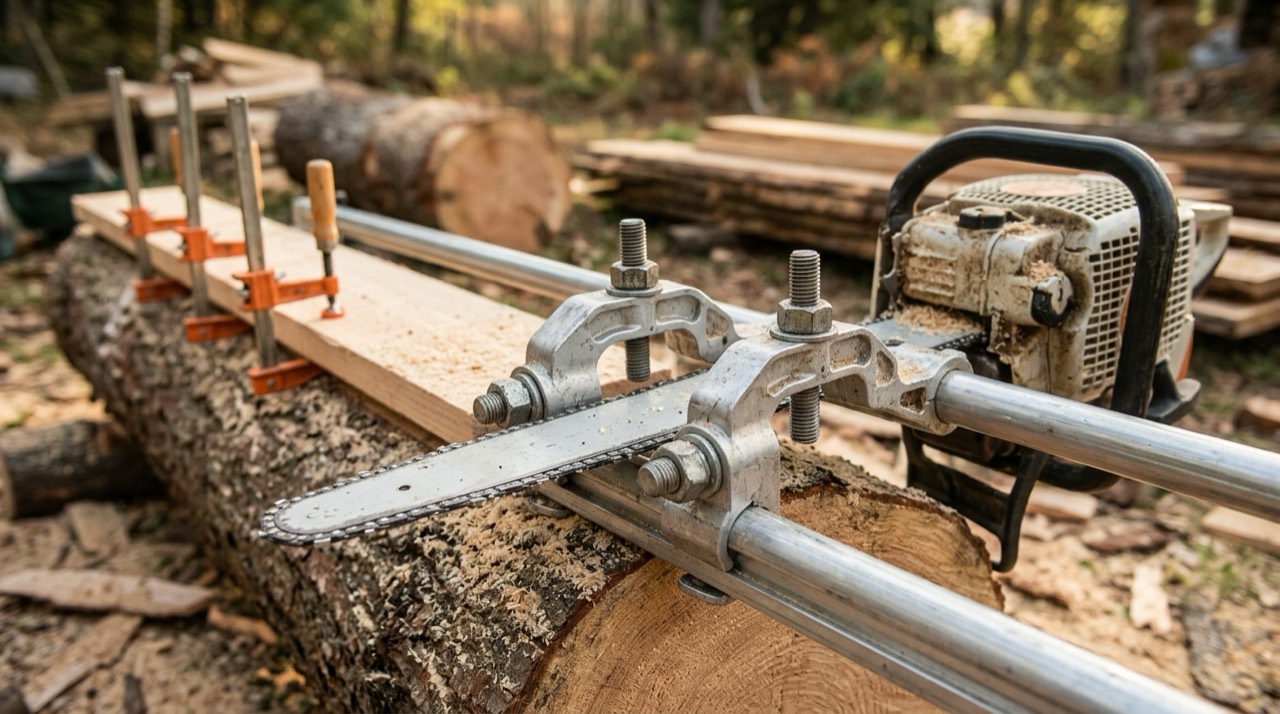
A chainsaw mill is a metal frame that clamps onto your chainsaw's bar and guides it in straight, parallel passes so an ordinary saw can rip a log into flat boards and slabs. It turns felled trees and storm timber into usable lumber right where they fall, with no sawmill required.The appeal is simple: you keep wood that would otherwise become firewood or landfill, and you can cut wide live-edge slabs no lumberyard stocks. The trade-off is effort, because milling asks far more of a saw than crosscutting does, and it is slow, heavy, fuel-hungry work. This guide sits inside our chainsaws hub, and it assumes you already own or plan to buy a saw big enough for the job.
Most people who take up milling are woodworkers, homesteaders, and arborists who already have logs on hand: a storm-dropped oak, a cleared paddock tree, or offcuts from tree work that are too good to burn. The mill lets them turn that raw material into tabletops, mantels, bench tops, and framing timber for a fraction of retail lumber prices. It is a patient craft rather than a fast one, and it pairs cutting skill with wood knowledge, because what you do after the cut, drying and storing the slabs, matters as much as the milling itself.
What size chainsaw do you need for milling?
Milling needs a big-bore gas saw, because ripping along the grain for a full log length is one of the hardest tasks you can give an engine. A rough rule is 50-60cc for narrow slabs up to about 16 inches, 70-90cc for boards up to 24 inches, and 90cc and above for wide hardwood slabs.Underpowered saws overheat, bog down, and wear out fast when pushed into continuous rip cuts they were never designed for. Battery and small homeowner saws are not milling tools; this is gas territory, and often the largest saw in the range. See our gas chainsaw guide for the powerhead classes, and the table below maps slab width to the engine size most millers run.
| Slab width | Typical saw size | Example use |
|---|---|---|
| Up to 16 in | 50-60cc | Small softwood slabs, mantels |
| 16-24 in | 70-90cc | Furniture boards, hardwood |
| 24 in and up | 90cc+ | Wide live-edge slabs, tabletops |
Displacement is not the only number that matters. A milling saw should have a strong oil pump, good air filtration, and enough torque low in the rev range to keep pulling when the whole bar is buried in wood. Many millers keep a dedicated older big saw for the mill and spare their main felling saw, because the sustained heat, fine dust, and constant full-throttle load of milling are hard on any engine. If your only saw is a mid-size homeowner model, resist the urge to force it through wide hardwood; either limit yourself to narrow softwood on a small-log mill or step up to a proper milling powerhead first.
What bar and chain does chainsaw milling require?
Chainsaw milling requires a long, solid bar and a dedicated ripping chain filed for cutting along the grain rather than across it. The bar should be a few inches longer than your widest log, and a ripping chain grinds its cutters to a shallower angle, near 10 degrees, so it shears long fibres cleanly instead of tearing them.A standard crosscut chain will mill, but it cuts rough and slow and dulls quickly. Purpose-made ripping chains from Granberg, Oregon, and Stihl leave a smoother surface and pull less. Our chainsaw chains guide explains chain types, our chainsaw bars guide covers bar sizing, and because milling dulls a chain fast, keeping it razor sharp with our chainsaw sharpening guide matters more here than in any other cutting.
Plan for the chain to dull fast. Milling drives the cutters through far more wood per pass than crosscutting, and any grit or embedded bark in a log strips the edge quickly, so most millers touch up or swap the chain every few slabs. Keeping two or three sharp ripping chains on hand means you can change out a blunt one and keep working instead of stopping to file. A correctly set depth gauge is just as important as the cutter angle, because a ripping chain with the rakers filed wrong will either grab and stall or barely bite.
How does an Alaskan chainsaw mill work?
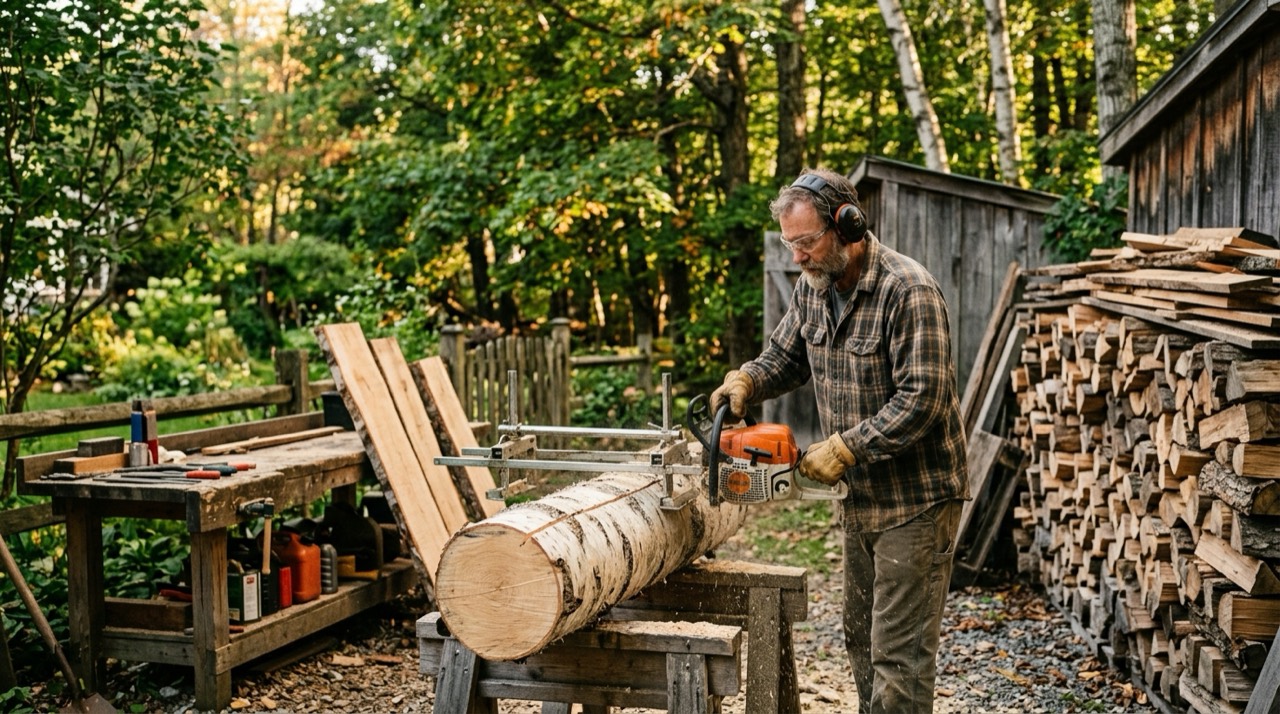
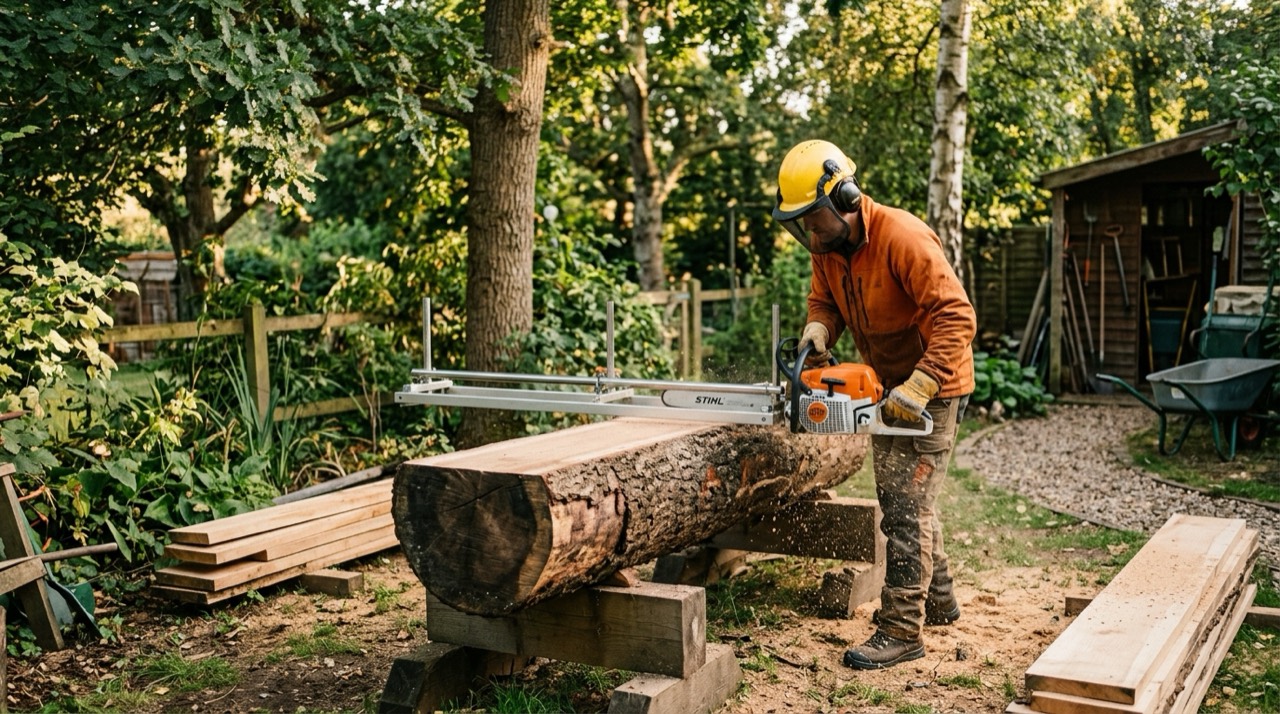
An Alaskan mill clamps to the bar at both ends and rides on top of the log, with adjustable posts that set how thick each slab will be. You make the first pass along a straight guide fixed to the log, then remove the guide and let the freshly cut flat surface guide every cut after it.The first cut is the one that decides everything, because a flat, level opening pass gives you a reference face for the whole log. Most millers screw a ladder or a straight board to the top of the log, or use a purpose-built rail, to guide that opening cut. After that, you lower the mill by your chosen thickness and repeat until the log is milled.
What can you make with a chainsaw mill?
A chainsaw mill can produce live-edge slabs, dimensional boards, beams, mantels, and bench tops from a single log, limited mainly by your bar length and the log's diameter. Wide slabs for tables are the signature product, but the same setup cuts framing timber, fence rails, and cants for further sawing.- Live-edge slabs keep the natural outer edge of the tree and are prized for tabletops and shelves.
- Dimensional lumber, square-edged boards, comes from squaring a log into a cant first, then slabbing it.
- Beams and posts for timber-frame and outdoor structures are cut by taking a few flat faces off a large log.
- Cookies and rounds are crosscut discs, though these are cut without the mill and are prone to cracking as they dry.
Matching the product to the log is part of the craft: a straight, clear trunk yields clean furniture slabs, while a twisted or knotty log is better broken down into shorter beams or rustic pieces where character is welcome. Thinking about the finished piece before the first cut also guides how you orient the log and where you take the flat face.
How fast is chainsaw milling, and how much wood do you get?
Chainsaw milling is slow, and honest expectations help: a single pass through a wide hardwood log can take several minutes of hard cutting, and a big log yields only a handful of slabs in an afternoon. Kerf loss is high too, because a chainsaw's cut is wide and wastes more wood than a bandsaw mill.Speed depends on saw power, chain sharpness, wood species, moisture, and slab width. Green softwood cuts far faster than seasoned oak. Milling is a physical, deliberate process rather than a production line, so it rewards patience, sharp chains, and realistic goals over brute force.
As a worked example, a hobbyist slabbing a 24-inch green cedar log with a sharp ripping chain on an 80cc saw might take three to five minutes per pass and produce six to eight slabs in a morning, stopping to refuel, sharpen, and rest. The same passes through seasoned oak of the same width could take twice as long and demand more frequent sharpening. Build your day around the wood in front of you rather than a fixed slab count, and treat every cut as a chance to let the saw and yourself cool.
How do you dry and season milled slabs?
Fresh-milled slabs are wet and heavy, and they must be stickered and dried for months before they are stable enough to build with, or they will cup, twist, and split. The rule of thumb for air drying is roughly one year per inch of thickness, though a kiln shortens that considerably.The process is slow but straightforward:
- Sticker the slabs by stacking them with evenly spaced dry spacers between each layer, so air moves across every face.
- Keep the stack off the ground, weighted or strapped on top, and out of direct sun and rain under a roof or cover.
- Seal the end grain with wax or a proprietary end sealer to slow the fast moisture loss that causes end checking.
- Let the wood reach equilibrium with its surroundings before final surfacing, checking with a moisture meter where you can.
Cutting slabs slightly thick leaves material to flatten away the inevitable drying movement later. Skipping the drying stage is the most common way a promising slab is ruined, so plan storage space and time before you mill, not after.
What safety gear and precautions does chainsaw milling demand?
Chainsaw milling demands full chainsaw PPE plus extra attention to fumes, heat, and fatigue, because you run a large saw at wide throttle for long, continuous cuts. Wear cut-retardant chaps, a helmet with a face screen, hearing and eye protection, gloves, and boots on every cut.Two milling-specific hazards stand out. First, exhaust: never mill in an enclosed space, because a big saw run continuously produces a lot of carbon monoxide, so work outdoors with good airflow. Second, heat and oil starvation: long rip cuts run a bar hot, so many millers fit an auxiliary bar oiler and use plenty of bar and chain oil. Start with proper chainsaw chaps and PPE, take frequent breaks, and remember that felling the tree that becomes your log is a separate, dangerous job best left to a trained professional when the tree is large, leaning, or near structures.
Milling also keeps your body close to a running saw for long stretches, so guard against fatigue-driven mistakes: keep both hands on the mill's handles, never straddle or reach over the bar, and stop the moment your concentration slips. Because the bar is buried and the tip stays inside the cut, kickback risk is lower than in freehand work, but a chain that snags on a knot or a shifting log can still lunge the saw, so a stable, chocked log and a firm stance matter on every pass.
What does a chainsaw milling setup cost to own?
A chainsaw milling setup costs far less upfront than a bandsaw mill but carries real running costs in chains, bar oil, fuel, and saw wear. The frame itself is the cheapest part; the powerhead big enough to drive it is usually the largest single expense, followed over time by consumables.Budget realistically for:
- Consumable chains, since milling dulls and eventually wears out ripping chains far faster than normal cutting.
- Bar oil in volume, because long rip cuts burn through it, and running dry ruins bars and chains.
- Two-stroke fuel and mix oil, as a milling saw drinks fuel at full throttle.
- Bars, which are consumables under milling heat, covered in our chainsaw bars guide.
Weighed against buying finished slabs, which are expensive and often unavailable in the widths milling produces, a chainsaw mill pays for itself quickly if you have logs and the patience to dry them. If you mill only rarely, the low entry price is the whole appeal; if you mill often, the effort and consumable cost are what push some owners toward a bandsaw mill.
Is a chainsaw mill worth it compared to a bandsaw mill?
A chainsaw mill is worth it when you want low cost, portability, and the ability to slab logs too big or too remote to move, and it is the cheapest way into milling by a wide margin. A bandsaw mill cuts faster, wastes less wood, and is easier on your body, but it costs far more and is hard to carry into the bush.Choose a chainsaw mill if you mill occasionally, value taking the tool to the log, and accept slower cutting and more kerf waste. Choose a bandsaw mill if you mill often and want speed and yield. For most hobbyists making the odd slab or beam, a chainsaw mill and a big saw are the sensible start. Compare the best chainsaw mills to see which setup fits your logs.