


What is a gas lawn mower, and who is it for?
A gas lawn mower is a walk-behind mower driven by a small petrol engine, built to cut medium and large lawns, thick or damp grass, and ground well beyond the reach of a power cord. It suits homeowners with a quarter-acre or more, sloped or uneven yards, and anyone whose grass grows fast through summer.Gas power buys two things that cords and batteries still struggle to match on bigger lawns: sustained cutting power in tall, wet, or dense grass, and unlimited runtime from a tank of fuel. You refuel in seconds and keep going, with no pack to recharge halfway through the yard. If your lawn is small, flat, and close to the house, a battery lawn mower or a corded electric mower may serve you better, and this guide sits inside our wider lawn mowers hub so you can weigh every type in one place.
Every gas mower needs fuel, engine oil, and a little seasonal upkeep that electric mowers avoid, so there is a small learning curve to owning one. In return you get a mower that powers through the toughest grass a walk-behind can face and keeps working season after season with basic care.
Do you need a self-propelled or push gas mower?
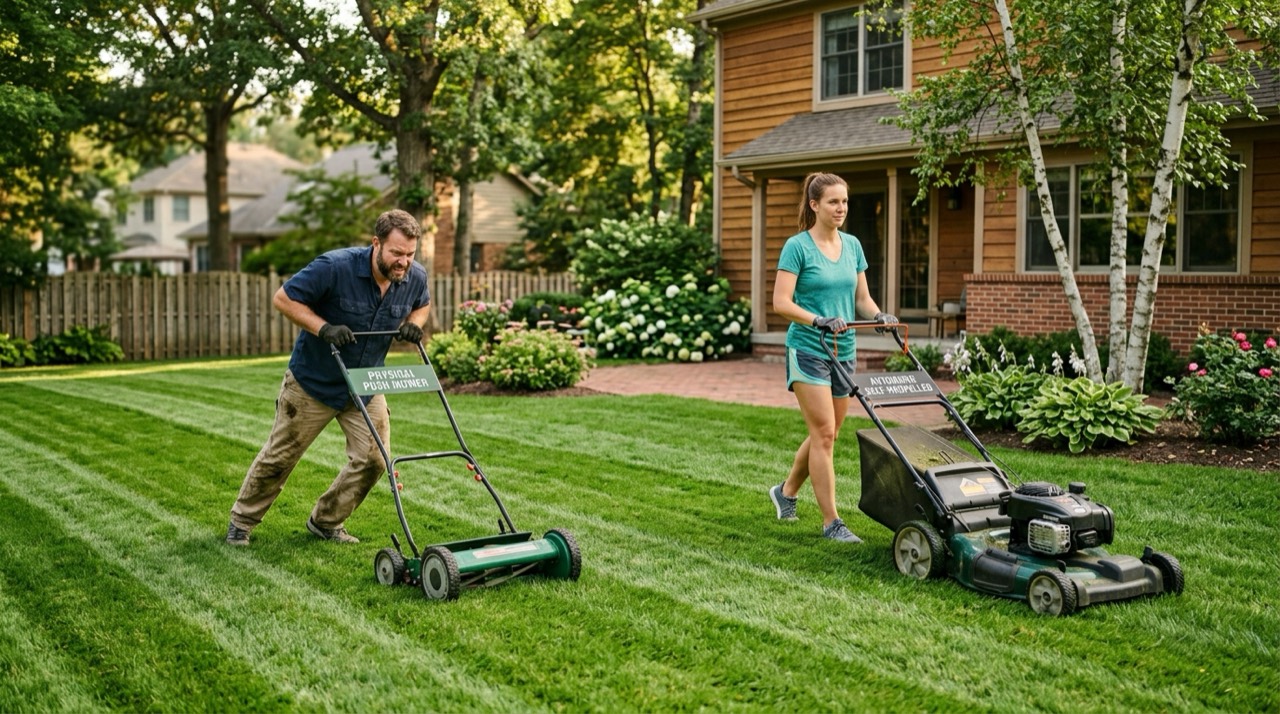
Choose a self-propelled gas mower if your lawn is large, sloped, or simply more than you want to push, and choose a push mower if it is small, flat, and quick to finish. Self-propelled models drive their own wheels so you steer rather than shove, while push mowers are lighter, cheaper, and simpler to maintain.Self-propelled drive is the single feature most owners of a mid-size or hilly lawn say they would not give up, because it turns a workout into a walk. It does add weight, cost, and a drive system that can eventually need service. We compare the drive types in depth in our self-propelled versus push gas mower breakdown, and our best gas lawn mower picks flag which models drive their own wheels.
What cutting deck width suits your lawn?
Cutting deck width sets how much grass you clear per pass, so it decides how long mowing takes. Most walk-behind gas mowers use a 20 to 22 inch deck that suits lawns up to about half an acre, while wide 30 inch decks cut large lawns in far fewer passes at the cost of extra weight and a wider turning circle.The rough guide below maps deck width to the lawn size it mows comfortably.
| Deck width | Typical lawn size | Notes |
|---|---|---|
| 20 in | Small yards up to ~1/4 acre | Light, easy to store and turn |
| 21-22 in | Suburban lawns up to ~1/2 acre | The most common all-round size |
| 30 in | Large lawns ~1/2 to 1+ acre | Fewer passes, heavier, needs room to turn |
How much engine power (cc) does a gas mower need?
Engine displacement, measured in cubic centimetres (cc), decides how well a mower pulls through tall, wet, or dense grass without bogging down. Most walk-behind gas mowers run engines between about 140cc and 224cc, and for typical dry suburban grass anything from 140cc upward handles the job.Step up in engine size if you cut tall or damp grass, bag heavy clippings, or run a wide 30 inch deck, because those loads make a small engine labour. The engine brand matters as much as the number, and Honda, Briggs & Stratton, and Kohler power most quality mowers, which we cover in our gas mower engine comparison. Buying far more cc than your grass needs mostly adds weight and fuel use.
Displacement is not the only number on the engine. Mowers now quote gross torque in foot-pounds, the twisting force that keeps the blade spinning at full tip speed in thick grass, so a higher-torque engine bogs down less. A 140 to 160cc engine suits a normal lawn, while a wide deck, heavy bagging, or acreage rewards 190cc and up. Whatever the figure, an engine fed fresh fuel and clean oil out-performs a bigger engine that has been neglected.
Should you mulch, bag, or side-discharge your clippings?
Most modern gas mowers are 3-in-1, meaning one machine can mulch, bag, or side-discharge, and you switch between them with a plug and a chute. Mulching returns fine clippings to feed the lawn, bagging collects them for a clean finish, and side-discharge clears tall or overgrown grass fast.The three ways to handle clippings, and when each wins, are listed below.
- Mulching: best for regular cutting on a healthy lawn, since fine clippings break down and feed the soil.
- Bagging: best when you want a tidy finish, are collecting leaves, or the grass is too long to mulch cleanly.
- Side-discharge: best for tall, thick, or overgrown grass that would clog a mulching deck.
Mulching works best under the one-third rule: never remove more than a third of the blade height at once, so the short clippings decompose within days and feed the soil instead of matting down and smothering the lawn. If the grass has grown too long between mows, side-discharge or bag the first pass, then mulch on the next.
What features should you look for on a gas lawn mower?
The features worth paying for on a gas mower are a single-lever deck-height adjuster, a rugged steel or composite deck, large rear wheels, a washout port, and an easy-start or blade-brake clutch. Each one makes routine mowing and clean-up noticeably less of a chore.The features that separate a mower you keep for a decade from a throwaway are listed below.
- Single-lever height adjustment: raises or lowers all four wheels at once, so you actually change cut height instead of avoiding it.
- Deck material: stamped steel is durable and repairable, while composite decks such as Honda's NeXite never rust; thin stamped decks on the cheapest mowers dent and corrode.
- High rear wheels and ball bearings: roll more easily over rough ground and turf ruts than small plastic wheels on bushings.
- Washout port: lets you clip a hose to the deck and rinse clippings out without tipping the mower.
- Blade-brake clutch: stops the blade while the engine keeps running, so you can clear the chute or cross a path without restarting.
- Folding, adjustable handle: makes storage and different-height users far easier to accommodate.
How do you start a gas lawn mower?
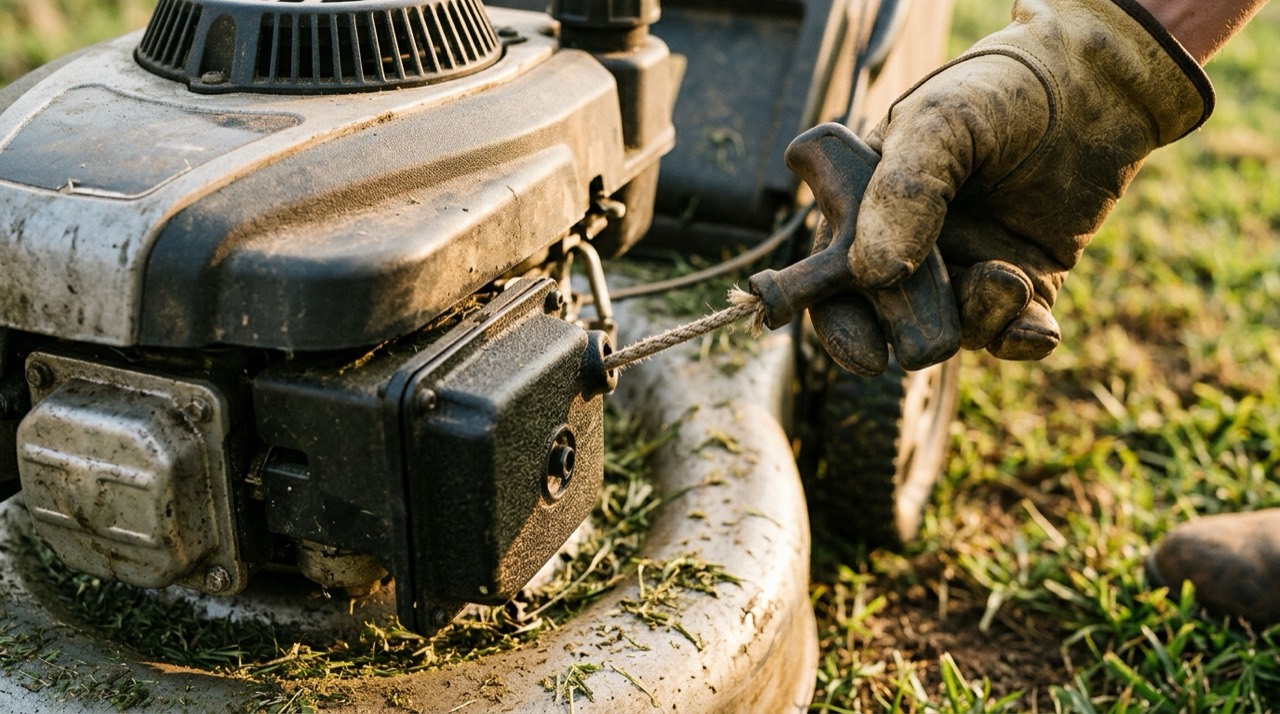
Start most modern gas mowers by pushing the primer bulb three times on a cold engine, holding the operator-presence bail against the handle, and pulling the recoil cord in one firm stroke. Warm engines usually skip the primer. Push-button electric-start models replace the pull entirely.The reliable cold-start sequence for a typical recoil-start mower is below.
- Move the mower onto firm, level ground and check the oil and fuel before starting.
- Push the primer bulb firmly three times, pausing a second between presses, on a cold engine only.
- Set the throttle to fast or the choke to on if your engine has one, rather than a primer.
- Squeeze and hold the operator-presence bail lever against the upper handle.
- Grip the recoil handle and pull it straight out in one smooth, firm stroke, letting it retract fully before the next pull.
- Once running, release the choke gradually and let the engine settle before you start cutting.
If the engine floods from over-priming, the fix is patience: wait ten to fifteen minutes for the excess fuel to evaporate, then pull the cord with the primer untouched and the throttle at full. Repeated hard pulling on a flooded engine only makes it worse.
What maintenance does a gas lawn mower need?
Gas lawn mowers need routine upkeep that electric mowers skip: changing the engine oil, cleaning or replacing the air filter, checking the spark plug, keeping the blade sharp, and running fresh, correctly stored fuel. Skip these and the engine gets harder to start and cuts more poorly.The most common cause of a mower that will not start in spring is stale fuel left in the tank over winter, so use fresh petrol, add a fuel stabiliser, or drain the tank before storage. A dull blade tears grass instead of slicing it, leaving ragged brown tips, so sharpen it at least once a season. Our lawn mower maintenance guide walks through the full service routine for a gas mower.
What are the most common gas mower problems, and how do you avoid them?
The most common gas mower problems are a no-start from stale fuel, a ragged cut from a dull blade, clumping from mowing wet grass, engine surging from a dirty carburettor, and blue or white smoke from overfilled or tipped oil. Almost all trace back to skipped maintenance.The faults owners meet most often, and the fix for each, are set out below.
- Will not start: nine times in ten it is old fuel or a fouled spark plug; drain stale petrol, fit a fresh plug, and check the primer.
- Ragged, brown-tipped cut: the blade is dull or nicked; sharpen or replace it, since a sharp blade does more for cut quality than any spec.
- Clumping and streaking: the grass is wet or too tall; wait for it to dry and never take off more than a third of the height.
- Surging or hunting revs: dirty carburettor jets from stale fuel; run fresh stabilised petrol and clean or rebuild the carburettor.
- Blue or white smoke: usually too much oil or a mower tipped the wrong way; check the dipstick and always tip a mower with the air filter facing up.
Tipping a mower the wrong way catches most first-time owners: oil runs into the cylinder or air filter and the engine smokes on restart, so always tip a mower with the spark plug and air filter pointing skyward when you clean the deck or change the blade.
What safety gear and precautions do gas mowers require?
Gas lawn mowers demand respect because a spinning steel blade turns fast enough to sever fingers and to fling stones, wire, and debris at high speed. Wear sturdy closed shoes, eye protection, and hearing protection, and clear the lawn of sticks and rocks before you start.Never put your hands or feet near the deck while the engine runs, mow across slopes rather than up and down, and keep children and pets well clear of the discharge. Handle fuel outdoors, never refuel a hot engine, and let the mower cool before topping up. Start with basic hearing and eye protection and a good pair of work gloves; steep banks and wet slopes are jobs where a self-propelled mower can get away from you, so treat them with extra care.
How much does a gas lawn mower cost to buy and run?
A gas walk-behind mower typically costs between about 200 and 900 dollars to buy, with basic push mowers at the low end, self-propelled models in the middle, and premium or wide-deck machines at the top. Running costs add fuel, oil, filters, spark plugs, and the occasional blade each year.Roughly what you pay at each tier, and who it suits, is mapped below.
| Price tier | Typical machine | Best suited to |
|---|---|---|
| ~$200-300 | Basic push, generic or small Briggs engine | Small, flat lawns and tight budgets |
| ~$350-500 | Self-propelled 21 in, mid Briggs or Kohler | Most suburban lawns |
| ~$500-900 | Premium self-propelled, Honda or composite deck | Owners keeping a mower a decade |
| ~$1,000+ | Wide 30 in deck | Large lawns finished in fewer passes |
Running costs are modest but real: a few dollars of petrol per mow, a yearly oil change, an air filter and spark plug every season or two, and an occasional replacement blade. Buying a repairable mower from an established brand pays off, because parts stay available over the many years you keep it.
Which gas mower matches your yard?
Match the mower to the yard: a small flat lawn wants a light push mower, a mid-size suburban lawn wants a 21 inch self-propelled mower, a large or hilly lawn wants a wide deck or rear-wheel drive, and an acre or more is riding-mower territory. Grass type and slope tip the balance.Reading your own yard against the common scenarios below narrows the field quickly.
- Small, flat lawn under a quarter-acre: a basic push mower, or even a quiet push reel mower, finishes fast with the least upkeep.
- Mid-size suburban lawn: a 21 inch self-propelled gas mower is the all-round sweet spot of speed, power, and manageable weight.
- Large half-acre-plus lawn: a wide 30 inch deck or a strong rear-wheel-drive mower cuts the pass count and the fatigue.
- Sloped or banked ground: rear-wheel or all-wheel drive holds traction where front-wheel drive and push mowers slip.
- An acre or more: step up to a riding mower or zero-turn mower, since a walk-behind means too many passes.
Gas, battery, or corded — which should you choose?
Choose gas for large, tall, or overgrown lawns and long mowing sessions, choose battery for quiet, low-maintenance cutting on suburban lawns, and choose corded electric for small yards close to the house. Most owners simply match the mower to their lawn size and how tough the grass gets.If you are weighing the trade-offs, our electric versus gas lawn mower comparison breaks down power, cost, and upkeep side by side, and our best gas lawn mower picks narrow the field to a handful of proven machines.