


What engine brands power gas lawn mowers?
Most walk-behind gas mowers are powered by one of three engine makers: Honda, Briggs & Stratton, or Kohler, and the mower brand on the deck is often different from the engine brand underneath. A Toro, Craftsman, or Troy-Bilt mower, for example, usually carries a Briggs & Stratton engine, while Honda builds both the deck and the engine on its own mowers.Knowing the engine brand tells you more about starting ease, longevity, and parts support than the mower badge does, because the engine is the part that does the hard work and eventually needs service. All three makers build reliable engines, so the differences are in reputation, price, and the specific series fitted. This guide sits alongside our main gas lawn mower guide, which covers deck size, drive, and clipping options.
How do Honda gas mower engines perform?
Honda gas mower engines, chiefly the GCV series, have a strong reputation for easy starting, smooth running, and long life, which is why Honda mowers command a premium. The GCV170 at around 166cc and the GCV200 at around 201cc power Honda's popular HRN and HRX walk-behind mowers.Honda engines use an overhead-cam design that tends to start on the first or second pull when fuel is fresh, and owners often report them running for many years with routine oil changes and clean air filters. The trade-off is price and, more recently, availability, since Honda has scaled back its consumer mower range in some markets, so check current stock. If you value a quiet, easy-starting engine and plan to keep the mower a long time, a Honda engine is a common recommendation, as our best gas lawn mower picks reflect.
What should you know about Briggs & Stratton mower engines?
Briggs & Stratton is the volume standard in walk-behind mowers, powering a huge range of Toro, Craftsman, Troy-Bilt, and other machines across budget and mid-range prices. Its engines are known less for premium refinement than for being everywhere, easy to service, and cheap to find parts for.Common Briggs mower series include the value-focused engines around 140 to 150cc and stronger units up to 190cc and beyond for wider decks and self-propelled models. Many feature a ReadyStart system that skips the primer bulb and choke, so you just pull the cord. Because Briggs engines are so widespread, almost any mower shop can service one and parts are easy to source, which is a real advantage over the life of the mower.
Where do Kohler and other engines fit?
Kohler engines, and other makers such as Loncin-built units on some budget mowers, fill out the rest of the market, with Kohler generally positioned as a solid mid-tier to premium choice. Kohler's mower engines appear on a range of Cub Cadet and other mowers and are known for dependable starting and decent longevity.The main point is that engine brand and engine quality do not always track the mower's price, so it pays to check what is under the hood before you buy. A quality engine from any of the major makers, fed fresh fuel and given regular oil changes, will outlast a neglected engine of any brand. Generic, unbranded engines on the cheapest mowers are the ones to be wary of, mainly because parts and service can be hard to find later.
How do you read a mower engine spec sheet?
Read a mower engine spec sheet by looking past the headline number to displacement in cc, gross torque in foot-pounds, and the valve design, because together they describe how the engine behaves under load. Modern mowers quote torque rather than horsepower, which better reflects a mower's ability to keep the blade spinning in thick grass.The figures that actually matter, and what each tells you, are below.
- Displacement (cc): the engine's size and a rough guide to power; 140 to 160cc suits normal lawns, 190cc and up suits heavy grass and wide decks.
- Gross torque (ft-lb): twisting force at the crankshaft, and the best single number for pulling through dense growth without bogging.
- Gross versus net ratings: gross figures are measured on a bare engine, so real installed output is a little lower; compare like with like.
- Valve design: overhead-valve (OHV) engines run cleaner and cooler than older side-valve designs.
- Starting system: primer, choke, or ReadyStart-style automatic starting changes how the engine behaves on a cold morning.
How do the main starting systems differ?
Mower engines start in one of three ways: a primer-bulb system you prime a few times cold, a choke lever you set and release as the engine warms, or an automatic ReadyStart-type system that needs neither. Push-button electric start adds a battery so there is no cord to pull at all.Each system suits a different owner. A primer bulb is simple and common but easy to over-prime into a flooded engine if you press it too many times. A manual choke gives the most control in cold weather but asks you to remember to open it as the engine warms. Automatic systems such as Briggs & Stratton's ReadyStart remove the guesswork, which is why they appear on so many value mowers, and electric start is the friendliest of all for anyone who struggles with a recoil pull. Whichever system a mower uses, fresh fuel does more for easy starting than any starter design.
How much do engine size and OHV design actually matter?
Engine size in cc and valve design shape how well a mower handles tough grass, and the practical rule is that overhead-valve (OHV) engines run cleaner, cooler, and more efficiently than older side-valve designs. Most current quality mower engines are OHV, so you rarely have to choose, but it is a mark of a better engine.For cutting performance, match cc to your grass: roughly 140 to 160cc suits normal suburban lawns, while 190cc and up helps with tall, wet, or thick grass, wide decks, and heavy bagging. The comparison below lines up the main engine families.
| Engine | Typical cc range | Design | Reputation |
|---|---|---|---|
| Honda GCV | ~166-201cc | Overhead cam | Easy starting, long life, premium price |
| Briggs & Stratton | ~140-190cc | Overhead valve | Widespread, easy to service, good value |
| Kohler | ~149-187cc | Overhead valve | Dependable mid-tier to premium |
How long should a mower engine last?
A well-maintained mower engine from Honda, Briggs & Stratton, or Kohler commonly lasts eight to ten years or more, and often outlives the deck and drive around it. Lifespan depends far more on fresh fuel, regular oil changes, a clean air filter, and correct storage than on the badge on the shroud.The engines that die early are almost always the neglected ones, run on stale fuel, choked with a clogged air filter, or left full of untreated petrol over winter until the carburettor gums up. A generic, unbranded engine on the cheapest mower is the real gamble, not because it cannot run but because parts and service dry up, so a small failure ends its life. Buy a serviceable engine from a major maker, give it the basics, and the engine is rarely what retires the mower.
What basic engine care keeps any mower engine running?
The care that keeps any mower engine running is simple: change the oil each season, keep a clean air filter, fit a fresh spark plug when starting gets hard, and run only fresh, correctly stored fuel. Neglect on these four points causes the great majority of engine failures.The seasonal engine routine is set out below, and our lawn mower maintenance guide covers it in full.
- Change the engine oil at least once a season, using the grade the manual specifies and never overfilling past the dipstick.
- Clean or replace the air filter, since a clogged filter starves the engine and makes it run rich and smoky.
- Inspect the spark plug and fit a fresh one if the mower is hard to start or runs roughly.
- Use fresh regular unleaded with no more than 10 percent ethanol, and add a stabiliser or drain the tank before storage.
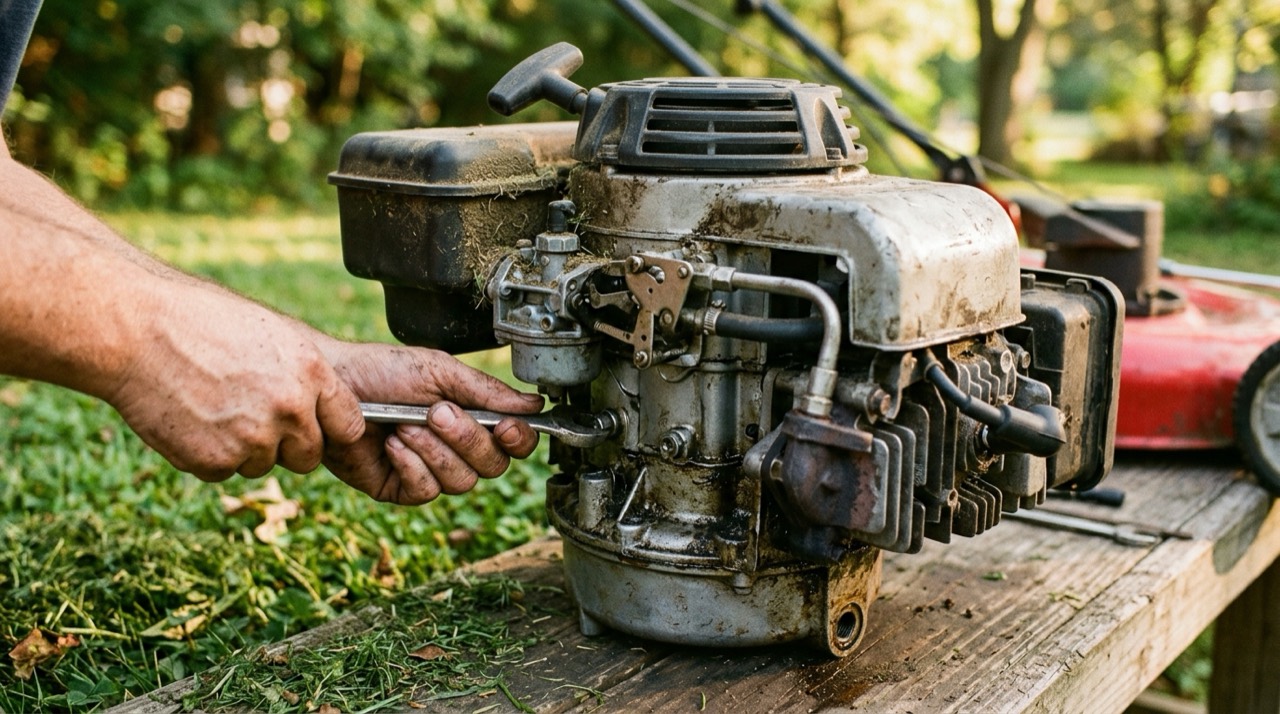
- Keep the cooling fins and recoil housing clear of clippings so the engine sheds heat properly.
Whichever engine you choose, keeping fuel fresh and oil clean matters far more than the badge, and the right bar oil, chain oil, and fuel supplies make that routine easy to keep up.