
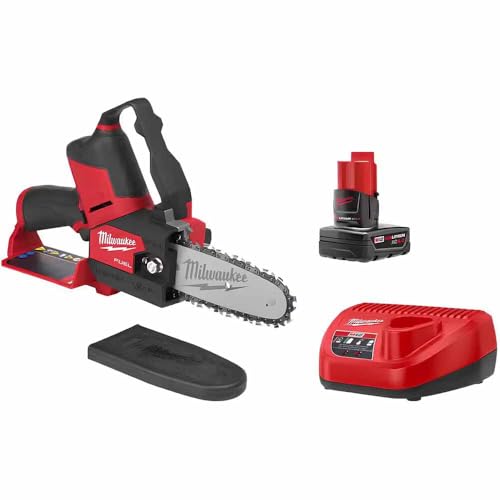


What is a mini chainsaw, and what jobs does it do best?
A mini chainsaw is a compact, usually one-handed cordless saw with a 4-to-8-inch bar, built for pruning branches, bucking small logs, clearing overgrowth, and quick DIY cuts around the yard. It trades a full-size saw's raw power for light weight and grab-and-go convenience.Most owners choose one because it starts at the push of a button, weighs only a few pounds, and slices through branches up to roughly bar-length thick without the bulk of a full-size battery chainsaw. It sits inside our wider chainsaws hub, where you can line up every saw type side by side before you buy.
The jobs a mini chainsaw does best share one trait: they are small, frequent, and close to the ground. The tasks owners most often reach for a mini to handle are listed below.
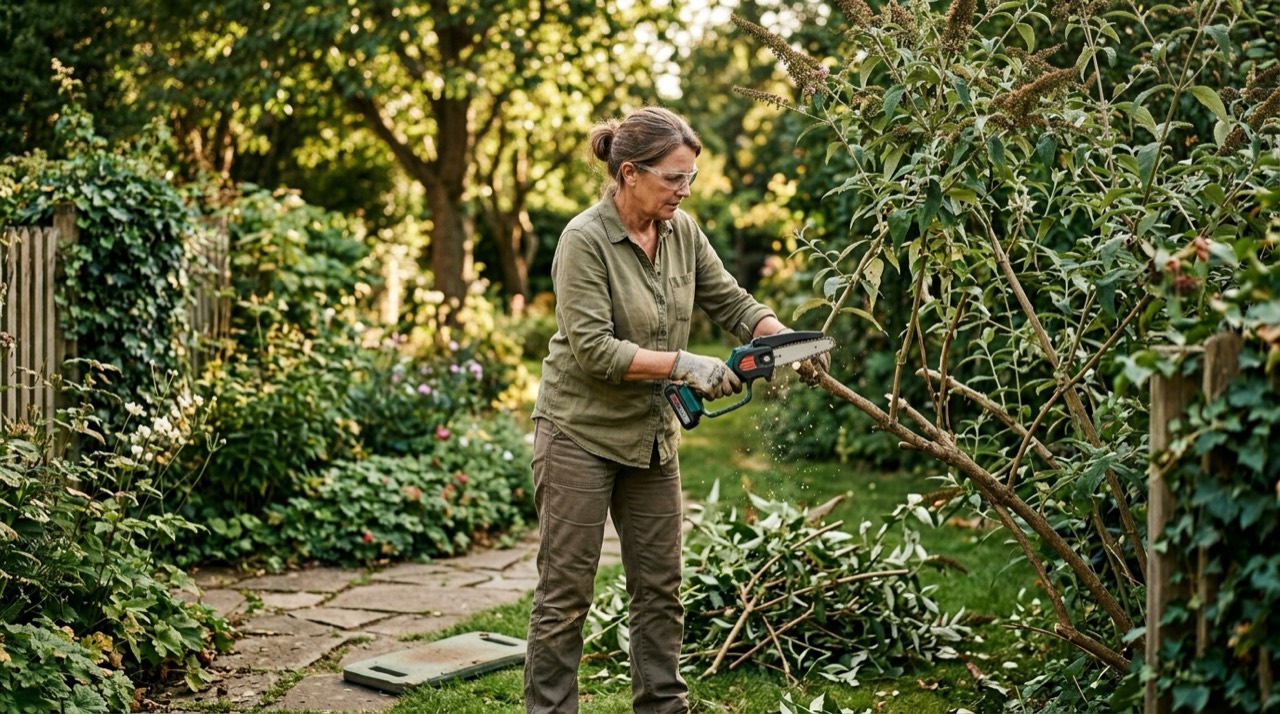
- Pruning live branches and shaping shrubs during the growing season.
- Cutting back vines, canes, and fast-growing overgrowth along fences and beds.
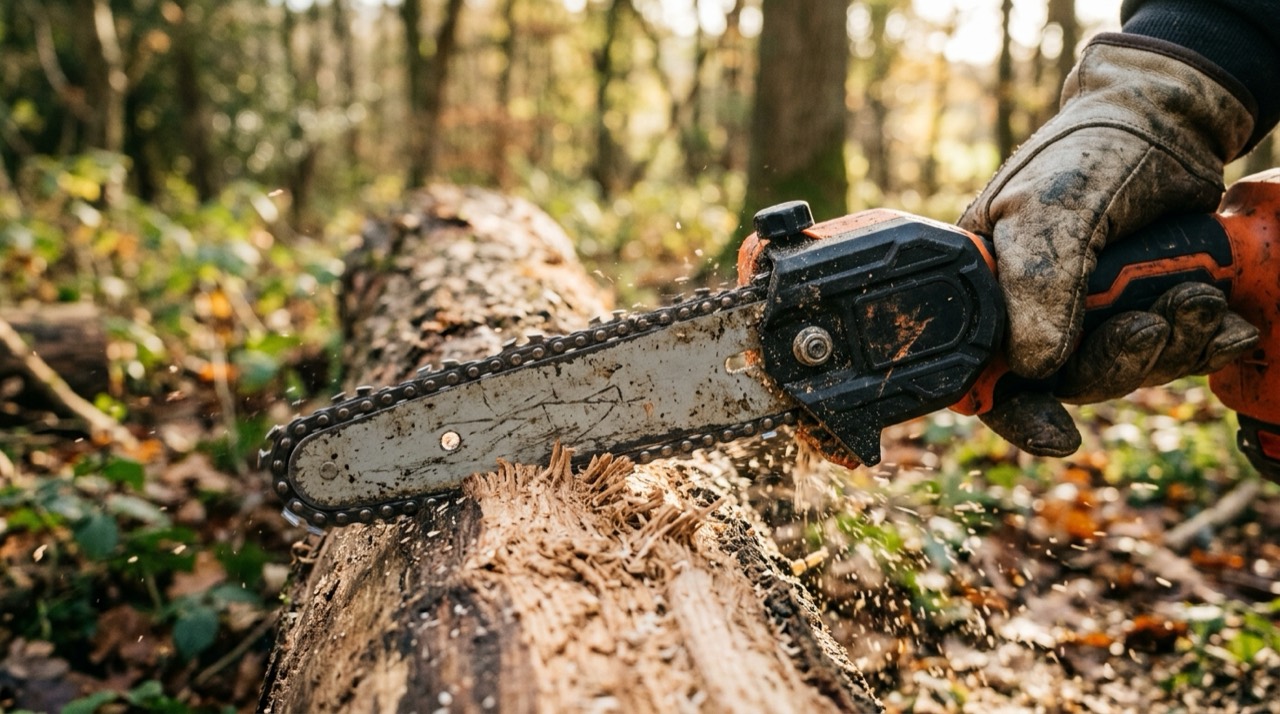
- Removing deadwood and clearing fallen limbs after wind or a storm.
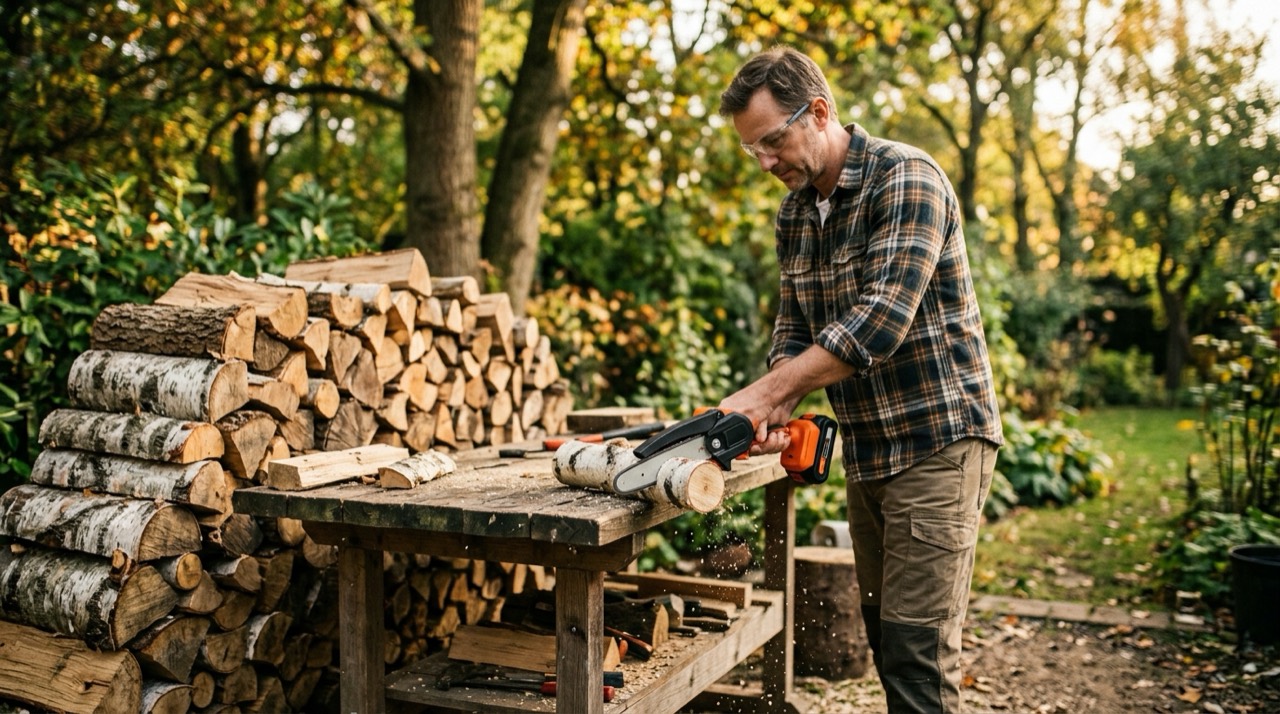
- Bucking small logs to length for kindling or garden edging.
- Quick DIY cuts on timber, stakes, and pallets around the yard.
Where the work turns to felling, firewood, or anything overhead, the mini hands off to a bigger or more specialised tool, which the rest of this guide maps out.
How thick a branch can a mini chainsaw actually cut?
A mini chainsaw cuts material up to about its bar length in one pass, so a 6-inch model handles branches around 5 inches thick and an 8-inch pruning saw stretches to roughly 7 inches. Anything larger needs two cuts from opposite sides or a bigger saw.Branch diameter, not just wood species, decides whether a mini saw is the right tool for the job. The table below maps common bar sizes to the branch thickness and tasks owners report tackling with each.
| Bar length | Cuts branches up to | Typical use |
|---|---|---|
| 4 in | around 3-4 in | Twigs, vines, light pruning |
| 6 in | around 5 in | Suburban pruning, small deadwood |
| 8 in | around 7 in | Limbing, small logs, storm cleanup |
| 10 in | around 9 in | Light firewood and thicker branches |
For wood consistently thicker than about 8 inches, step up to a compact saw from our best small chainsaw for home use picks instead of forcing an undersized bar.
What bar length should a mini chainsaw have?
Bar length should match your thickest regular branch plus a small margin, so most homeowners are well served by a 6-inch mini for pruning or an 8-inch model for occasional limbing. A 4-inch saw suits only twigs and vines, while 10 inches edges into full compact-saw territory.A longer bar tempts buyers into thinking bigger is always better, but on a small battery it drains charge faster and makes a light saw feel nose-heavy. Match the bar to the work you actually do rather than the worst case you can imagine.
The practical split between the two most popular sizes comes down to how often you meet thicker wood. A 6-inch bar keeps the saw lightest and most nimble for repeated one-handed pruning, while an 8-inch bar adds reach and a little more depth for the occasional limb or small log at the cost of extra nose weight. If you find yourself turning the saw to finish a cut more than once or twice a session, the longer bar is usually worth the trade.
How much does a mini chainsaw weigh, and does it matter?
Most one-handed mini chainsaws weigh between 2 and 4 pounds with a small battery fitted, and that weight matters more than any headline spec once you are pruning above shoulder height or working through a long hedge. A saw you can hold steady with one hand cuts more accurately and tires you far less.Weight comes from three places: the powerhead, the bar and chain, and the battery. A larger battery adds run-time but also weight, so the lightest kit is not always the most comfortable in real use. The balance point matters as much as the number on the box. Hold a mini as you would to prune and check whether it sits level in your hand or wants to dip at the nose, because a nose-heavy saw is tiring and harder to keep out of a kickback position. For anyone with limited grip strength or a wrist or shoulder complaint, the lightest 4-to-6-inch models are far easier to live with than a heavier 8-inch pruning saw, and they encourage the two-handed steadiness that keeps cutting safe.
Should you buy a battery, corded, or gas mini chainsaw?
Battery is the right choice for almost every mini chainsaw buyer, because the whole appeal of this class is a cordless saw you grab, cut a few branches with, and put away. Corded electric minis exist for continuous work near an outlet, and true gas minis are rare and rarely worth the fumes.Cordless models on platforms like Milwaukee M12, DeWalt 20V MAX, Ryobi ONE+, Worx 20V, and Greenworks 24V let one battery power several tools, which is where the real savings live. A corded saw never needs charging but tethers you to an extension lead, so it fits a fixed spot rather than a walk-around pruning session. For heavier felling or firewood, a gas chainsaw remains the tool, not a mini.
The three power sources suit clearly different buyers, and the table below sums up where each fits.
| Power source | Best for | Main trade-off |
|---|---|---|
| Cordless battery | Walk-around pruning and cleanup | Limited run-time per charge |
| Corded electric | Fixed cutting near an outlet | Tethered to an extension lead |
| Gas | Almost never in this class | Fumes, weight, and upkeep |
What safety risks come with a one-handed mini chainsaw?
One-handed operation is the biggest hazard with a mini chainsaw, because a kickback, pinch, or slip is far harder to control than with a two-handed grip. Treat every mini saw as a real chainsaw, not a toy, and keep your free hand and legs clear of the cutting path.Kickback happens when the bar's upper nose contacts wood or a hidden branch, snapping the saw back toward you in a fraction of a second. Cut with the lower part of the bar, keep the chain sharp and tensioned, and never reach overhead or up a ladder with one hand on a saw. Basic work gloves, eye protection, and sturdy footwear are the minimum, and overhead limb work near power lines belongs to a trained arborist. These guides are general information, not a substitute for hands-on training.
How do you set up a new mini chainsaw before the first cut?
You set up a new mini chainsaw by fitting and tensioning the chain, filling the bar-oil reservoir, charging the battery fully, and running the saw briefly off the wood to spread oil before making a single cut. Five minutes of setup prevents most first-day problems.The order that gets a new mini cutting safely is set out below.
- Fit the bar and chain per the manual, checking the chain runs the correct direction along the top of the bar.
- Tension the chain so it hugs the bar with no sag underneath but still pulls freely by hand.
- Fill the bar-oil reservoir with chain oil and confirm the cap is seated.
- Charge the battery fully, then read the trigger-lock and chain-brake controls before switching on.
- Start the saw off the wood, let the oiler wet the chain, then make a test cut on scrap.
New chains stretch as they warm, so recheck tension after the first few cuts. Skipping the oil step is the single fastest way to ruin a new bar and chain, so never dry-run a mini beyond a couple of seconds.
Which features separate a good mini chainsaw from a cheap one?
The features that separate a quality mini saw from a throwaway are a brushless motor, an automatic oiler, tool-free or auto chain tensioning, and a bar and chain from a known maker such as Oregon. These make the saw cut cleaner and stay reliable through a full season.Bargain no-name minis often skip the oiler, run a soft chain that dulls in an afternoon, and leave you without replacement parts. Sticking with established brands protects your money when the chain finally wears out, and it means a fresh chain, bar, or battery is a quick order away. A chain brake and a comfortable, non-slip grip round out the specs worth paying for.
How much should you spend on a mini chainsaw?
Mini chainsaws are among the most affordable powered saws you can own, and spending more mainly buys a brushless motor, a larger battery platform, and a tougher build. Bare-tool models cost the least when you already own compatible batteries, while kits that bundle a battery and charger cost more upfront but get you cutting the same day.Value depends less on the sticker and more on the battery system behind it. A saw that shares packs with tools you already own is far cheaper to live with than a standalone bargain that locks you into one more charger. For the shortlist worth your money, see our best mini chainsaw picks.
Does a small yard or acreage change which mini chainsaw you need?
Yard size changes the battery and bar you should buy more than it changes the saw class, so a small suburban plot is well served by the lightest 6-inch mini and a single battery, while a large block or light acreage is happier with an 8-inch saw and a spare pack. The technique stays the same; the run-time and reach requirements grow.On a compact suburban lot most cutting is a handful of branches at a time, and a small battery easily covers a session before it needs a charge. On a larger property the same saw still cuts fine, but you will empty a small pack partway through clearing a fence line or a windfall, so a second battery or a step up to a compact two-handed saw from our best small chainsaw for home use picks saves the stop-start. Match the battery capacity to the size of the job, not just the size of the tool.
Where does a mini chainsaw fit against pole saws, loppers, and pruning saws?
A mini chainsaw fills the gap between hand tools and full-size saws, handling branches too thick for loppers yet too small to justify a heavy gas saw. It is faster than a manual pruning saw but limited to what you can reach from the ground.For high branches you cannot safely reach, a pole saw keeps both feet on the ground and both hands on a stable pole, which is safer than stretching a one-handed mini overhead. Think of the mini as your everyday pruning and cleanup saw, and send bigger, higher, or heavier jobs to the tool built for them.