


What is a manual pole pruner?
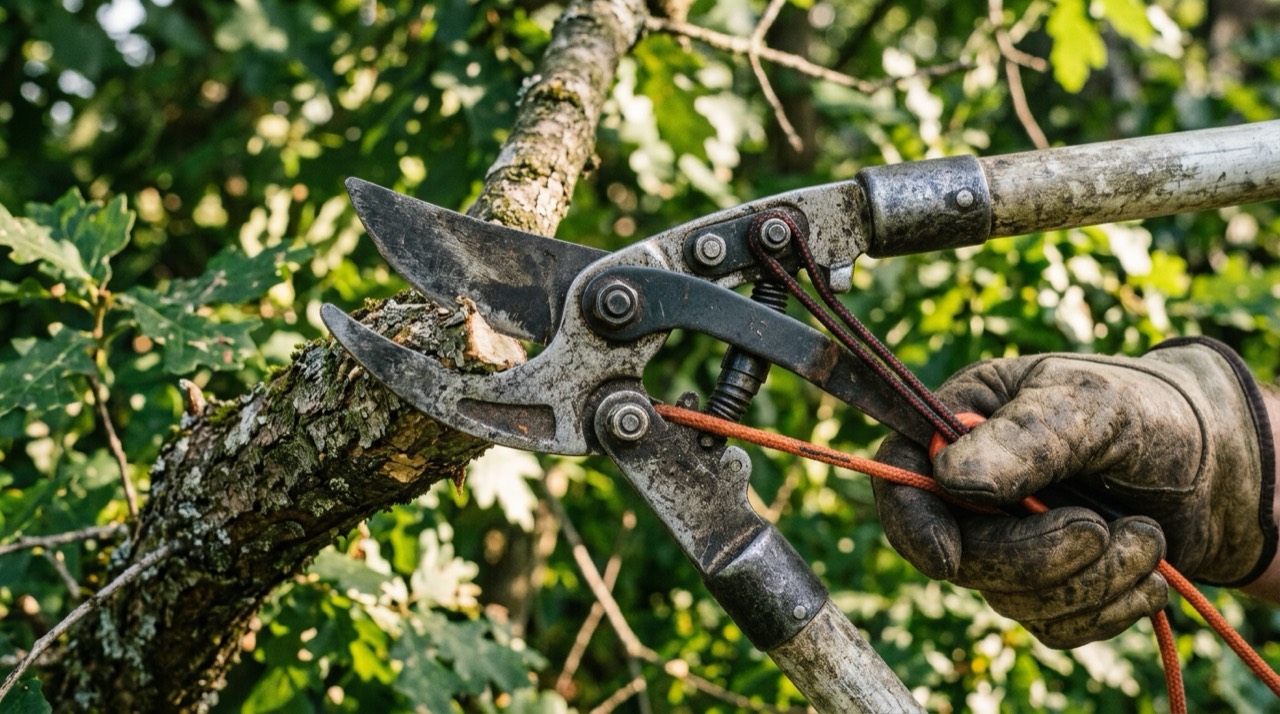
A manual pole pruner is a non-powered tool that mounts a cutting head on a long pole so you can trim branches 8 to 16 feet overhead while standing safely on the ground. Most designs carry two heads: a rope-operated bypass pruner for live limbs up to about 1¼ inches, and a curved pole-saw blade for thicker or dead wood you could not reach any other way. Because there is no motor, a manual pole pruner is quiet, needs no fuel or charging, and weighs far less than a powered unit — which is why it stays the default choice for routine pruning around the home.Manual pole pruners sit between hand tools and machines. For branches you can reach standing, loppers or a pruning saw are faster and more accurate. Once limbs climb out of arm’s reach, the pole extends your cut without a ladder — the single biggest safety win these tools offer.
What can a manual pole pruner cut?
A manual pole pruner cuts branches from pencil-thin twigs up to roughly 4 to 8 inches thick, depending on which of its two heads you use. The rope-and-pulley bypass head slices live green limbs up to about 1 to 1¼ inches with a clean scissor action that heals well; anything thicker, dead, or dry goes to the saw blade, which will work through much larger wood given patience and a steady pole.Branch thickness is the deciding factor. Green wood under 1¼ inches suits the pruner head, which leaves a smooth cut the tree closes over quickly. Dead, gnarled, or oversized limbs blunt and jam a bypass head, so the saw blade is the right tool there. Matching the head to the branch protects the tool, the tree, and your shoulders.
How much reach do you actually get?
Working height equals pole length plus your own standing reach, so a 12-foot pole gives most adults around 17 to 18 feet of cutting height. Manufacturers quote “reach” inconsistently — some mean pole length, others the height of the finished cut — so read the spec carefully and add roughly 5 feet of raised-arm reach to any pole length to estimate what you can actually cut.Reach comes in two forms. Telescoping poles slide out and lock with collars for quick, tool-free adjustment, while sectional systems bolt on extra lengths for greater rigidity at height. Longer is not always better: every extra foot adds flex and weight, making the head harder to place accurately. For most suburban trees a 12-to-16-foot pole is the practical sweet spot, and the best manual pole pruners balance reach against control rather than chasing the biggest number.
Rope-and-pulley head or pole-saw blade — which do you need?
The rope-and-pulley head makes fast, clean scissor cuts on green branches up to about 1¼ inch, while the pole-saw blade handles anything thicker, dead, or too wide for the pruner jaws to close around. Buying a combination tool that carries both heads is the most flexible choice for a mixed yard, because you rarely know in advance which branch will need which head.Rope heads shine on live maintenance pruning — thinning water sprouts, tidying fruit trees, removing crossing branches. Saw blades earn their keep on storm damage and thick deadwood. Curved, pull-stroke saw blades cut aggressively on the down pull and clear sawdust well, which matters when you are sawing above your head and fighting gravity the whole time.
What pole material and mechanism should you choose?
Pole material sets the weight, stiffness, and safety of the tool: fiberglass is stiff and non-conductive, aluminum is light but conducts electricity, and telescoping composite poles trade a little rigidity for pack-down convenience. Fiberglass is the professional, safety-first pick because it will not carry current if it brushes a live line — though no pole is truly safe near power lines.Cutting mechanisms differ by brand. Chain-drive and Power-Lever heads from Fiskars multiply your pull for easier cuts; Corona’s compound-action heads use linked pivots for the same effect; classic rope-and-pulley heads from Jameson give a smooth, serviceable pull that professionals can rebuild. Whichever you choose, look for a low-friction pulley, a replaceable blade, and a rope you can swap when it frays.
How do you match a manual pole pruner to your yard?
Match the tool to your tallest routine branch and the wood you cut most often, not to the longest pole on the shelf. A small suburban plot needs a light 10-to-12-foot pruner; an established garden with fruit trees wants a dual head; a large block with mature trees justifies a long saw.On a small suburban lot with young ornamentals and a hedge or two, a light 7-to-12-foot pruner does almost everything you need, and it stays easy to aim while your other hand steadies the pole. Reach beyond that is wasted weight you hold overhead on every cut.
An established garden with apples, pears, or ornamental trees is the classic case for a combination tool. You spend most of your time making clean bypass cuts on live growth under 1¼ inch, then occasionally meet a dead limb that only the saw blade will clear. A leverage-assisted head keeps those live cuts effortless across a long session.
A large rural block or acreage with tall, mature trees is where a dedicated long-reach saw earns its place. Here the limiting factor is control, not ambition — a 20-foot pole is only useful if you can hold it steady enough to place the cut accurately.
Storm cleanup blurs these lines. Fallen and hanging limbs are usually thick, dead, and awkward, which favours a strong saw blade over a rope head — but anything under tension, lodged, or near a structure or line is a job to leave to a professional rather than tackle from the ground.
What are the most common manual pole pruner mistakes?
The most common mistakes are buying too much pole, cutting flush to the trunk, forcing a bypass head onto oversized wood, and standing under the drop zone. Each is easy to avoid once you know it, and avoiding them protects the tool, the tree, and you.- Buying more reach than you can control. Every extra foot adds flex and weight; a pole you cannot aim accurately is more dangerous, not more capable.
- Cutting flush against the trunk. Removing the branch collar stops the wound sealing and invites decay — always cut just outside that swollen ring.
- Leaving long stubs. A stub past the collar dies back and rots; take the branch back to the collar in a final clean cut.
- Forcing the rope pruner onto thick wood. A bypass head is built for green limbs up to about 1¼ inch; anything thicker jams it, frays the rope, or crushes the branch. Switch to the saw blade instead.
- Sawing a heavy limb in one pass. The weight tears bark down the trunk as it falls; use the three-cut method on any branch heavy enough to peel.
- Standing under the cut. A falling limb is unpredictable — stand to the side, clear a drop zone, and never work directly beneath the branch.
- Ignoring rope and blade wear. A frayed rope that snaps at height, or a dull blade that forces you to push harder overhead, turns a routine cut into a hazard.
How do you prune safely overhead with a pole pruner?
Never use a manual pole pruner within 10 feet of overhead power lines — a wet or aluminum pole can conduct lethal current, and even fiberglass is unsafe once dirty or damp; contact your utility for any branch near a line. Overhead work also drops cut limbs unpredictably, so wear eye protection and a hard hat, stand to the side of the drop zone rather than under it, and keep bystanders well clear.Ground-based pruning is far safer than climbing, but it is not risk-free. Never combine a pole pruner with a ladder — the recoil of a cut can pull you off balance. Watch for neck and shoulder fatigue on long sessions, take breaks, and keep both hands on the pole. Large, leaning, or storm-damaged trees, and anything near structures or lines, belong to a certified arborist. Proper head and eye protection is essential for any overhead cutting.
What does a manual pole pruner cost to own?
A manual pole pruner is cheap to own because it burns no fuel, needs no battery, and has only two wear parts — the rope and the saw blade — both of which cost little to replace. The purchase price is nearly the whole cost of ownership, unlike a powered tool.Running costs are minimal. There is no petrol, two-stroke oil, spark plug, or lithium battery to replace over the tool’s life, and no service interval beyond wiping the blade and oiling the pivot. Against a powered pole saw — which adds fuel or charging, chain and bar oil, and periodic servicing — a manual tool can run for a decade on a few dollars of replacement rope and the odd new blade.
The parts that do wear are inexpensive and, on better tools, designed to be swapped. A replacement pruning rope costs little; an impulse-hardened saw blade is usually cheaper to replace than to sharpen. This is why serviceability is worth paying for at purchase: a model with a rebuildable pulley head and a genuine replacement blade outlasts a sealed budget tool whose failure ends its life. Buying a slightly better tool once is cheaper than replacing a cheap one twice.
How does a manual pole pruner fit alongside your other cutting tools?
A manual pole pruner covers the gap between arm’s-reach hand tools and powered machines, handling overhead branches you cannot reach standing but that do not justify a chainsaw. Below head height, other hand tools are faster and more precise.For branches you can reach from the ground, hand pruners handle twigs and stems up to about ¾ inch, and loppers take live limbs up to roughly 2 inches with far more control than a pole. A pruning saw or a bow saw cuts thick wood at close range more accurately than a saw waved overhead. The pole earns its keep only once the branch climbs out of reach — that is the one job it does better than anything short of a ladder, which you must never combine with a pole tool.
Above the pole pruner sits the powered pole saw, which drives a small chainsaw bar for fast cuts through thick limbs. It is the right answer for frequent heavy work, but it adds weight, noise, maintenance, and real danger overhead. Owning both a manual pruner and a powered saw, and reaching for the lightest tool that will do each job, is the honest setup for most properties.
When should you switch to a powered pole saw?
Step up to a powered pole saw when you face frequent thick limbs, regular storm cleanup, or long sessions that tire your arms with a manual blade. A motorized head cuts far faster through 3-to-6-inch wood, but it adds weight, noise, and maintenance, and it demands more respect because a moving chain overhead is genuinely dangerous.For most homeowners the honest answer is to own both: a manual pole pruner for quick, quiet live pruning and a powered unit for heavy work. If your trees have outgrown a hand tool, compare options in our guide to powered pole saws and the current best pole saws before you buy.