Best Manual Pole Pruner
Best Manual Pole Pruner, ranked from aggregated owner ratings and reviews, not first-hand testing. Real pros, cons, and who each pick is best for.


Our Top 3 Picks
Quick Comparison
| Product | Best for | Buy | |
|---|---|---|---|
| Fiskars 393981-1001 Chain-Drive Extendable Pole Saw & Pruner | Best Overall | See Amazon | View (paid link) |
| Corona TP 6870 Compound Action Tree Pruner | Best Value | See Amazon | View (paid link) |
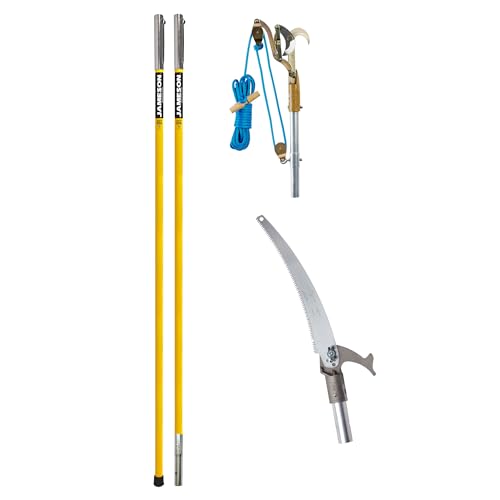
| Jameson FG-6PKGB Fiberglass Landscaper Pole Saw & Pruner Package | Best Heavy-Duty | See Amazon | View (paid link) |
| Silky Hayauchi 179-39 Telescoping Pole Saw | Best Premium | See Amazon | View (paid link) |
| Fiskars 9463 Power-Lever Extendable Tree Pruner | Best for Beginners | See Amazon | View (paid link) |
| DocaPole 7-30 Foot Pole Pruner with Saw and Pruner Attachments | Editor's Pick | See Amazon | View (paid link) |
How the top manual pole pruners compare
The six manual pole pruners below cover every common need, from clean live-branch cuts to extreme-reach saw work. The table lists each pick’s cutting system, published reach, and the buyer it suits best so you can shortlist before reading the detail.| Model | Cutting system | Published reach | Best for |
|---|---|---|---|
| Fiskars 393981 Chain-Drive | Bypass pruner + 15" saw | ~7–16 ft pole | All-round home pruning |
| Corona TP 6870 | Compound-action pruner + saw | ~14 ft | Low-effort live cuts |
| Jameson FG-6PKGB | Rope-and-pulley + tri-cut saw | 12 ft+ (add sections) | Daily and pro use |
| Silky Hayauchi 179-39 | Pull-stroke saw only | ~21 ft pole | Thick, very high limbs |
| Fiskars 9463 Power-Lever | Bypass pruner + 15" saw | ~7–12 ft pole | Small yards, beginners |
| DocaPole 7–30 ft | Saw + pruner attachments | up to ~30 ft | Occasional extreme reach |
What reach do you need for your trees?
Match pole length to your tallest routine cut, then stop — excess reach costs you control. Measure the branches you prune most, add about 5 feet for your own raised-arm reach, and choose the shortest pole that clears them. A 12-to-16-foot pole handles most suburban trees; only reach for a 20-foot-plus system if you genuinely have tall, mature trees, as covered in our manual pole pruner guide. Buying more pole than you need leaves you fighting flex and weight on every cut.Which cutting head suits your branches?
Choose a bypass pruner head for frequent live cuts and a saw-equipped combo if you also face thick or dead wood. Rope, chain-drive, compound, and Power-Lever heads all cut live limbs up to about 1 to 1¼ inches; the difference is how much effort each takes and how easily it rebuilds. A combination tool that carries both a rope pruner and a saw blade is the most flexible pick for a mixed yard, because you rarely know in advance which branch will need which head. The Silky Hayauchi is the exception — a saw only, aimed at people cutting thick, high wood rather than small green growth. If most of your work is thinner, reachable growth, a set of loppers may serve you better than a pole.How do the six picks differ in cutting effort?
The picks split into four mechanisms that trade effort for simplicity — chain-drive, compound-action, Power-Lever, and plain rope-and-pulley — plus a pull-stroke saw with no pruner head at all. The more a mechanism multiplies your pull, the easier a big live cut feels, and usually the more there is to maintain.The Fiskars 393981’s chain-drive head runs the rope over a toothed gear to multiply force, which is what lets it close on live limbs near 1¼ inch without a fight. Corona’s compound-action head on the TP 6870 links several pivots to the same end, giving the most effortless scissor cut of the group on repeated live growth. The Fiskars 9463’s Power-Lever geometry boosts a plain pull for smaller branches, keeping the tool light and simple for a beginner.
Jameson (paid link)’s rope-and-pulley Big Mouth head is the traditional professional choice: a smooth, serviceable pull with no gears to wear, easy to rebuild after years of daily use. The Silky Hayauchi sits outside this comparison entirely — it is a pull-stroke saw with no rope head, so its cutting effort is a matter of blade quality and reach rather than leverage. Weigh how often you make large live cuts: the more you do, the more a geared or compound head is worth paying for.
Which pole material is right?
Pick fiberglass for stiffness and electrical safety, aluminum for light weight, and telescoping composite for easy storage. Fiberglass is the safest and most rigid, which is why professional packages like Jameson’s use it; telescoping poles pack down small but flex more at full extension. Weight matters too, because you hold the whole pole overhead — a lighter model is easier to aim but often shorter, while a long, stiff pole cuts accurately at height but tires your arms faster. No pole, fiberglass included, is safe to use near live power lines — keep every model at least 10 feet away.What features matter most?
Prioritize a low-friction pulley or lever, a replaceable saw blade, secure section locks, and a swappable rope. A smooth cutting mechanism saves your shoulders over a long session, replaceable blades keep the tool useful for years, and reliable locks stop the pole collapsing mid-cut. A sharp, well-maintained blade cuts faster and more safely than any amount of extra reach, so factor in how easily each model can be serviced.What should you look for in the rope, pulley, and blade?
Look for a low-friction pulley, a rope you can replace, and a saw blade that is easy to source, because these three parts decide how the tool cuts and how long it lasts. A sealed head that cannot be serviced is a false economy.- A smooth pulley or lever saves your shoulders. Friction at the head is effort you supply on every cut; a well-machined pulley or a geared head makes a long session far less tiring.
- A replaceable rope keeps the tool alive. Cutting rope frays with use and eventually snaps — a hazard at height — so a model that lets you thread a fresh rope of the same diameter is worth choosing.
- A standard, replaceable saw blade matters more than the original blade’s sharpness. Curved, impulse-hardened blades are usually replaced rather than sharpened, so check that a genuine replacement is easy to buy before you commit.
- Secure section locks stop the pole collapsing mid-cut. Collar and pin locks should hold firmly under load; a pole that creeps shorter while you saw is both frustrating and unsafe.
Keeping a blade sharp and a pulley free-running with the right sharpening files and tools does more for cutting speed than any amount of extra reach.
How do you set up and test a new manual pole pruner?
Set up a new pole pruner by seating the rope, checking the locks, and testing both heads at ground level before you ever raise it overhead. Five minutes of setup prevents a jammed head or a slipping collar twenty feet up.- Fit the heads. Attach the pruner head and, on a combination tool, the saw blade, tightening every fastener to the maker’s marks.
- Thread the rope correctly. Feed the cutting rope over the pulley along its intended path and tie it off; a mis-seated rope slips off the pulley under load.
- Test the pruner at chest height. Pull the rope through its full stroke and confirm the blade opens and closes fully on a spare branch before trusting it overhead.
- Check every lock. Extend the pole, lock each telescoping collar or section, and lean on it to confirm nothing creeps or collapses.
- Learn its balance. Raise the pole empty first to feel its weight and flex, then spread both hands and brace the butt against your hip.
Run this check on any second-hand or long-stored tool too, paying special attention to the rope and the section locks, which are the parts most likely to have degraded.
Which manual pole pruner fits your budget?
Manual pole pruners span three rough price tiers — budget beginner tools, mid-range dual-head combinations, and premium professional systems — and the right tier depends on how often and how hard you prune. Spending more buys serviceability and reach, not magic.At the entry level, a light single-focus tool such as the Fiskars 9463 keeps a small yard tidy for the least outlay, trading reach and hardwood power for simplicity. The mid tier — the Fiskars 393981 chain-drive and the Corona TP 6870 — is where most homeowners land, adding a real saw blade, more reach, and an easier cutting action for a modest step up in price.
The premium tier covers the Jameson fiberglass package and the Silky Hayauchi. These cost noticeably more, but they reward daily users and owners of tall trees with rebuildable heads, genuine replacement blades, and reach or cut quality the cheaper tools cannot match. The DocaPole (paid link) is the odd one out: inexpensive for its extreme reach, but bought for height alone, not precision. For repeated heavy cutting, the money is often better spent on a powered pole saw than on the longest manual pole you can find.
When is a manual pole pruner the wrong tool?
A manual pole pruner is the wrong tool when the wood is too thick for the saw to clear in reasonable time, when the branch is under tension or near a power line, or when the work is all within arm’s reach. Using it anyway wastes effort or courts danger.For thin, reachable growth, loppers or hand pruners are faster and far more accurate than a saw waved overhead — reserve the pole for branches you genuinely cannot reach standing. For thick limbs you cut often, or for storm cleanup that fills an afternoon, a manual saw blade becomes exhausting, and a powered pole saw does the job in a fraction of the strokes.
Some jobs are not DIY at all. Any branch touching or within 10 feet of an overhead line, any large limb over a house or fence, and any tall, leaning, or storm-damaged tree belong to a certified arborist or your electricity utility. Recognising these limits is part of using the tool well — a manual pole pruner is superb inside its range and hazardous outside it.
Which manual pole pruner should you buy?
Buy the Fiskars 393981 Chain-Drive if you want one do-everything tool, the Corona TP 6870 for the easiest live cuts, and the Silky Hayauchi if you need to saw thick limbs far overhead. Jameson’s fiberglass package rewards daily users, the Fiskars 9463 suits small yards, and the DocaPole handles rare extreme-reach jobs. For heavy, repetitive cutting, weigh a powered pole saw instead — and always pair overhead work with proper head and eye protection.Full Ranking, Reviewed
Best for Homeowners who want one tool for both clean cuts and thick limbs
- Extends from about 7 to 16 feet for most suburban trees
- Chain-drive rope mechanism adds power at the pruner head
- Bypass pruner cuts live branches up to around 1¼ inches
- Includes a 15-inch WoodZig steel saw blade for thicker limbs
- Dual head covers nearly all yard pruning
- Chain-drive leverage makes big live cuts easier
- Strong reach for the price
- Heavy and flexy at the full 16-foot extension
- Head assembly can rattle loose over time
Verdict: A do-everything manual pole pruner that pairs a powerful chain-drive pruner with a real saw blade, making it the best first choice for most homes.

Best for Gardeners cutting lots of live limbs who want low-effort scissor cuts
- Compound-action head multiplies hand force for easy cuts
- Bypass blade cuts live branches up to around 1¼ inches
- Non-conductive fiberglass pole with published reach near 14 feet
- Includes a saw blade for occasional thicker wood
- Compound action makes larger live cuts feel effortless
- Non-conductive fiberglass pole
- Corona replacement parts are widely available
- Fixed length rather than telescoping on this model
- Rope can slip from the pulley if not seated correctly
Verdict: A well-built, keenly priced pruner whose compound-action head takes the strain out of repeated live cuts.
Best for Landscapers and serious owners who prune all day and may add reach
- Rope-and-pulley Big Mouth pruner head for smooth live cuts
- Barracuda tri-edge saw blade for fast, aggressive sawing
- Non-conductive fiberglass poles built for daily use
- Base package accepts add-on sections to extend past 12 feet
- Modular reach via extra fiberglass sections
- Smooth, rebuildable pulley pruner action
- Pro-grade build survives heavy use
- Premium price for a homeowner
- Extension sections cost extra and add weight
Verdict: The pick for people who prune professionally: a rugged fiberglass system you can service and extend for years.

Best for Arborists and enthusiasts sawing thick, very high limbs a rope head can’t reach
- Telescopes to about 21 feet on a three-section pole
- Professional Japanese pull-stroke blade cuts fast on the pull
- Secure section locks hold the blade steady at height
- Saw only — no rope pruner head for small green cuts
- Exceptional cut speed and blade quality
- Huge reach for a hand-powered tool
- Genuine replaceable Silky blade
- No bypass pruner for small live branches
- Premium price and long, unwieldy at full height
Verdict: The finest long-reach manual saw you can buy — unbeatable for thick, high limbs, provided you don’t need a rope pruner too.

Best for Small yards and first-time users pruning limbs within about 12 feet
- Extends from about 7 to 12 feet for smaller trees
- Power-Lever pruner head boosts cutting power
- Bypass blade cuts live branches up to around 1 inch
- Includes a 15-inch WoodZig saw blade
- Light and easy to handle
- Simple to set up and use
- Lower cost than long chain-drive models
- Shorter reach than 16-foot models
- Less power on hardwood than a chain-drive head
Verdict: A light, affordable pole pruner that is the easiest way for a beginner to keep a small yard tidy.
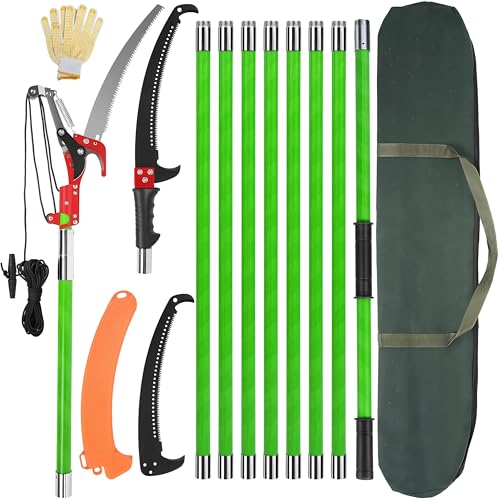
Best for Owners of very tall trees who need extreme reach on an occasional basis
- Telescoping extension pole reaches up to about 30 feet
- Accepts a curved pruning-saw blade and a rope tree-pruner head
- Locking collars at each section for tool-free height changes
- Doubles as a multi-use pole for other high yard tasks
- Unmatched reach for a manual tool
- Versatile attachment system
- Packs down small for storage
- Very flexible and hard to control near full extension
- Cutting attachments are sold separately
Verdict: The reach champion for rare, very high cuts — buy it for the height, not for precision or speed.
Frequently Asked Questions
Are manual pole pruners worth it over a powered pole saw?
For routine live pruning, yes. A manual pole pruner is lighter, quieter, cheaper, and needs no fuel or charging, and its rope head makes cleaner cuts on small green branches. Step up to a powered pole saw only when you regularly cut thick limbs or handle storm cleanup.
What size branches can the best manual pole pruners cut?
The rope or lever pruner heads on these picks cut live branches up to about 1 to 1¼ inches cleanly. The included saw blades work through much thicker wood — commonly 3 to 6 inches — though large limbs take time and a steady pole overhead.
How long should my pole pruner be?
Match the pole to your tallest routine cut, then add about 5 feet for your own reach. A 12-to-16-foot pole suits most suburban trees; only choose a 20-foot-plus model like the Silky Hayauchi or DocaPole if you truly have tall, mature trees.
Do manual pole pruners come with both a saw and a pruner?
Many do. Combination tools such as the Fiskars 393981 and the Jameson package carry both a rope-operated bypass pruner and a saw blade on one pole. The Silky Hayauchi is a saw only, with no rope pruner head.