


What do CFM and MPH mean on a leaf blower?
CFM (cubic feet per minute) measures how much air a leaf blower moves, while MPH (miles per hour) measures how fast that air leaves the nozzle. CFM is the volume of leaves you can push at once; MPH is the force that gets stuck, wet debris moving.Think of the two numbers as a team. A high-MPH, low-CFM blower fires a thin, fast jet that dislodges packed leaves but struggles to sweep a wide area, while a high-CFM blower moves a big, steady wall of air that herds loose leaves across a lawn quickly. Manufacturers headline whichever figure looks best, so read both. Homeowner handhelds typically fall around 350–600 CFM and 90–170 MPH, while the strongest gas and battery units push past 700 CFM. For much larger loads you step up to a backpack blower, which is covered in its own guide.
Which matters more, CFM or MPH?
CFM matters more for most yard cleanup, because moving a large volume of air clears leaves faster than a narrow high-speed jet. MPH helps break loose wet leaves, pine needles, and matted debris, but without enough CFM behind it that force fizzles out across a wide lawn.The best real-world blowers pair the two, and the figure worth watching is often the newton rating, which combines airflow and speed into one measure of blowing force. When comparing models, favour a balanced spec over a single headline number: a 600 CFM / 130 MPH unit will out-clear a 200 CFM / 200 MPH bargain blower on almost any task. Save the ultra-high MPH tools for stubborn, stuck-on messes, and lean on CFM for sheer speed over open ground. Our best leaf blower picks list both numbers side by side so you can weigh them yourself.
What size leaf blower do you need for your yard?
Match the blower to the ground you actually clear: a courtyard or small city lot is happy on 350–500 CFM, a standard quarter-acre suburban block wants 500–650 CFM, and anything approaching or past half an acre with heavy autumn fall calls for 650–730 CFM. Buying more airflow than the yard needs only adds weight, noise, and cost.The quick way to size a handheld is by property and typical leaf load, shown below.
| Yard | Typical size | Suggested airflow | Sensible power type |
|---|---|---|---|
| Courtyard / townhouse | Under 1,000 sq ft | 350–450 CFM | Corded or small battery |
| Suburban lot | ~5,000–10,000 sq ft | 500–650 CFM | Battery handheld |
| Large lot | Quarter to half acre | 650–730 CFM | Strong battery or gas |
| Acreage | Over half an acre | 700 CFM+ | Backpack blower |
Leaf type shifts the numbers as much as area does. A lawn ringed by deciduous trees that drop wide, wet leaves needs more force than a yard shedding a light scatter of dry ones, and pine needles or matted leaves reward higher MPH whatever the lot size. If your honest answer is a big yard, heavy fall, and long sessions, read the backpack blowers guide before committing to a handheld — the shoulder-carried motor is what makes those loads bearable over a full afternoon.
Should you buy a gas, battery, or corded leaf blower?
Battery blowers suit most homeowners today; gas blowers still lead for acreage, wet leaves, and all-day runtime; corded electric models are the cheapest and lightest but tie you to an outlet. Match the power source to your yard size, how far you roam, and the noise you can tolerate.The three power types trade off differently on runtime, weight, and upkeep, as compared below.
| Power type | Best for | Typical runtime | Upkeep |
|---|---|---|---|
| Battery (cordless) | Small to medium yards, quiet work | About 15–45 min per charge | Minimal — charge and go |
| Gas (2-stroke) | Large yards, wet leaves, endurance | Refuel in seconds | Fuel mixing, plugs, filters |
| Corded electric | Small yards near an outlet | Unlimited while plugged in | Almost none |
Battery platforms have improved fast, and a strong 56V or 80V handheld now matches a mid-size gas blower for most homeowner jobs. If you already own cordless tools, staying on one battery system saves money — the same packs run our recommended battery lawn mowers.
Do you need a handheld or a backpack leaf blower?
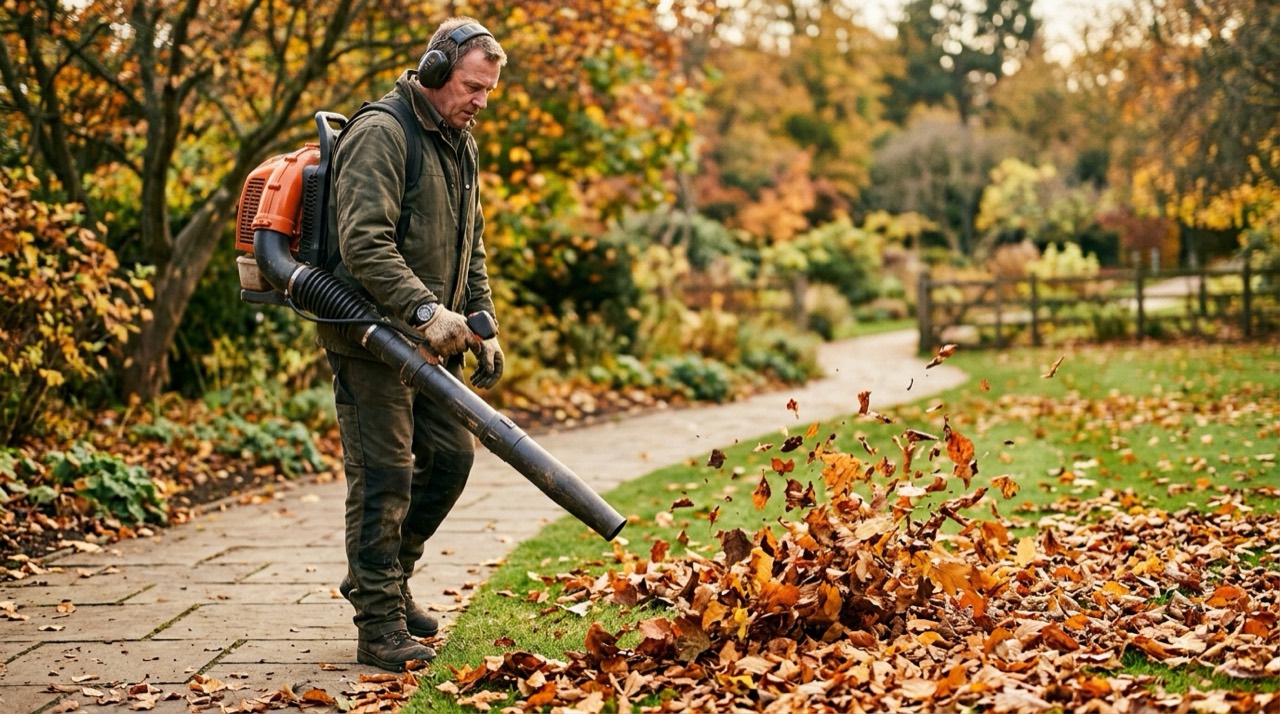
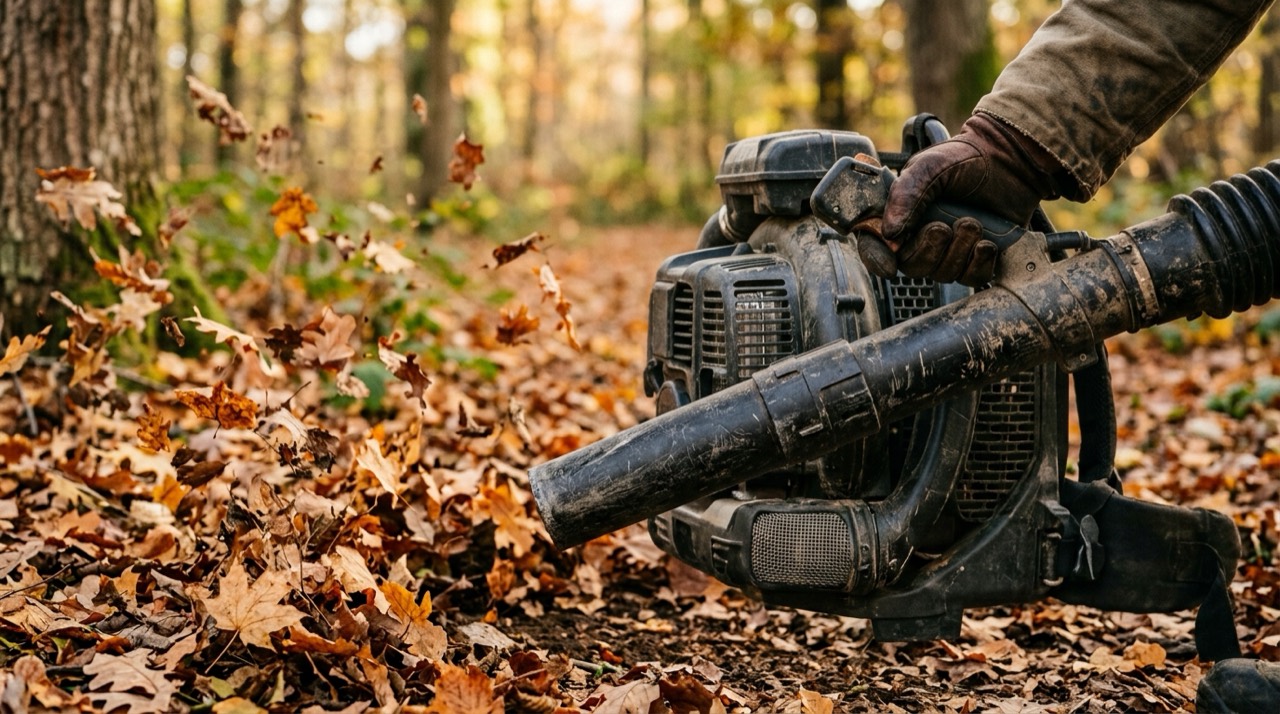
Handheld leaf blowers suit the majority of home yards — they are lighter, cheaper, and easy to store, handling driveways, decks, and lawns up to about half an acre. Backpack blowers carry the motor on your shoulders for far longer sessions and higher airflow, so they belong on big properties.Weight decides comfort over a long session. A handheld hangs off one arm, which is fine for 15 to 30 minutes but tiring beyond that, whereas a backpack spreads the load across your shoulders and frees your wrist. For anything larger than a half-acre, heavy leaf fall, or regular commercial work, the extra capacity of a backpack blower pays off. Most homeowners with a typical suburban lot are better served by a capable handheld, and can add a lawn sweeper to collect the piles the blower builds.
What features separate a good leaf blower from a cheap one?
A variable-speed trigger, a cruise-control lock, a brushless motor, and low weight separate a good leaf blower from a frustrating one. Brushless motors run longer and cooler on battery models, while variable speed lets you ease off around flower beds and open up on the driveway.The features worth checking before you buy are listed below.
- Variable-speed trigger controls airflow so you do not blast mulch out of garden beds.
- Cruise-control or speed lock holds a set speed so your finger does not cramp.
- Brushless motor delivers more runtime, power, and life on cordless tools.
- Nozzle attachments such as flat, round, and concentrator tips tune the airflow to the job.
- Balanced, low weight keeps a handheld comfortable through a full cleanup.
A blower that also vacuums and mulches earns its keep in a small yard — see the lawn sweepers and vacuums guide for dedicated collection tools. Skip gimmick turbo buttons that simply run the motor flat out and drain the battery for little real gain.
How do you use a handheld leaf blower efficiently?
Work with the wind in long, overlapping passes toward a single downwind collection point, keep the nozzle low and angled slightly forward, and let the airflow do the work rather than swinging the tool. Good technique clears a yard in a fraction of the time and saves your arm and shoulder.The routine that clears a typical yard quickly follows these steps.
- Check the wind direction and pick one collection spot downwind of the whole yard.
- Start at the far upwind edge so every pass drives leaves toward that spot.
- Set low speed near beds, gravel, and mulch; open up on lawn and hard surfaces.
- Sweep in overlapping strokes with the nozzle a few inches off the ground.
- Build the leaves into a long windrow rather than a scattered heap, then herd it onto a tarp or into bags.
Two-handed control and a steady walking pace beat frantic waving, and a cruise-control lock lets your trigger finger rest on the long passes. Damp leaves move far more easily once the midday sun has dried them, so timing a cleanup often saves more effort than raw force. Once the piles are built, a lawn sweeper collects them faster than stooping with a rake.
How do you maintain a handheld leaf blower?
Maintenance depends on the power source, but every blower benefits from keeping the air-intake screen clear, wiping the housing down after use, and storing it dry and out of the weather. A clogged intake is the most common cause of weak airflow across all three types.The upkeep that keeps each type running is summarised below.
- Battery blowers: store packs at partial charge in a cool spot, keep terminals clean and dry, and never leave a pack sitting on the charger for months. The same packs run your other battery chainsaws and trimmers, so treat them as a shared investment.
- Corded blowers: check the cord and plug for nicks before each use and never run a damaged lead. There is almost nothing else to service.
- Gas blowers: run fresh, correctly mixed fuel, clean the air filter, replace the spark plug about yearly, and drain or stabilise the tank before long storage. Stale fuel causes most no-start faults.
Keep the tool somewhere protected — a wall hook in a shed or garage keeps it off a damp floor, and our outdoor tool storage guide covers tidy options. A blower given this small routine care lasts many seasons; neglect shows up first as hard starting on gas models and weak airflow on any type.
How loud is a leaf blower, and are they being restricted?
Leaf blowers are among the loudest yard tools, with many gas models rated around 95–105 decibels at the operator and battery models often nearer 60–75 decibels. That gap is a big reason several U.S. cities and the state of California restrict or ban gas blowers, pushing homeowners toward quieter cordless units.Noise regulation is spreading. California has phased out the sale of new gas-powered leaf blowers, and many towns limit blower use to set hours or ban gas models near homes and schools. Beyond the law, decibels matter for your own hearing — sustained exposure above roughly 85 dB can damage it, so hearing and eye protection is sensible on any gas blower. Battery blowers marketed as whisper or low-noise trade a little power for neighbourly quiet, which is why brands now publish sound ratings prominently on the box.
What safety gear does using a leaf blower need?
A leaf blower throws grit, twigs, and dust at high speed, so wear wraparound eye protection and hearing protection, closed-toe shoes, and long sleeves, and add a dust mask when clearing dry, dusty debris. Keep the nozzle pointed away from people, pets, windows, and vehicles at all times.Hearing protection is the item people skip most and need most, especially on gas models loud enough to harm ears within minutes. Beyond gear, aim with the wind rather than against it, never point the blower at anyone, and switch it off before clearing a clogged nozzle. Store gas blowers with stabilised or drained fuel, keep bystanders well back while the tool is running, and wear work gloves for a firmer grip. This guide is general information, not a substitute for the operator's manual supplied with your blower.