


What is a log holder for cutting logs?
A log holder for cutting logs is a stand — a sawhorse, sawbuck, clamping jaw, or log jack — that grips a log at working height so you can buck it into firewood without it rolling, sinking into the dirt, or pinching your bar. It turns an awkward, ground-level job into a stable one.
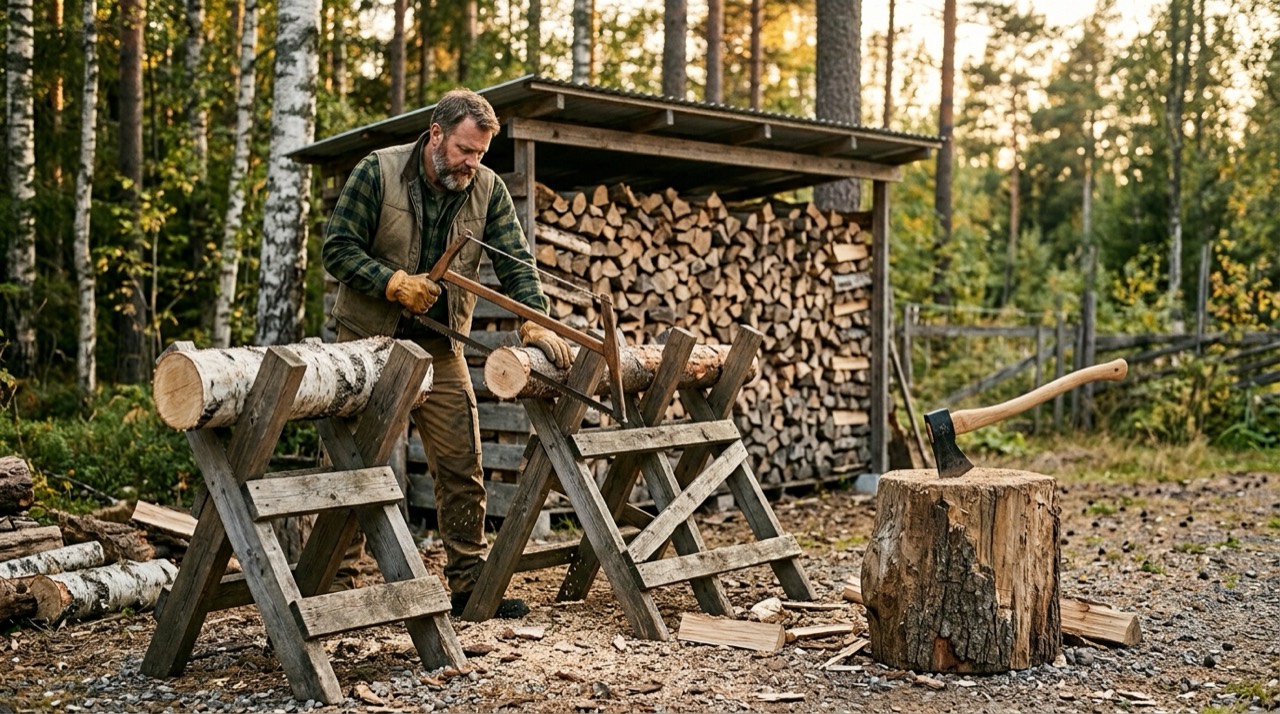
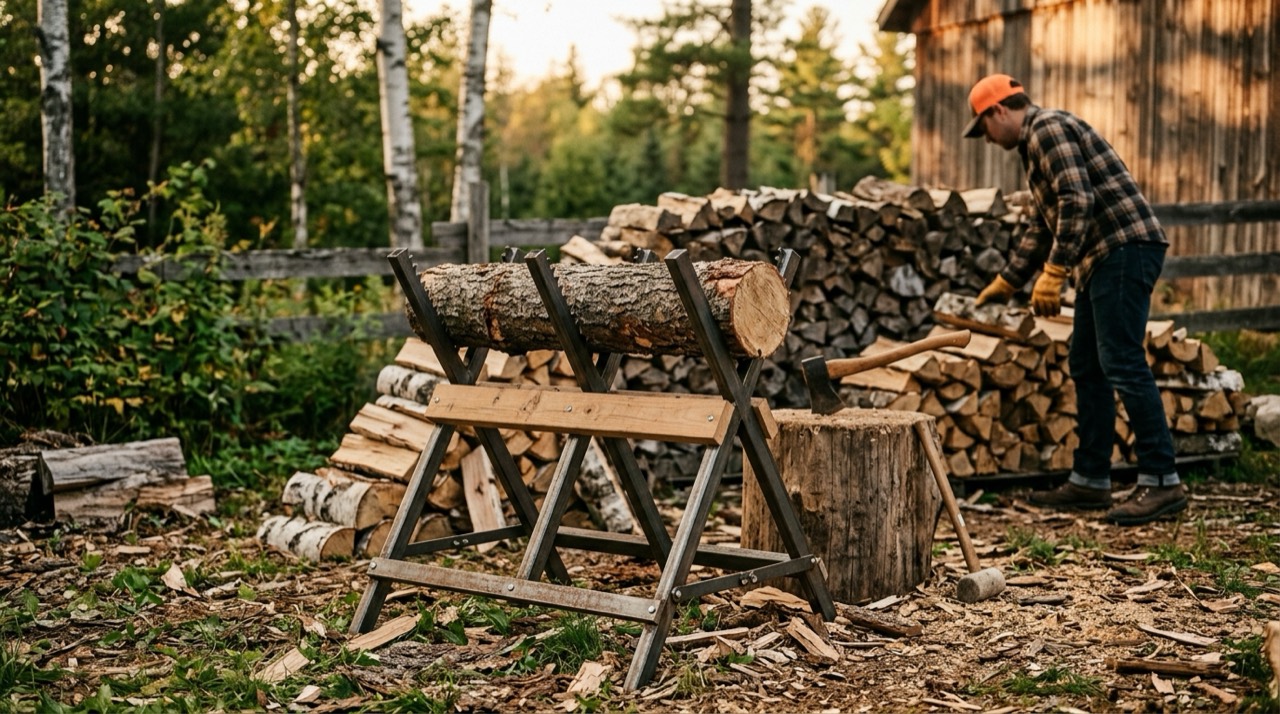
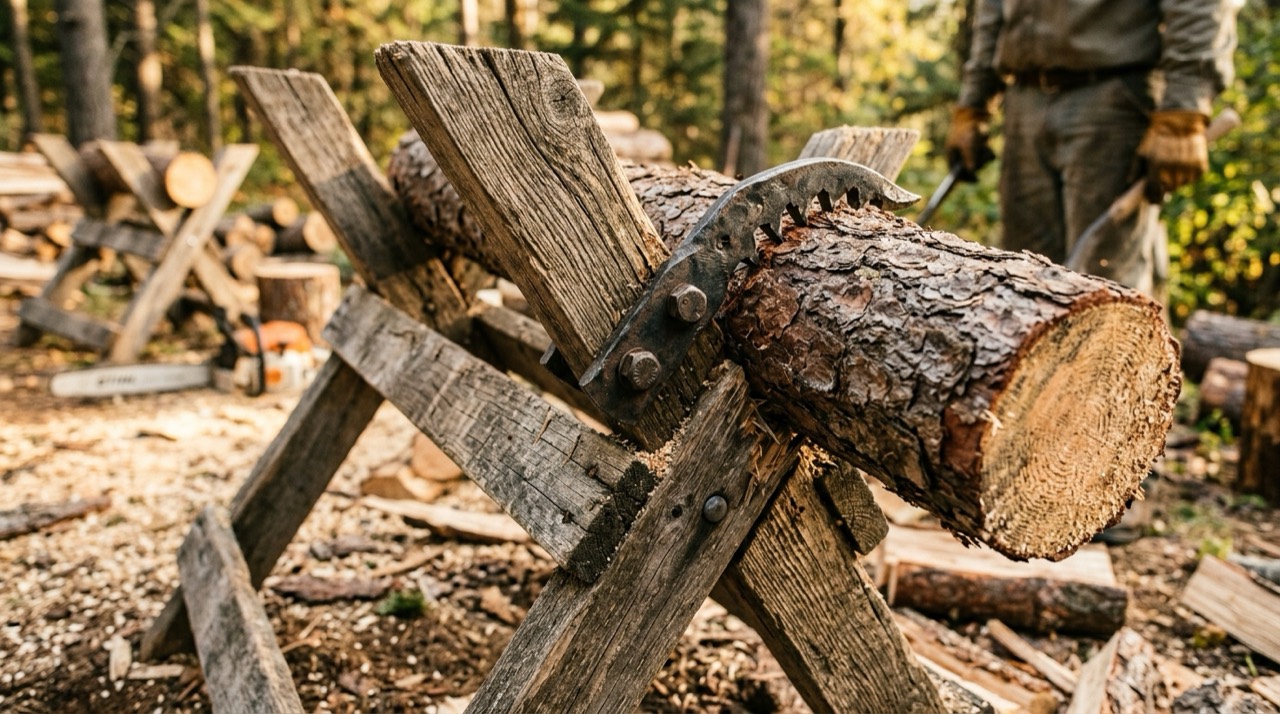
Most holders fall into a few families. A sawbuck is an X-frame that cradles one or more logs in its crossed timbers. A folding steel sawhorse does the same but packs flat and often adds a grab or chain to lock the log down. A clamping work-holder such as the Rockwell JawHorse squeezes a single log in powerful jaws. A log jack or cant hook rolls and lifts a heavy log a few inches off the ground so your chain clears the soil. Which one you want depends on how much wood you process and how big the pieces are.
Why hold a log off the ground before you cut?
Holding a log off the ground keeps your chainsaw bar out of the dirt — the single fastest way to dull a chain — and it stops the log rolling or settling onto the bar and pinching it mid-cut. Both problems are safety problems, not just annoyances.
When a bar tip touches soil or grit, the cutters go blunt in seconds, and a blunt chain grabs and kicks back more readily. A log lying flat on the ground also closes up as you cut through it, trapping the bar; freeing a pinched saw is where many hands get hurt. Raising the wood to roughly hip height also saves your back — you cut standing upright instead of stooping. If your chain does touch dirt, plan to touch it up; see our chainsaw sharpening guide. And whatever holder you use, cut in full PPE — read the chainsaw chaps and PPE guide before you start.
How does stable support prevent chainsaw kickback and pinch?
A stable holder prevents the two ways a bucking cut turns dangerous — kickback and pinch — by keeping the log from shifting into the bar and by supporting the wood so the cut opens instead of closing. A log that cannot move is a log that cannot trap or throw your saw.
Kickback is the violent upward-and-back lurch that happens when the nose of the bar catches or the chain binds, and a log that rolls or drops onto the tip mid-cut is a common trigger. Pinch is the slower failure — the kerf closes on the bar and grips it — and it happens when a log is supported at both ends and cut in the middle so its own weight folds the cut shut. A good holder answers both. It locks the log so it cannot roll onto the tip, and it lets you load the wood with the cut-off end overhanging so gravity pulls the kerf open rather than closed. That is why a purpose-built cradle with a chain or grab is safer than balancing a log on the ground: it removes the movement that feeds kickback and the mid-span support that feeds pinch. Set the holder up well and the frame, not your reflexes, becomes your first line of defence.
What types of log holders and sawhorses are there?
The five common ways to hold a log for cutting are compared below by how they grip the wood and who they suit.
| Holder type | How it holds the log | Best for |
|---|---|---|
| Steel sawbuck | X-notches cradle several logs at once | High-volume firewood bucking |
| Folding sawhorse with grab | V-cradle plus a chain or lever grab | Weekend firewood, easy storage |
| Clamping work-holder (JawHorse) | Powered foot-pedal jaws squeeze one log | Rock-solid single-log cuts |
| Log jack / cant hook | Rolls and lifts the log a few inches up | Big rounds too heavy to lift |
| Log stand / round holder | Rings or spikes hold short rounds upright | Re-cutting and splitting rounds |
Sawbucks and folding sawhorses are the everyday choice for cutting branch wood to stove length. A clamping holder shines when you want a single log held dead still. A log jack earns its keep on heavy trunks you would rather roll than hoist onto a frame.
Which log holder suits your yard and volume of wood?
Match the holder to how much wood you cut and where you cut it: a light folding sawhorse suits a small yard and the odd load, a fixed steel sawbuck suits regular cord-cutting in one spot, and a log jack or clamp suits heavy or awkward pieces on acreage. Volume and log size decide it more than price does.
A homeowner burning a few loads a winter is well served by a folding V-cradle that hangs on the shed wall between weekends. Someone processing several cords a year in a fixed woodlot gains real speed from a sawbuck that cradles a batch of logs at once, so the saw runs almost continuously. On acreage, where trunks often arrive too heavy to lift, a cant hook or log jack that rolls and props the wood is frequently the only sensible option. The wood itself matters too: softwood cuts fast and forgiving, while dense, knotty hardwood loads the frame harder and rolls more stubbornly, so size up the holder when you cut oak, ironbark, or old fruitwood. Whatever you settle on, pair it with the firewood tools that match your workflow so the holder is not the slow link in the chain.
How much weight and log size can a sawhorse hold?
Most folding steel sawhorses are rated to hold roughly 300–500 lb of log across the frame, while heavier fixed sawbucks and clamping holders like the JawHorse handle more and grip logs up to around 10–12 inches across. Treat published capacities as a guide, not a guarantee.
Capacity is about the frame, but stability is about the footprint. A wide, low sawhorse resists tipping better than a tall, narrow one, even at the same rated load. For diameter, a V-cradle comfortably takes branch wood and small rounds; anything much thicker is better rolled with a log jack or handled with the right firewood tools. Length matters too — cradle several shorter logs together for speed, but never overhang the frame so far that the offcut whips down as you finish the cut.
How do you cut firewood on a log holder safely?
Set the holder on firm, level ground and secure the log before the saw ever runs. A holder makes cutting safer only if you load and use it in the right order.
- Place the sawhorse on flat, solid ground with room to work on both sides.
- Load the log so the section you will cut sits just outside the cradle, not between the notches.
- Lock the grab, chain, or jaw so the log cannot roll.
- Start the saw on the ground, then bring it to the wood at full chain speed.
- Cut down through the overhanging end so the offcut falls clear, away from your legs.
- Keep both hands on the saw and your thumbs wrapped around the handles throughout.
Never cut between two supports where the wood can pinch the bar, and keep bystanders well back. Felling or limbing standing trees is a different, higher-risk job — leave large or leaning trees to a professional with the right chainsaw.
How do you set up a sawhorse on uneven or sloping ground?
Set a sawhorse on the firmest, most level patch you can find, and if the ground slopes, position it so the log cannot roll downhill toward you. A holder is only as stable as the ground beneath its feet, so setup is where safe bucking begins.
- Clear the work area of branches, bark, and offcuts that could trip you or foul the saw.
- Choose level, compacted ground and avoid soft soil, mud, or loose gravel that lets a leg sink.
- On a slope, stand the frame so its length runs across the fall line, not down it.
- Pack a flat stone or timber offcut under any leg that rocks, then test the frame is dead steady.
- Load the log and lock the grab or chain before the saw ever runs.
- Re-check the footing after a few cuts, because vibration can walk a frame on soft ground.
If you cannot get a frame steady, move to better ground rather than cutting on a wobbling holder. An unstable base reintroduces exactly the roll-and-shift risk the holder is meant to remove, so a minute spent levelling the frame is never wasted.
What mistakes do people make when cutting firewood on a sawhorse?
The most common sawhorse mistakes all come back to letting the log move or cutting where the bar can be trapped. Avoiding a short list of them removes most of the risk from bucking firewood.
- Cutting between two supports, so the kerf closes and pinches the bar.
- Loading the log without locking the chain, grab, or strap, so it rolls mid-cut.
- Overhanging the cut-off end so far that it whips down and twists the saw.
- Letting the bar tip touch the ground on the final pass and dulling the chain.
- Overloading a light folding frame with a round it was never rated to hold.
- Cutting in trainers and shorts instead of proper chainsaw chaps and PPE.
Each of these is easy to fix once you know to watch for it: secure the log before you cut, keep the cut on the overhanging end, and keep the chain sharp so it pulls through cleanly instead of grabbing. A holder rewards good habits and punishes shortcuts, so build the routine and stick to it every load rather than cutting corners when you are tired near the end of a session.
How do you maintain and store a steel sawhorse or sawbuck?
Keep a steel holder working by knocking off sawdust and bark after each session, checking bolts and welds for movement, and storing it dry so the frame does not rust. A holder lives a hard, outdoor life, and a few minutes of care buys years of service.
Steel frames mostly fail at their joints and their coating: bolts loosen under vibration, and chipped paint lets rust creep in where the frame is scratched by chains and bark. Nip up any loose fasteners, touch up bare metal with a rust-inhibiting paint, and oil a folding hinge or grab mechanism so it keeps moving freely. Store the frame under cover — a shed wall or garage hook is ideal for a folding model — rather than leaving it out in the weather where damp and grit shorten its life. Because a good steel holder can outlast several chains, the cost of ownership is low if you look after it. Keep the same eye on the saw itself: pair holder care with regular chainsaw maintenance so the whole setup stays reliable load after load.
Steel sawbuck or folding sawhorse — which should you buy?
Choose a fixed steel sawbuck if you process cords of wood in one place and want to cradle several logs at once; choose a folding sawhorse if you value storage space, portability, and a built-in grab for the occasional load. Both do the core job well.
A welded sawbuck is heavier, more rigid, and shrugs off years of hard cutting, which is why they dominate serious firewood yards. A folding sawhorse trades some rigidity for the ability to hang on a garage wall between weekends, and many models add a lever or chain grab that a bare sawbuck lacks. If you are torn, our best chainsaw sawhorse picks compare specific steel and folding models side by side.
Where does a log holder fit in your firewood workflow?
A log holder sits at the bucking stage — between felling and splitting — where long logs become stove-length rounds. Getting this step efficient speeds up everything after it.
Once your rounds are cut clean and consistent, they are ready to split with a splitting axe or maul or a manual log splitter, then season and stack. Pairing the right holder with a sharp chain and the firewood kit that suits your volume is what turns a weekend of cutting from a chore into a system. Start with a holder sized to your logs, keep your chain sharp, and the rest of the process falls into place.