


What is a pole saw, and who needs one?
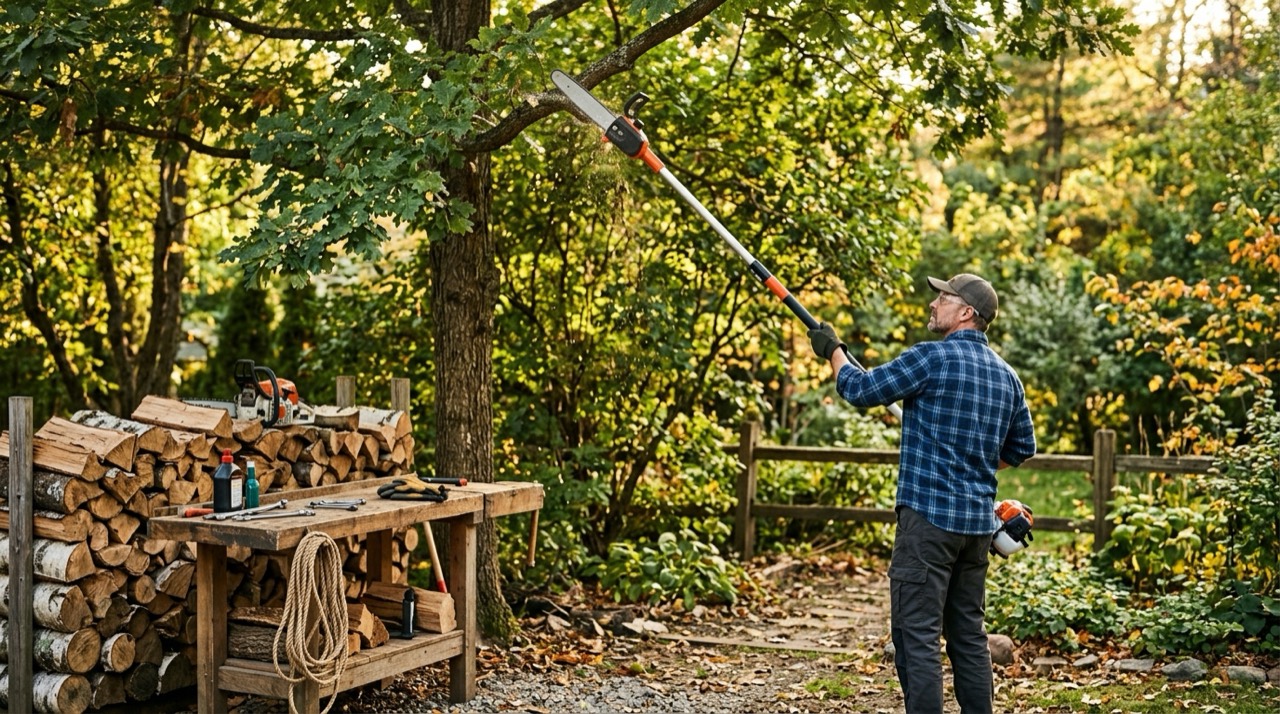
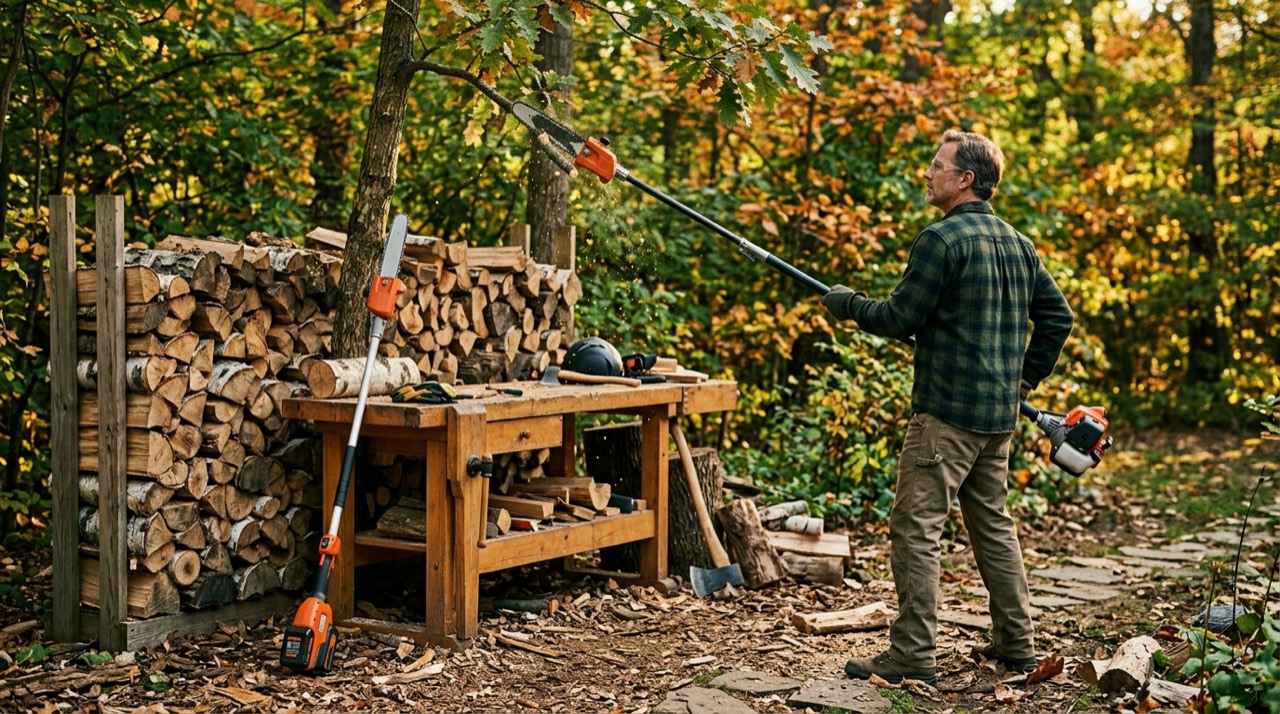
A pole saw is a small chainsaw or curved saw blade mounted on a long shaft, letting you cut branches up to roughly 15 feet overhead while keeping both feet on the ground. It suits homeowners, orchard keepers, and property managers who prune high limbs without climbing a ladder.The whole point of a pole saw is to take the most dangerous part of tree pruning, a ladder standing under a falling branch, off the table entirely. Instead of climbing, you extend a shaft, position the cutting head against the limb, and let a powered chain or a pull-stroke blade do the work from below. Lighter trimming that stays within arm's reach is better served by loppers or a pruning saw, and this guide sits inside our wider chainsaws hub so you can compare pole saws against every other cutting tool.
What jobs is a pole saw built for, and what is it not?
A pole saw is built for reaching cuts on standing wood: thinning a crowded canopy, clearing deadwood, lifting the lowest branches off a path, and shaping fruit trees you cannot reach from the ground. It is a limbing tool, not a felling or firewood tool.Typical jobs are removing a broken limb after a storm, cutting branches that scrape a roof or gutter, opening light into a garden bed, and keeping an orchard tidy through the dormant season. What these share is that the wood is overhead, attached to a living tree, and no thicker than a few inches. The moment a job means felling a whole tree, bucking logs into firewood, or cutting timber under tension, you have left pole-saw territory and should work from the ground with a full-size gas chainsaw or battery chainsaw instead.
How much reach does a pole saw give you?
Most pole saws give a total cutting reach of about 10 to 15 feet once you add your own height and arm extension to a shaft of roughly 7 to 10 feet. Telescoping shafts extend and lock at several lengths, while fixed shafts stay lighter and stiffer.Reach is the attribute that sells a pole saw, but it is a trade-off: a longer shaft touches higher wood yet weighs more, flexes more, and is harder to hold steady overhead. Add the branch's own height to the tool's reach and you can safely clear limbs that would otherwise need a climber. Anything higher than you can control from the ground belongs to a trained arborist, not a taller pole. The reach factors worth weighing are listed below.
- Shaft length: fixed shafts stay light and rigid, while telescoping shafts adjust but add weight.
- Body height: your standing height plus arm span adds several feet to the tool's rated reach.
- Working angle: cut at a slight offset from vertical, never with the limb directly above your head.
How do you measure the reach you actually need?
Measure the reach you need by estimating the height of your highest target branch and subtracting the height you can comfortably raise the cutting head to, which is usually your standing height plus about three to four feet of arm and shaft you can hold steady. The shaft only has to bridge the gap that remains.A quick way to gauge a branch is to compare it against something of known height nearby, such as a single-storey gutter at roughly nine to ten feet. If your tallest limbs sit around twelve feet, a shaft that reaches fifteen is plenty and leaves margin to angle the cut, while a twenty-foot pole only adds weight and flex you fight on every stroke. When a branch clearly sits beyond a fifteen-foot cutting height, that is the signal to call a professional rather than buy a longer pole.
Should you choose a gas, battery, or corded electric pole saw?
Choose a battery pole saw for quiet, low-maintenance pruning of a normal yard, a gas pole saw for large properties with heavy or frequent work, and a corded electric model for light trimming close to the house. Power source decides weight, runtime, and how much upkeep you take on.Battery pole saws dominate the homeowner market now because they start at a button, make little noise, and hold enough charge for a session of pruning. Gas models add sustained power and unlimited runtime but are heavier to hold aloft and need fuel mixing and servicing, much like a full-size gas chainsaw. Corded electric saws are the cheapest and lightest but tie you to an extension lead. The table below lines up the three power sources.
| Attribute | Battery | Gas | Corded electric |
|---|---|---|---|
| Weight overhead | Light to moderate | Heaviest | Lightest |
| Runtime | Limited by pack | Unlimited with fuel | Unlimited on mains |
| Maintenance | Low | Highest | Lowest |
| Noise | Quiet | Loud | Quiet |
| Best setting | Most suburban yards | Large or rural property | Light work near the house |
For a deeper look at the same three power sources in full-size saws, see our battery chainsaw guide and electric chainsaw guide.
Which power source suits your property size?
Match the power source to how much wood you cut in a year, not to the biggest engine you can afford. A quarter-acre suburban block with a handful of trees is a battery job; several acres of orchard, shelterbelt, or bush suits gas; a few branches near the back door suits a corded saw you already have somewhere to plug in.Think in sessions rather than single cuts. A battery pole saw that clears a tree or two per charge is ample for a homeowner who prunes twice a year, and a spare pack covers a longer afternoon. A grower or rural owner who spends whole days limbing will empty batteries faster than they charge, so unlimited fuel runtime earns its extra weight. The corded saw only makes sense where every branch is within a lead's reach of an outlet.
What bar length and cutting capacity do pole saws have?
Pole saws carry short bars of about 8 to 12 inches and comfortably cut branches up to roughly 6 to 8 inches thick, though smaller limbs are faster and safer. The bar is sized for reaching cuts, not felling, so capacity is deliberately modest.Bar length matters less than on a ground saw because you are limbing, not bucking logs. A sharp chain does far more for cutting speed than a longer bar, and keeping it keen is covered in our chainsaw sharpening guide. For any limb thicker than the bar can handle in one pass, bring it down in sections rather than forcing a long overhead cut. The bar, chain, and drive on a pole saw are consumable parts, so it helps to understand chainsaw bars and chainsaw chains as items you will eventually replace.
How heavy is too heavy for overhead cutting?
Weight held overhead is the real limit on a pole saw, so a tool that feels fine on the ground can become exhausting and unsafe after a few minutes at full extension. Most homeowners are comfortable with pole saws in the 8 to 12 pound range, and lighter is better for long sessions.Balance matters as much as raw weight, because a head-heavy saw at 12 feet is hard to hold to a branch accurately. Fatigue is a safety issue, not just a comfort one: a tired operator loses control of where both the cut and the falling limb end up. Take frequent breaks and stop before your arms give out rather than after.
How do you cut down on arm fatigue?
Cut down on fatigue by supporting the shaft against your body, working in short bursts, and letting a sharp chain pull itself through the wood rather than pushing. The less you fight the tool, the longer you can work safely. A few habits that help are listed below.- Brace the lower shaft against your hip or forearm so your arms guide rather than carry the full weight.
- Position yourself so the cut sits at a slight angle in front of you, not straight overhead where your arms lock out.
- Make several light passes on a thick limb instead of leaning into one long cut.
- Lower the saw fully to rest between branches rather than holding it aloft while you plan the next cut.
- Keep the chain sharp and correctly tensioned, because a dull chain forces you to press and doubles the effort.
What safety gear and technique does pole saw work demand?
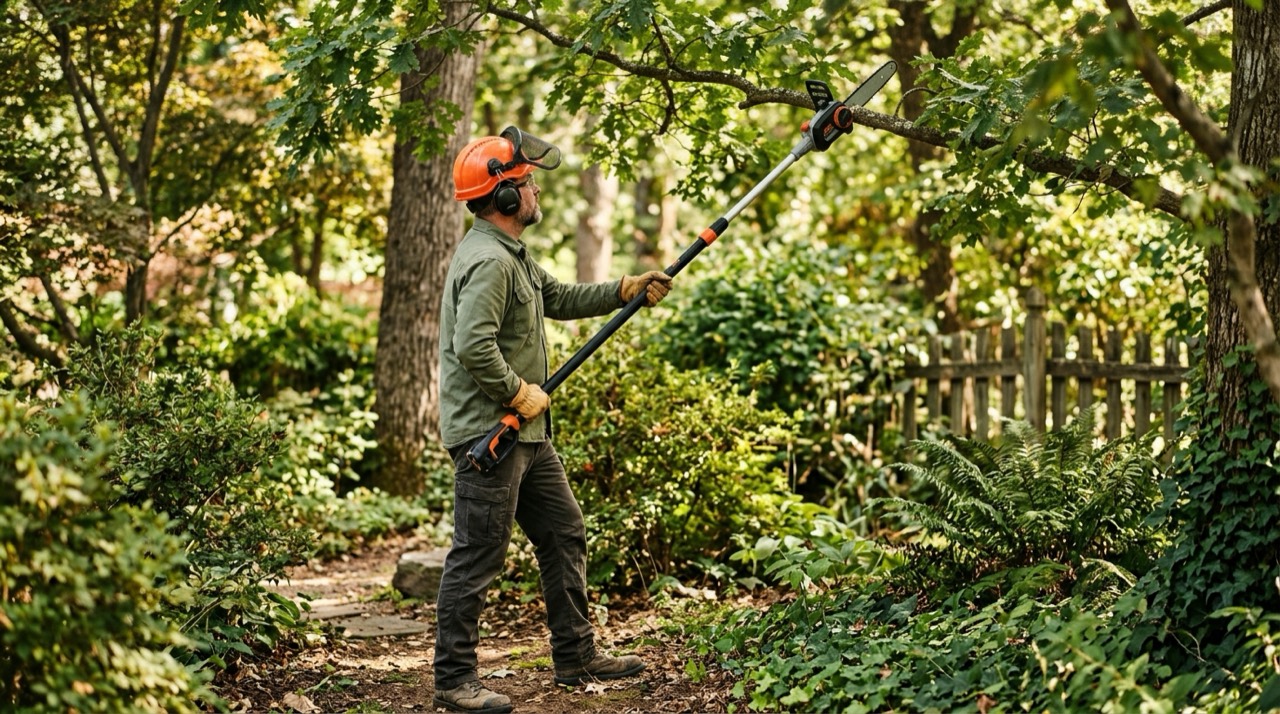
Pole saw work demands a helmet, eye and ear protection, and constant awareness of what is above you, because you are dropping wood from height while looking up. The single most serious hazard is overhead power lines: a metal or wet shaft touching a live line can be fatal, so never use a pole saw near power lines.Overhead cutting is among the most dangerous yard tasks, since limbs fall unpredictably and the saw is hard to control at full stretch. Plan an escape path, keep bystanders well clear of the drop zone, and undercut each branch slightly so it does not tear bark down the trunk. Start with a forestry helmet with a face screen and ear defenders and the rest of your chainsaw PPE. Any work near lines, over a roof, or that tempts you onto a ladder belongs to a professional arborist, and this guide is general information, not a substitute for training.
How do you make a clean pruning cut from the ground?
Make a clean pruning cut by undercutting the limb first, then finishing from the top so the branch drops without tearing bark down the trunk. Working in this order protects the tree and keeps the falling piece predictable. The sequence for an overhead limb is set out below.- Clear the area beneath the branch and plan where you will step to get out of its fall line.
- Look up and confirm there are no power lines, dead limbs, or tangled branches above your target.
- Make a shallow undercut on the underside of the limb, a short way out from the trunk, to stop the bark peeling.
- Move slightly along and make the top cut down to meet the undercut, letting the branch fall clear.
- If any stub remains, trim it back to just outside the branch collar so the wound can heal cleanly.
Never stand directly under the limb, and never try to catch a falling piece. Take a large or spring-loaded branch down in short sections from the tip inwards so no single piece can swing onto you.
What are the most common pole saw mistakes?
The most common pole saw mistakes are overreaching, cutting straight overhead, ignoring the chain, and misjudging where a limb will fall. Each turns a manageable job into a hazard, and each is avoidable. The recurring errors owners report are listed below.- Buying more reach than the job needs, then fighting a heavy, whippy pole on every cut.
- Standing directly under the branch instead of off to one side of its fall line.
- Letting bar oil run dry, which overheats and blunts the chain and can seize the bar.
- Forcing a dull chain through thick wood rather than sharpening it or reducing the limb in stages.
- Working near power lines, over a roof, or from a ladder, all of which belong to a professional.
Should you buy a dedicated pole saw or an attachment?
Buy a dedicated pole saw if pruning high branches is your main job, and a pole-saw attachment if you already own a compatible split-shaft powerhead or string trimmer system. Attachment heads share one engine or motor across several tools, which saves money and storage.Dedicated pole saws are purpose-balanced and ready to grab, while attachment systems such as split-boom combi tools trade a little balance for versatility. If you own a manual reach tool already, compare it with a powered saw in our manual pole pruner guide before upgrading. Whichever route you take, keep the chain sharp, the shaft clear of lines, and the work within what you can safely control from the ground, and see our best pole saw picks for models reviewers rate.
When should you hire a professional arborist instead?
Hire a professional arborist whenever the work sits beyond safe ground reach, near power lines, over a structure, or on a large, dead, or leaning limb. A pole saw is a homeowner tool for routine pruning, not a substitute for trained rigging and climbing. Treat the following as clear stop signs.- The branch is above about fifteen feet of cutting height, where a longer pole loses all control.
- Any wire runs near the tree, since utility clearance is the arborist's or power company's job.
- The limb overhangs a roof, fence, car, or path where an uncontrolled drop would cause damage.
- The wood is dead, split, or under obvious tension and could fail or spring unpredictably.
- You feel tempted to climb, stand on a ladder, or overreach to finish a cut.
Knowing where the tool stops is part of using it well, and handing off the rest is the experienced choice, not a failure.