

How does a pole saw shaft set your reach?
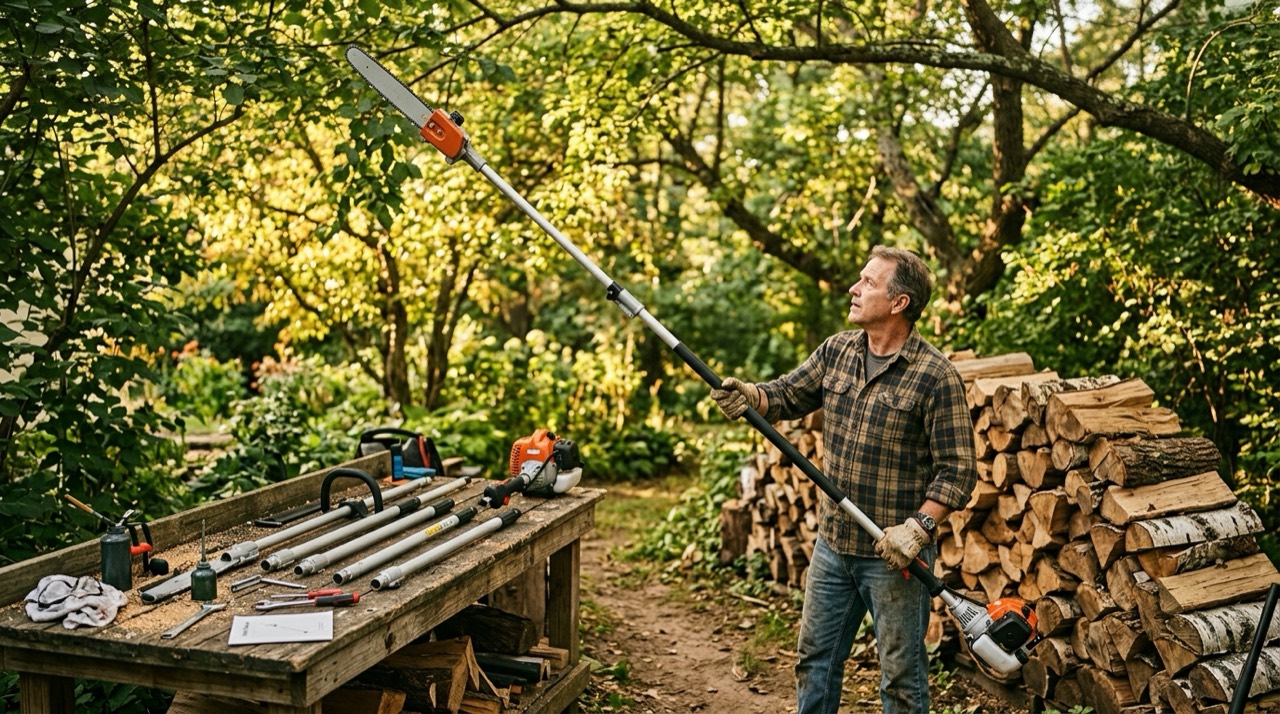
A pole saw's shaft sets its reach: a shaft of about 7 to 10 feet, plus your height and arm span, puts the cutting head roughly 10 to 15 feet up. The shaft is the part you are really buying when you shop for reach, and it shapes the tool's weight and control as much as its length.Reach is a balance, not a contest to buy the longest pole. A longer shaft touches higher wood but flexes more, weighs more, and swings the cutting head further from your control. Add the branch's own height to the shaft's reach and you can clear surprisingly high limbs from the ground; go beyond what you can hold steady, though, and the job belongs to a professional arborist with climbing or lift gear, not to a taller pole. If your limbs are small and low, a manual pole pruner may give all the reach you need without a motor.
Telescoping or fixed shaft: which should you choose?
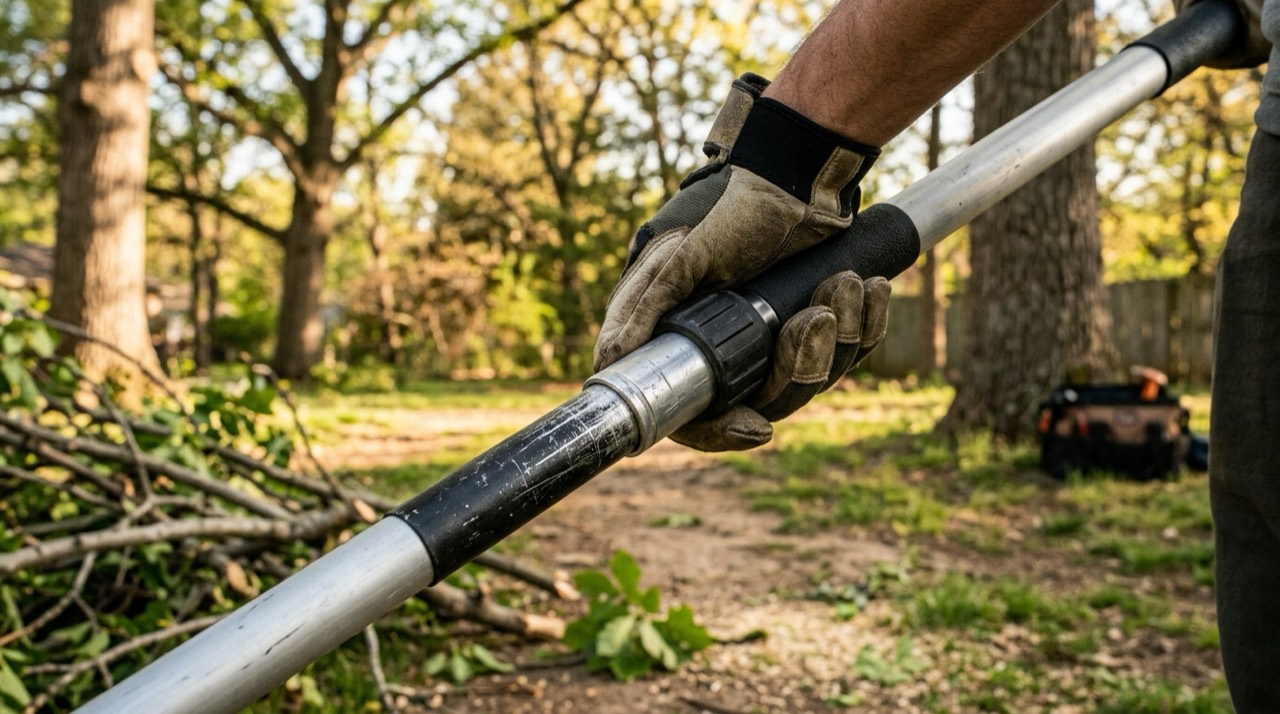
Choose a telescoping shaft if you prune trees of varying heights and want to dial in reach, and a fixed shaft if you value the lightest, stiffest tool for one job. Telescoping poles adjust and lock at several lengths, while fixed poles trade adjustability for rigidity and lower weight.Telescoping shafts are the more popular choice because one tool covers low and high branches, but the locking collars add weight and a little flex, and they need an occasional clean so grit does not seize them. Fixed shafts feel more precise at full stretch and have nothing to slip, which some owners prefer for repeated cuts at one height. The table below compares the two shaft types.
| Attribute | Telescoping shaft | Fixed shaft |
|---|---|---|
| Reach | Adjustable across a range | Set at one length |
| Weight | Heavier for the same reach | Lighter |
| Rigidity | Slight flex at the joints | Stiffest |
| Best for | Mixed pruning heights | Repeated cuts at one height |
How do you keep a telescoping shaft locking securely?
Keep a telescoping shaft locking securely by cleaning grit from the tubes, tightening the collars fully before each session, and checking for slip under light load before you raise the saw. A collar that creeps under weight is both tiring and dangerous, since the tool can suddenly extend or drop as you cut. A short pre-use routine prevents most failures.- Wipe the inner tube clean and clear any sawdust or grit from the locking collar or lever.
- Set the shaft to the length you need, then tighten the collar firmly by hand or lever.
- Press the extended saw lightly against the ground to confirm the joint holds without slipping.
- Re-check the lock after the first few cuts, since vibration can loosen a collar that felt tight.
- If a collar will not hold, stop and service or replace it rather than working with a slipping shaft.
A little silicone or dry lubricant on the threads keeps a collar turning freely without attracting grit, but avoid heavy grease that traps dust. A shaft that locks positively is one less thing to worry about while your attention is overhead.
Can you add an extension pole for more reach?
Some pole saws accept a separate extension pole or a longer replacement shaft, adding a few feet of reach, but every added foot makes the tool heavier and harder to control. Check that any extension is rated for your specific model before fitting one, since an overlong, whippy shaft is both tiring and unsafe.Extension poles make most sense on attachment systems, where a string trimmer powerhead drives a pole-saw head on a split-boom shaft you can lengthen. Even then there is a practical ceiling: past roughly 12 to 15 feet of cutting height, control and safety fall away fast, and the work is better handed to an arborist with proper climbing or lift equipment.
Does a longer shaft always mean a better pole saw?
A longer shaft does not always mean a better pole saw, because every foot of reach you add costs you weight, flex, and control. Beyond the length your trees actually need, a longer pole makes each cut harder and more tiring rather than easier. The right shaft is the shortest one that still reaches your highest limb.The physics is simple: a load held at the end of a long lever is far harder to steady than the same load closer in, so a saw head at fifteen feet demands much more from your arms than one at ten. A longer shaft also flexes more, so the cutting head wanders as you press. Buy for the tree you have, not the tallest one you can imagine, and if a genuinely tall limb appears now and then, hire it out rather than carrying a pole you fight on every ordinary cut.
What shaft materials do pole saws use?
Pole saw shafts are usually fiberglass, aluminium, or composite, and the material trades weight against stiffness and safety. Fiberglass and composite shafts are prized because they do not conduct electricity as readily as bare metal, which matters any time work strays near power lines.Aluminium shafts are light and stiff but conduct electricity, so they demand extra caution around any overhead wiring. Whatever the material, a pole saw is never safe to use near live lines, and contact with an energised conductor can be fatal, so treat every overhead wire as live and keep well clear. The safest habit is to look up and locate every wire before you raise the saw.
Are fiberglass shafts really safer near electricity?
Fiberglass and composite shafts are more resistant to conducting electricity than bare aluminium, which is why utility and arborist reach tools favour them, but no pole saw shaft is a safe insulator you can trust near live wires. A wet, dirty, or sap-coated fiberglass pole can still conduct enough current to injure or kill.The safety comes from keeping distance, not from the material. A dry, clean fiberglass shaft raises the resistance between you and a conductor, yet moisture, grime, and the metal cutting head at the top all undo that protection. Regulations and utilities set minimum approach distances to power lines for trained workers using rated equipment, and a homeowner pole saw meets none of that standard. Treat fiberglass as a small margin of forgiveness for an accidental brush, never as permission to work near lines, and hand any branch close to wiring to the power company or a qualified arborist.
How do you stay in control at full extension?
Staying in control at full extension means planting your feet, gripping the shaft with both hands, and cutting at a slight offset rather than straight overhead. A saw at 12 feet magnifies every wobble, so a stable stance and a sharp chain that cuts without force do more for control than muscle.Fatigue is the enemy of control, because tired arms let the head drift and the falling limb land where you did not plan. Work in short bursts, lower the saw to rest, and stop before your arms give out. Wear a forestry helmet and eye protection, plan an escape path, and keep bystanders clear of the drop zone. This is general guidance, not a substitute for professional training, and anything near lines or over a structure belongs to an arborist. See the full pole saw buying guide for choosing the right length.
What stance and body position keep you safe under a falling limb?
The safe stance is feet shoulder-width apart, weight balanced, and your whole body positioned to one side of the branch's fall line rather than under it. You want to be able to step back and away the instant the limb releases, never to catch or dodge it at the last second. A few positioning rules keep you clear.- Stand off to the side of the limb, so it falls into open ground you have already cleared.
- Keep both hands on the shaft and your head up, watching the cut and the branch above it.
- Plan an escape step before you start, and make sure nothing behind you will trip you.
- Keep bystanders, pets, and vehicles well outside the area where a limb could bounce or roll.
- Never work directly overhead, from a ladder, or while reaching past your balance point.
Control at reach is as much about where you stand as how you cut. A cutter who has planned the drop and their own exit turns each falling limb into a predictable event rather than a scramble.