



What is a chainsaw chain, and how is it built?
A chainsaw chain is the loop of linked steel that rides around the guide bar and does the actual cutting. It is built from four parts: cutters that slice the wood, drive links that sit in the bar groove, tie straps that join everything, and depth gauges that control the bite.The chain is the consumable heart of the saw, and no amount of engine or motor power fixes a chain that is dull, wrong-sized, or worn out. Whether you run a gas chainsaw or a cordless one, learning the four parts and the three key measurements below lets you buy the right replacement and keep it cutting cleanly. This guide sits inside our wider chainsaws hub so you can match the chain to your saw and bar.
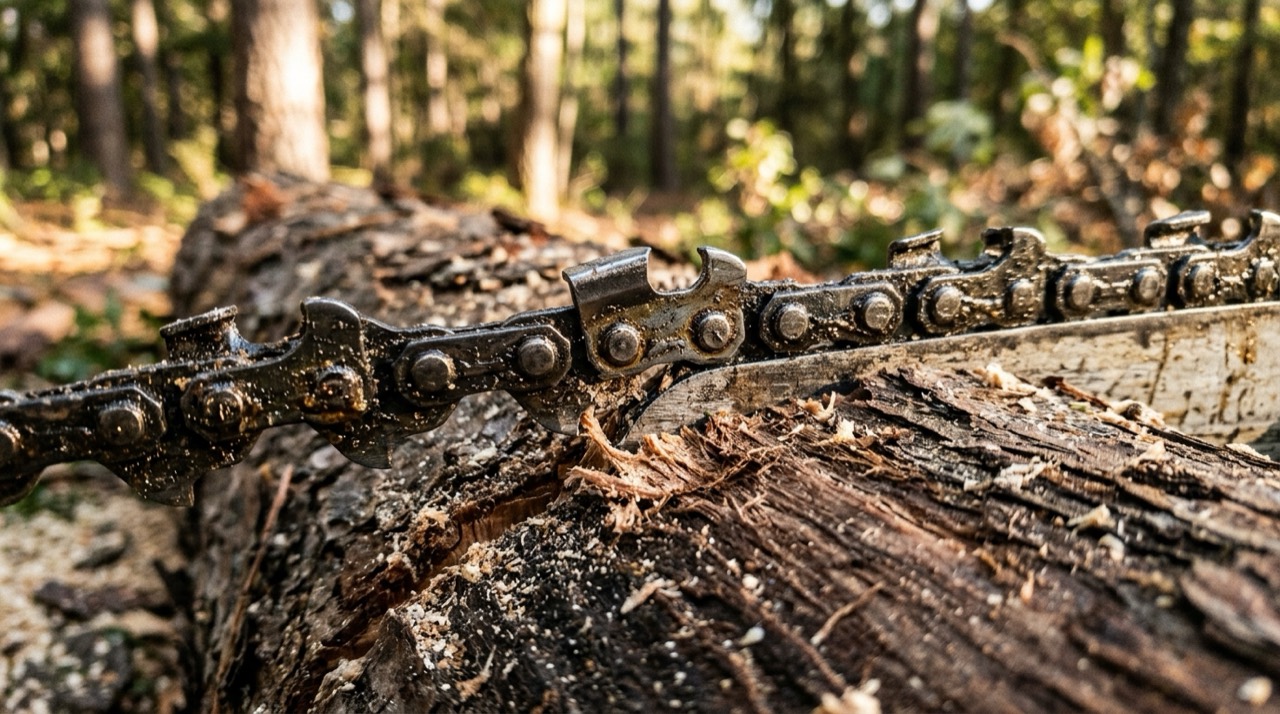
Each cutter is a small L-shaped tooth with a curved top plate and a side plate that meet at the working corner, and cutters alternate left and right around the loop so the chain carves a flat-bottomed kerf. The drive links are the pointed tabs on the underside; their tang rides in the bar groove, keeps the chain tracking straight, and their leading edge scoops oil along the bar. Tie straps are the plain outer plates riveted between cutters; on many chains they carry the anti-kickback guard links.
Which three measurements decide the chain you need?
Three numbers define every chainsaw chain: pitch, gauge, and drive-link count. Match all three and the chain fits your bar and sprocket and cuts properly; get one wrong and it will not seat or drive. These are the only figures you need to order a replacement.The three measurements, and where each one is found, are listed below.
| Measurement | What it means | Where to find it |
|---|---|---|
| Pitch | Spacing of the rivets, the chain's "size" | Stamped on the bar or a drive link |
| Gauge | Thickness of the drive link in the bar groove | Stamped on the bar |
| Drive links | Number of drive links in the loop, which sets length | Count them, or read the old box |
Bar length — 16 inch, 18 inch, 20 inch — is how saws are advertised, but it is not one of the three fitting numbers, because two bars of the same called length can take different drive-link counts. Treat bar length as a rough starting point and the three stamped-or-counted numbers as the real specification. If you remember only one rule from this guide, make it this: buy on pitch, gauge, and drive-link count, never on bar length alone.
What chainsaw chain pitch do you need?
Pitch is the distance between any three consecutive rivets divided by two, and it must match your bar and drive sprocket. The five common pitches are 1/4 inch, .325 inch, 3/8 inch low profile, 3/8 inch standard, and .404 inch, and most homeowner saws run 3/8 inch low profile.Pitch broadly tracks saw size, because bigger, more powerful saws swing larger, heavier cutters. The usual pitch classes and the saws they suit are listed below.
- 1/4 inch and 3/8 inch low profile: mini, battery, and homeowner saws with lighter cutters.
- .325 inch: mid-size gas saws in the 45 to 55cc range.
- 3/8 inch standard: professional saws built for felling and bucking.
- .404 inch: large professional saws and harvester heads.
The single most confusing point for buyers is that "3/8 low profile" and "3/8 standard" are different chains that do not interchange, even though both are called three-eighths. Low profile (sometimes marked 3/8" LP, 3/8" P, or Picco) uses a shorter, lighter cutter for smaller saws, while 3/8 standard is a taller, more aggressive professional cutter. They ride on different sprockets, so confirm which your saw uses from the bar stamp or the old chain box.
What gauge fits your guide bar?
Gauge is the thickness of the drive link where it rides in the bar groove, and it must match the bar exactly or the chain will rattle loose or jam. The four common gauges are .043, .050, .058, and .063 inch, with .050 inch the most widely used on homeowner and mid-size saws.A thinner .043 inch narrow-kerf gauge removes less wood per pass, which suits low-power battery saws, while .058 and .063 inch gauges add strength for professional work. Your bar and chain gauge must be identical, so read the stamp on the bar before you buy, and see our chainsaw bars guide for how bar and chain are matched.
Gauge is stamped in inches or millimetres — 1.1 mm equals .043, 1.3 mm equals .050, 1.5 mm equals .058, and 1.6 mm equals .063 — so if your bar shows a metric figure, convert it before ordering.
How do you count drive links to get the length?
Drive-link count sets the true length of the chain for a given bar, so you count the small tabs that ride inside the bar groove all the way around the loop. Bar length alone is not enough, because two 18-inch bars can take different drive-link counts depending on pitch.The safest way to order is to combine the pitch and gauge from the bar stamp with an exact drive-link count from the old chain. Keep the box or the wrapper your last chain came in, as it prints all three numbers, and counting every drive link on the old chain is the surest way to get the length exactly right.
To count without losing your place, lay the loop flat, mark your starting drive link with a dab of paint or a marker, and count around until you return to the mark. If you no longer have the old chain, cross-reference the bar's model number to a drive-link count in the manufacturer's chart, though a physical count is more reliable.
Which cutter type cuts best, full chisel, semi-chisel, or low-profile?
Cutter shape sets the trade-off between speed and durability. Full-chisel chains with square-cornered teeth cut fastest in clean softwood but dull quickly; semi-chisel chains with rounded teeth stay sharp far longer in dirty, frozen, or hardwood cutting; and low-profile chains prioritise smooth, low-kickback cutting for homeowners.Cutter choice should follow the wood you cut and your experience, not just top speed. The three cutter families break down as follows.
- Full chisel: fastest in clean softwood, favoured by professionals, but dulls fast in grit and is less forgiving.
- Semi-chisel: holds an edge longer in dirty or frozen wood and firewood, the safe default for most owners.
- Low-profile and micro: smoother and easier to control, standard on homeowner and battery saws.
The reason semi-chisel lasts longer is geometry: its rounded working corner has more steel behind the edge, so it tolerates the grit, bark dirt, and the occasional buried nail that instantly round over a full-chisel's fine square point.
What is chain sequence, and does full-skip matter for you?
Chain sequence describes how many tie straps sit between the cutters, and it changes how aggressively the chain feeds. Standard full-complement chain has a cutter on every available link for the smoothest finish, while semi-skip and full-skip chains space the cutters further apart for long bars and big timber.Most owners never need to think about sequence, because saws up to about 20 inches almost always run standard chain for the cleanest cut and steadiest feed. Skip-tooth chain earns its place on long bars — roughly 24 inches and up — where fewer cutters mean less drag and easier chip clearance, which is why it appears on felling saws and in chainsaw milling. The trade-off is a rougher, grabbier cut, so unless you run a long bar in large hardwood, standard full-complement chain is the better default.
Should you run a low-kickback safety chain?
Most homeowners should run a low-kickback chain, which uses ramped depth gauges or guard links to soften the sudden upward kick that causes many chainsaw injuries. These chains meet the ANSI B175.1 low-kickback standard and trade a little cutting speed for a real safety margin.Aggressive full-chisel and full-skip chains cut faster but bite harder and are best left to trained users on the right saw. Whatever chain you fit, a spinning chain is dangerous, so wear cut-retardant chainsaw chaps and PPE, keep both hands on the saw, and leave felling large or leaning trees to a professional. This guide is general information, not a substitute for hands-on training.
Kickback happens when the upper quadrant of the bar nose touches wood and the chain's rotation throws the bar back toward the operator in a fraction of a second. Low-kickback chain fights this by limiting how much each cutter can bite as it rounds the nose, and it works with the saw's chain brake, which stops the chain if your hand strikes the front handguard. The habits matter as much as the hardware: keep the nose out of any cut you cannot see, stand to the side of the bar line, and never cut above shoulder height. Eye and ear protection belong on every job — see our hearing and eye protection guide.
When should you sharpen a chain, and when should you replace it?
Sharpen a chain whenever it throws fine dust instead of chips, pulls to one side, or forces you to lean on the saw. Replace it once the cutters are filed back to the wear line, or when teeth are cracked, missing, or the chain is stretched past adjustment.A sharp chain does more for cutting speed than extra engine power ever will, and it is the cheapest performance upgrade you can make. As cutters shorten with each sharpening, the depth gauges must be lowered to match, a step covered in our chainsaw sharpening guide alongside the sharpening files and tools you will need. Cutting into soil, nails, or gravel is what ends most chains early.
The clearest replacement signal is the wear-witness line marked on the top plate of each cutter; once filing reaches it, the remaining steel is too short to hold an edge or bite safely. Other end-of-life signs are cracks at the rivet holes, a cutter that has broken off, and a chain that keeps loosening because its rivets have worn and the loop has stretched beyond the bar's adjustment range. Chains are inexpensive next to a bar or powerhead, so retiring a suspect loop is cheap insurance, and rotating between two chains while keeping the bar clean — covered in our chainsaw maintenance guide — stretches the life of both.
Why is your chain cutting crooked or dulling fast?
A chain that curves through the cut or dulls within minutes usually has a mechanical cause you can fix, not a defective loop. Uneven cutter length, unequal filing angles, a worn bar groove, or simply touching dirt are the common culprits, and each leaves a recognisable clue.The typical faults and what causes them are listed below.
- Cuts in a curve: cutters on one side are longer or sharper than the other, steering the bar; reset all cutters to the length of the shortest one.
- Dulls almost immediately: the chain touched soil, sand, or a hidden nail, or the depth gauges are too low and overheating the edge.
- Throws smoke and fine powder: the chain is dull, the oiler is starved, or tension is too tight — check oil delivery and back off the tension.
- Grabs and self-feeds roughly: depth gauges are filed too far down, giving each tooth too big a bite.
- Rattles and jumps the bar: tension is too loose or the gauge does not match the bar.
How long does a chainsaw chain last, and what does it cost to run?
A well-treated chainsaw chain lasts for years of homeowner use and many sharpenings, so the real cost of ownership is low as long as you avoid the ground.Running cost comes down to three consumables: the chain, the bar and chain oil it drinks at roughly one reservoir per tank of fuel, and the files that wear with each sharpening. The biggest single saving is learning to sharpen, because a field touch-up costs pennies and restores most of the cut speed, whereas buying a new chain every time it dulls is the most expensive way to run a saw. Keeping a spare loop on the shelf means a dulled or damaged chain never ends a job early.
Which chainsaw chain brands should you consider?
Oregon, Stihl, and Husqvarna make the chain most owners should consider, with Carlton and budget names such as Archer filling the low-cost end. Oregon supplies much of the aftermarket and offers a loop to fit nearly any saw, while Stihl and Husqvarna chains are matched to their own machines.Choosing a chain is mostly about matching the three measurements and the cutter type to your saw, not brand loyalty. Our best chainsaw chains picks rank real chains by use case, and our chainsaw brands guide compares the makers. These recommendations are based on manufacturer specifications and aggregated owner feedback, not first-hand lab testing.
Where budget chain earns its bad name is in steel quality: the cheapest loops can arrive unevenly hardened, dull faster, and stretch more, which eats any saving in extra filing and re-tensioning. A mid-tier Oregon loop in the correct size is the reliable default for most owners, while OEM Stihl or Husqvarna chain buys a guaranteed match and dealer support.