



What sharpens a chainsaw chain, and which method should you use?
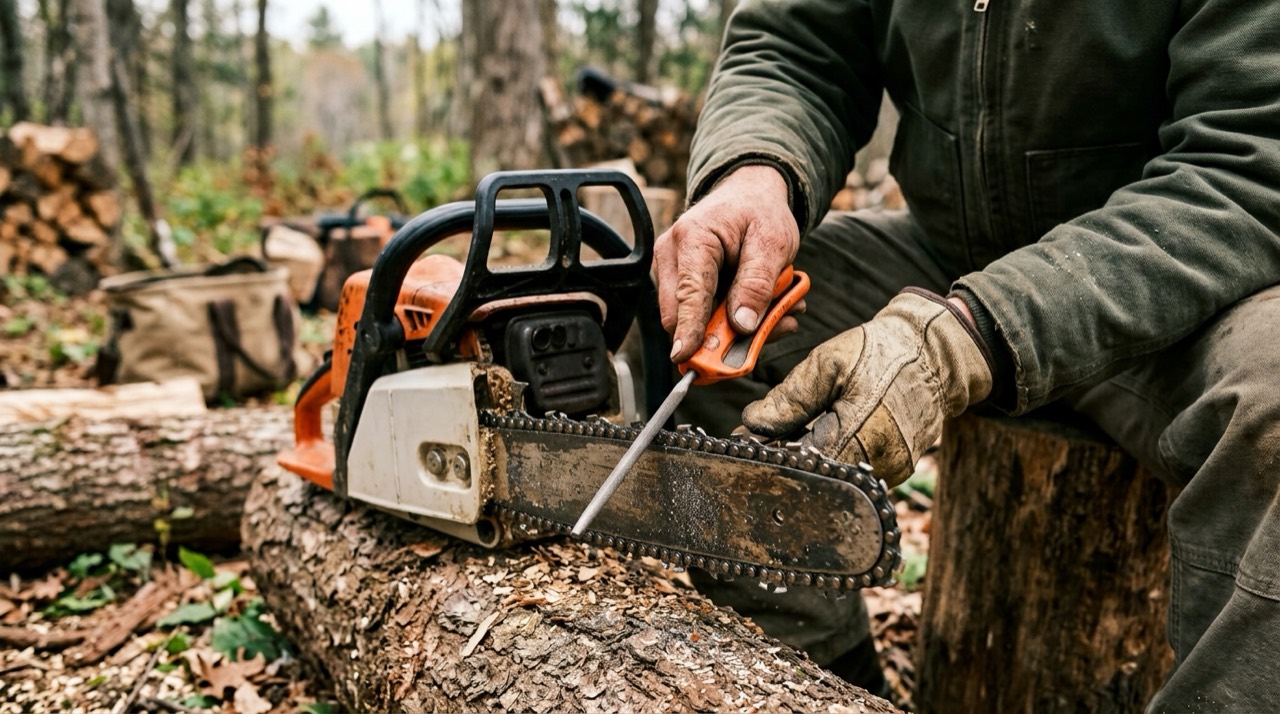
A chainsaw chain is sharpened by filing or grinding the small cutting teeth back to a keen edge, using a hand round file with a guide, a 2-in-1 file tool, a bar-mounted filing jig, a handheld rotary tool, or a bench-mounted electric grinder. The right method depends on how much you cut and how precise you want each tooth.Hand files are cheap, portable, and gentle on the chain, removing the least metal so the chain lasts longer. Powered grinders and rotary tools are faster and more consistent across many chains or badly damaged edges, but they remove more metal and can overheat a tooth if rushed. This guide sits inside our wider chainsaws hub; to jump straight to product recommendations, see our best chainsaw sharpener picks, and for the files, guides, and stones themselves, our sharpening files and tools guide.
How do you know when your chainsaw chain is dull?
A dull chainsaw chain makes fine sawdust instead of coarse chips, pulls to one side, needs you to push hard, smokes even with fresh bar oil, and rattles or skips rather than biting into the wood. A sharp chain self-feeds and throws square-edged chips the size of matchsticks.Look at the cutters too: sharp edges catch the light as a fine line, while dull ones show a rounded, shiny bevel. The fastest way to ruin a chain is to touch dirt, a buried nail, or a rock, which blunts every tooth in a single pass. When you notice any of these signs, stop and sharpen rather than forcing an edge that is already gone.
What tools do you need to sharpen a chainsaw chain?
A basic hand-sharpening kit is a round file sized to your chain's pitch, a flat file and depth-gauge tool for the rakers, a file guide or 2-in-1 holder to fix the angle, and cut-resistant gloves. A few extras make the job faster and more consistent.The tools worth keeping in a sharpening kit are listed below.
- Round file: sized to your chain pitch, from 5/32 to 7/32 inch, the tool that shapes the cutting edge.
- Flat file: pairs with a depth-gauge tool to lower the rakers.
- Depth-gauge tool: sets how far each depth gauge sits below the cutter.
- File guide or 2-in-1 holder: holds the round file at the correct height and top-plate angle.
- Filing vise or stump vise: clamps the bar so the chain cannot move while you file.
- Marker or paint pen: marks your starting cutter so you know when you have gone all the way around.
- Cut-resistant gloves: protect your hands from teeth that stay sharp even when they cut poorly.
Files wear out, so keep a spare; a glazed or worn file skates over the steel instead of cutting it. The full range of files, guides, and stones is covered in our sharpening files and tools guide.
What size file does your chainsaw chain need?
File diameter must match your chain's pitch, because a file that is too big or too small grinds the wrong hook into the tooth and cuts poorly. Most chains use one of a few round file sizes, from 5/32 inch on small chains to 7/32 inch on large 3/8-inch and .404-inch chains.Pitch is the distance between rivets and is usually stamped on the drive links or printed on the chain's box. The common pitch-to-file pairings are listed in the table below, but always confirm against your chain manufacturer's chart, as some 3/8-inch chains specify a 13/64-inch (5.2 mm) file instead.
| Chain pitch | Round file diameter |
|---|---|
| 1/4 inch | 5/32 in (4.0 mm) |
| 3/8 inch low-profile (Picco) | 5/32 in (4.0 mm) |
| .325 inch | 3/16 in (4.8 mm) |
| 3/8 inch standard | 7/32 in (5.5 mm) |
| .404 inch | 7/32 in (5.5 mm) |
If you are unsure which chain you run, our chainsaw chains guide explains how to read pitch and gauge markings before you buy a file.
Which parts of the cutter do you actually sharpen?
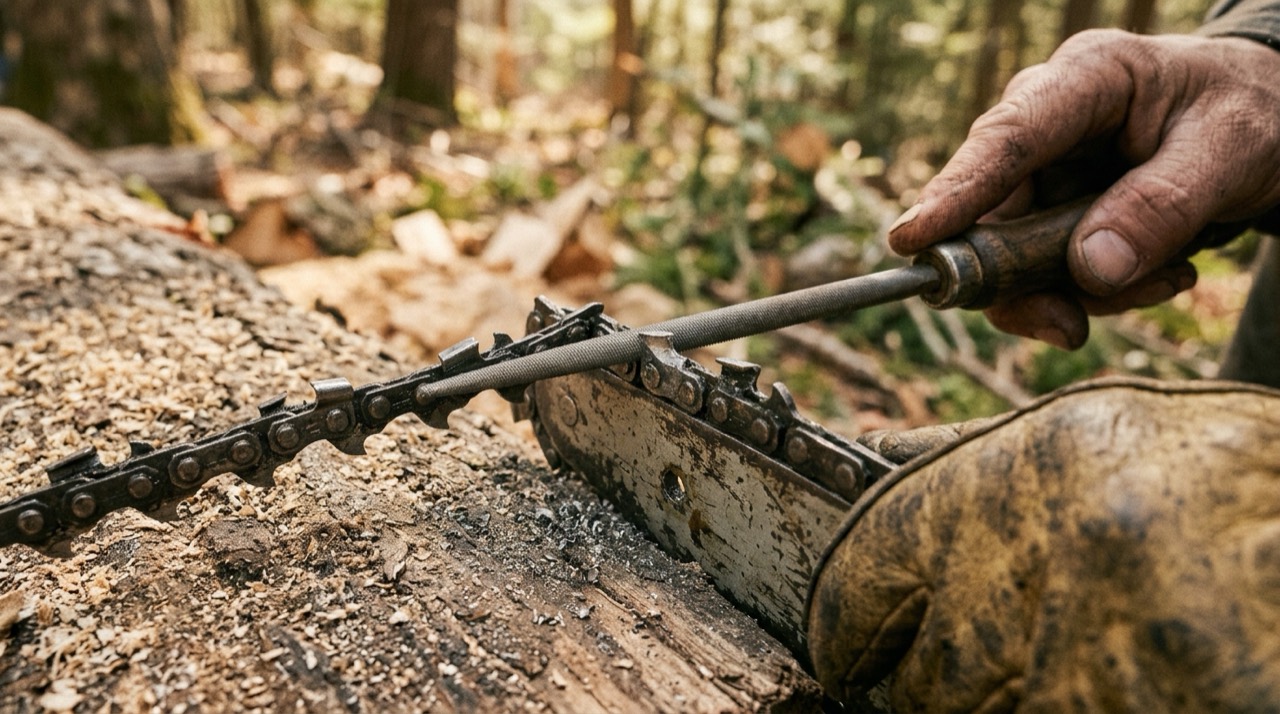
Each cutter has three parts you work on: a curved top plate, a side plate, and a depth gauge (the small fin, also called a raker, in front of the tooth). Filing the top and side plate restores the cutting edge and angle, while the depth gauge is lowered separately to control how deep each tooth bites.The three things you set on every cutter are listed below.
- Top-plate angle: usually about 30 degrees for general crosscutting, dropping to around 25 degrees for ripping or hard, frozen wood.
- File height and side-plate angle: hold the file level and let it seat naturally in the tooth so it shapes the side plate at the same time.
- Depth gauge: file it down to roughly 0.025 inch (0.65 mm) below the top plate, using a depth-gauge tool and a flat file, and only every few sharpenings.
Use the same number of file strokes on every tooth to keep the cutters even, and sharpen all the cutters facing one way before flipping the saw to do the rest.
How do you set up a chainsaw for sharpening?
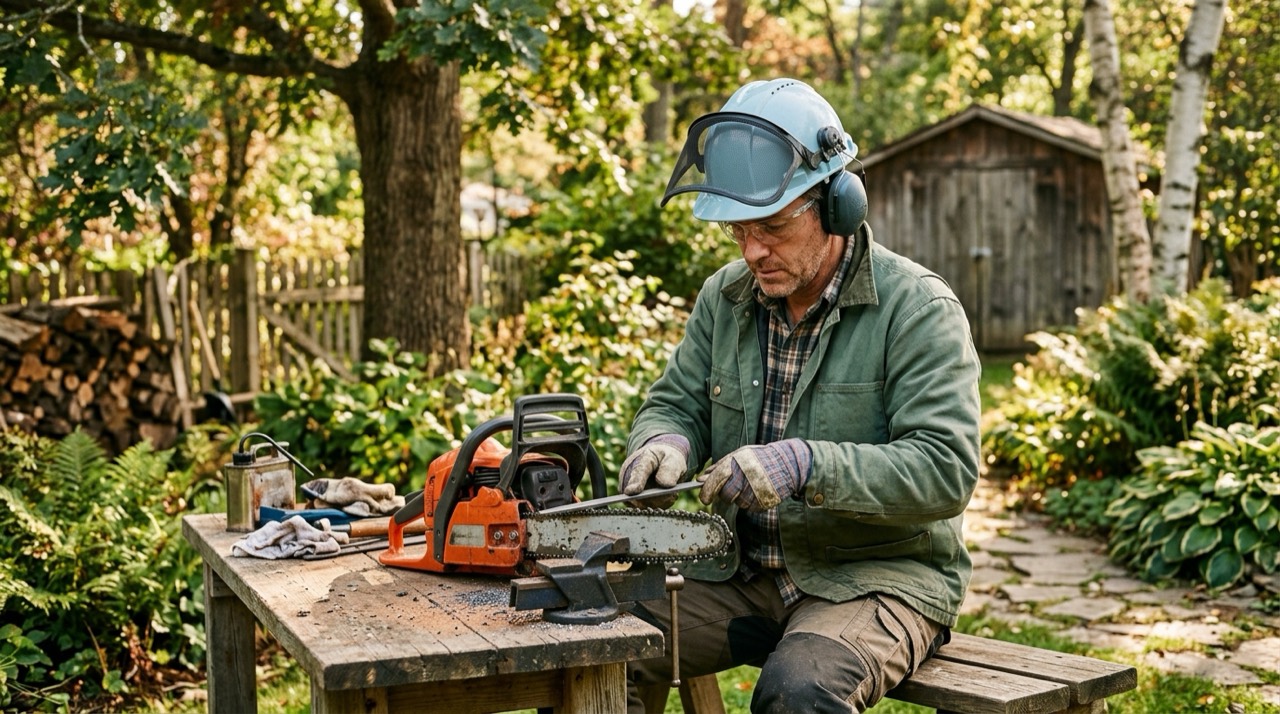
Set up by powering the saw down, immobilising the chain, and cleaning the cutters so you can see the edge before the file touches steel. A stable, well-lit bench and a clamped bar make every stroke more consistent than filing a saw balanced on your knee.Work through the setup in order.
- Stop the engine and let it cool, remove the battery, or pull the spark-plug boot so the saw cannot start.
- Engage the chain brake, then clamp the bar in a filing vise or wedge it firmly against a solid surface.
- Brush sawdust, oil, and grit off the chain so you can read the cutters and the witness marks.
- Check chain tension and adjust it so the chain sits snug in the bar groove but still pulls freely by hand.
- Find a cutter with an obvious flat or damage, start there, and mark it with a paint pen.
- Confirm your file size against the chain pitch before the first stroke.
A clean, correctly tensioned chain is easier to file evenly, and adjusting tension is part of the routine upkeep covered in our chainsaw maintenance guide.
What are the most common chainsaw sharpening mistakes?
The most common sharpening mistakes are using the wrong file size, letting the top-plate angle drift between teeth, filing the cutters to uneven lengths, and forgetting the depth gauges. Each one leaves the chain cutting slowly, crookedly, or roughly even though the teeth look sharp.The errors that most often spoil a sharpening job are listed below.
- Wrong file diameter: a file too small hooks the edge and grabs, while one too large leaves a blunt, weak edge.
- Inconsistent angle: an angle that wanders makes some teeth cut more than others.
- Uneven cutter length: taking more strokes on some teeth than others makes the saw pull to one side.
- Ignoring the depth gauges: cutters can be razor-sharp yet barely bite if the rakers are never lowered.
- Pressing on the return stroke: a round file only cuts on the push, so dragging it back dulls the file.
- Filing a dirty or loose chain: grit blunts the file and a slack chain moves under it.
Counting strokes and using a guide fixes most of these; the depth-gauge step is the one owners forget most, so check it every few sharpenings.
Why does a chainsaw cut crooked even after sharpening?
A chainsaw cuts crooked when the cutters on one side are sharper, longer, or set to a different angle than the other, so that side removes more wood and steers the bar. Uneven filing is the usual cause, though a worn bar or damaged cutters can do the same.To straighten a curved cut, compare the two sides of the chain. If the cutters on one side are longer, file that side back to match the shorter side, then use equal strokes on every tooth from then on. Check the depth gauges are even too, since a raker filed lower on one side lets those cutters bite deeper. If the teeth are even and the saw still wanders, the fault may be a worn or pinched bar rather than the chain, which our chainsaw bars guide covers, or a stretched chain nearing the end of its life, explained in our chainsaw chains guide.
Should you use a hand file or an electric sharpener?
Choose a hand file for cheap, portable, chain-friendly touch-ups, and an electric sharpener for speed, consistency, or reshaping chains that have hit rock or dirt. Hand filing removes the least metal, so a chain sharpened by file lasts through more sharpenings than one repeatedly ground on a machine.Electric bench grinders and rotary tools shine when you have many chains to do, a badly damaged edge to rebuild, or you struggle to hold a steady angle by hand. Their weakness is heat: grinding too hard bluish-burns the cutter and softens the steel, which shortens its life. For most owners, a 2-in-1 hand file for the field plus an occasional machine grind for damage is the practical combination. Our best chainsaw sharpener picks cover both paths.
How often should you sharpen, and when do you replace the chain?
Sharpen a chainsaw chain roughly every time you refuel, and immediately after the chain touches dirt, rock, or metal, because frequent light touch-ups beat rare heavy grinding. Replace the chain once the cutters have been filed back to the wear line stamped on each tooth, or when it will no longer hold tension.A chain also stretches with use, so check tension often and keep the bar groove clean, since a worn chainsaw bar makes even a sharp chain cut crooked. Sharpening is only one part of keeping a saw cutting well; our chainsaw maintenance guide covers tension, oiling, and cleaning, and the chainsaw chains guide explains when a chain is truly worn out.
What safety steps does sharpening a chainsaw require?
Before sharpening, stop the engine, remove the battery or pull the spark-plug boot, engage the chain brake or clamp the bar in a vise, and wear cut-resistant gloves, because the teeth stay razor-sharp even on a chain that cuts poorly. Sharpen on a stable surface, never with the saw running or the chain able to move freely.Good gloves prevent most sharpening injuries, so start with proper work gloves, and keep your full chainsaw chaps and PPE on hand for the cutting that follows. This guide is general information, not a substitute for hands-on training, and demanding jobs such as felling large or leaning trees and any work near power lines belong to a trained professional.