
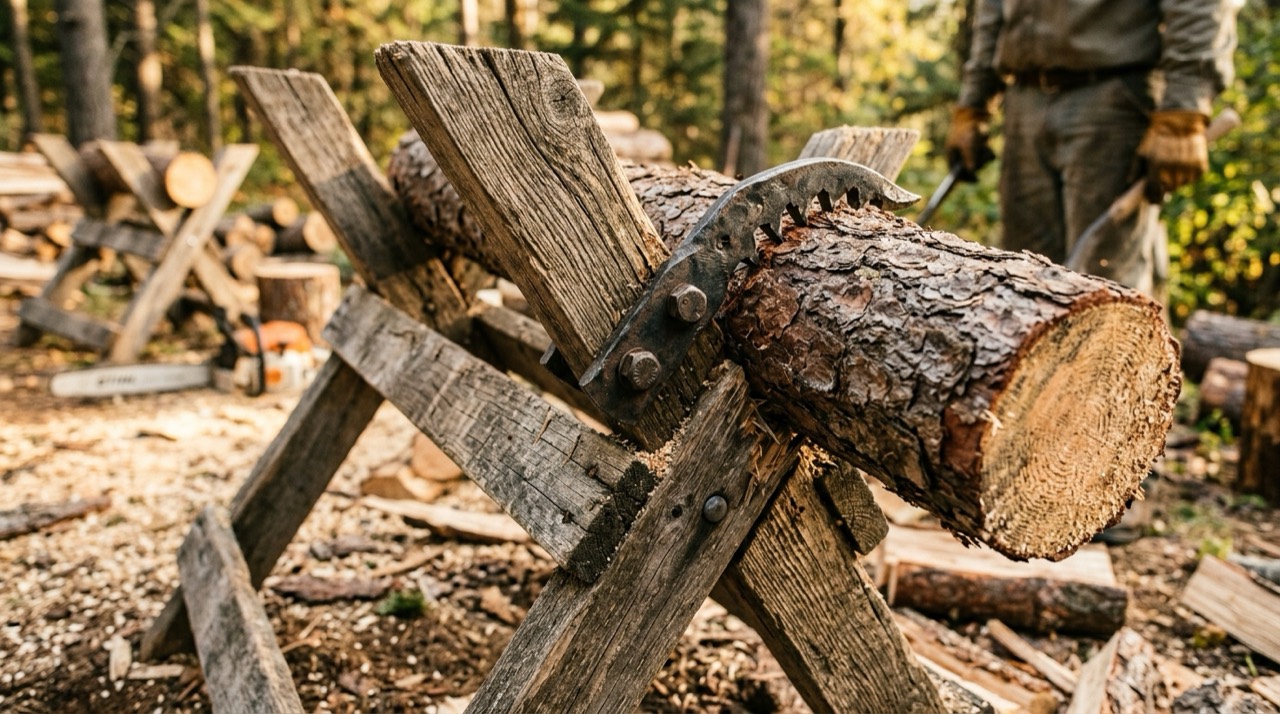


How does a log holder make chainsaw cutting safer?
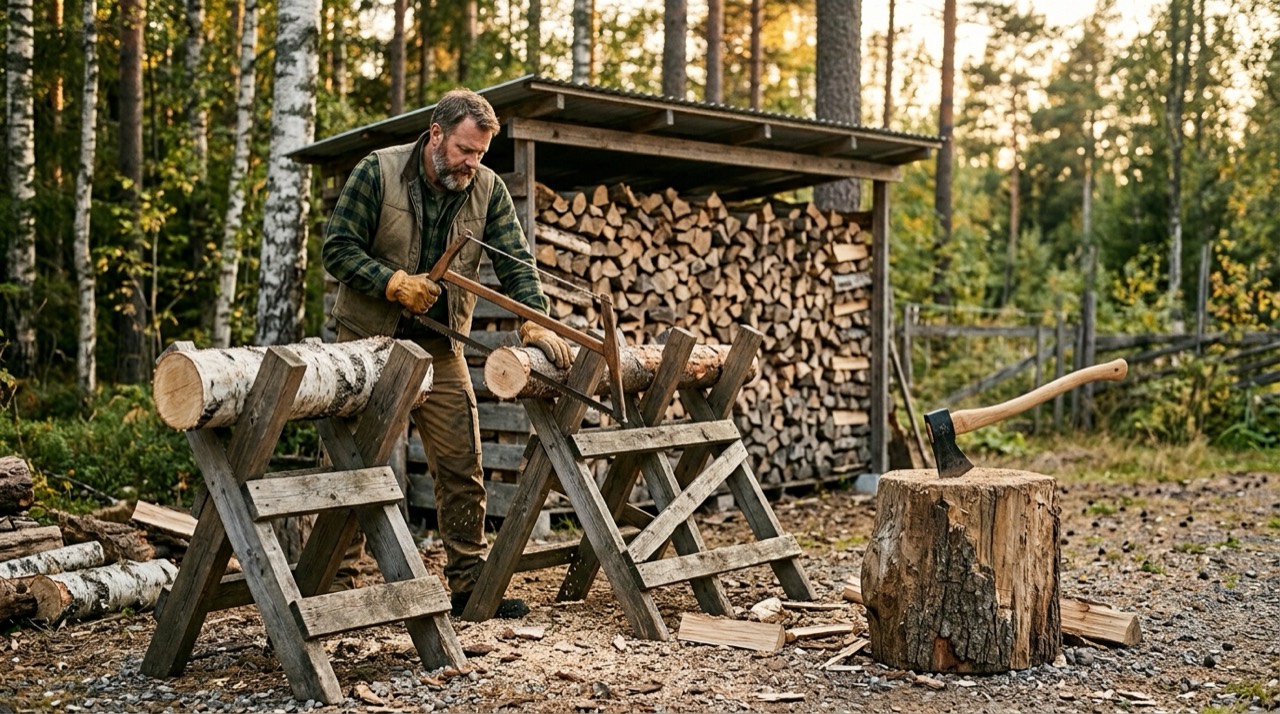
A log holder makes chainsaw cutting safer by locking the wood still and lifting it off the ground, which removes the two biggest hazards in bucking: a log that rolls into the bar, and a bar tip that touches dirt and snatches. A steady log means a predictable cut.
With the wood held firm at hip height, you cut standing upright, both hands on the saw, watching the bar instead of fighting the log. The holder also keeps the cut-off end where it will fall clear of your legs. Raising the wood also means you cut with a straight back instead of stooping, so fatigue — another cause of mistakes — sets in far more slowly. None of this replaces training or good technique — a holder is a stable base, not a safety guarantee — but starting from a locked, raised log removes most of what goes wrong when people cut firewood on the ground. For the frames that do this best, see our best chainsaw sawhorse picks.
What is bucking, and how does it differ from felling and limbing?
Bucking is cutting a felled log into shorter lengths — for firewood, into stove-length rounds — and it is the stage where a log holder does its work. It differs from felling, which drops a standing tree, and limbing, which strips the branches off a downed one.
The distinction matters because the three jobs carry very different risks. Felling deals with a whole standing tree under its own weight and wind load, and limbing deals with springy branches that can whip or hide tension; both demand training and are where the most serious chainsaw injuries happen. Bucking is comparatively controlled — the log is already down and cut to a manageable length — which is exactly why a holder helps so much: it takes an already-simpler job and removes its remaining hazards by locking the wood and lifting it off the ground. A holder is a bucking tool, not a felling aid. It assumes you are working on logs that have already been safely dropped and limbed, whether by you with the right training or by someone else. Keep the tasks separate in your mind and match the tool to the stage you are actually at.
Where should you stand and cut on a log holder?
Stand to the side of the saw's cutting line, never directly behind the bar, with your weight balanced and both feet planted. Load the log so the section you are cutting overhangs the frame, and make the cut on that overhanging end so the offcut drops away from you.
Position matters as much as the tool. Keep the log's cut line just past the cradle or jaw so the wood is supported right up to the cut, then falls free once through. Work from a stance where you could step back easily. Cut the pieces from the outside end inward, re-securing the log as it shortens. Keep your face and shoulders out of line with the bar in case of kickback, and keep bystanders and pets well outside the working area.
How do you make the first cut on a loaded log?
Make the first cut on the overhanging end of a locked log, starting the saw at full chain speed and entering with the lower part of the bar, not the tip. The first cut sets the rhythm for the whole log, so make it deliberately.
- Confirm the log is locked in the cradle, grab, or clamp and cannot roll.
- Check the cut-off end overhangs the frame so the offcut will fall clear.
- Plant your feet, take a balanced stance to the side of the bar line, and grip with both hands.
- Bring the saw to full throttle before the chain touches the wood.
- Enter the cut with the underside of the bar near the body, keeping the nose clear.
- Let the sharp chain pull itself down through the wood — guide it, do not force it.
If the saw bogs or the log so much as twists, stop, reset the log, and start again. A clean first cut, made on supported wood that drops away freely, tells you the holder is loaded correctly for the cuts that follow.
How do you avoid kickback when bucking on a sawhorse?
Avoid kickback by keeping the upper tip of the bar — the kickback zone — out of the wood and starting each cut at full chain speed. Kickback happens when the tip's top quarter contacts wood or the chain pinches, throwing the bar up and back toward you.
The steps below reduce kickback risk when bucking on a sawhorse.
- Start the saw at full throttle before the chain touches the log.
- Enter the cut with the lower part of the bar, not the tip.
- Keep the log locked so it cannot shift onto the bar.
- Maintain a firm grip with your thumb wrapped around the front handle.
- Keep the chain sharp and correctly tensioned, because a dull chain grabs.
A well-maintained saw with a working chain brake is your last line of defence; keep both in order with regular chainsaw maintenance.
How do you stop the bar pinching mid-cut?
Stop the bar pinching by supporting the log so the cut opens rather than closes as you go through it. On a holder, load the log so the cut-off end overhangs and drops away, keeping the kerf open around the bar.
Pinching happens when the wood's weight closes the cut and traps the bar — common when a log is supported at both ends and cut in the middle. On a sawhorse, always cut on the overhanging end, not between two supports. If the saw does begin to bind, stop, switch off, and free the bar with a wedge or by lifting the offcut rather than forcing the cut. Reading how the wood is loaded — where it is supported and which way it will fall — is the core skill of safe bucking, and a good holder makes that reading easy.
How do you buck a long log into several stove-length rounds?
Buck a long log by working from the free, overhanging end toward the frame, cutting one round at a time and re-securing the log as it shortens. Cutting in the right sequence keeps every cut supported and the kerf open.
- Load the log with the far end overhanging and the bulk resting in the cradle.
- Mark or eye your stove length and cut the first round off the overhanging end.
- Slide or roll the log along so the next cut line overhangs the frame.
- Re-lock the grab or chain, because a shorter log sits and balances differently.
- Repeat, cutting each round off the overhanging end so the offcut always drops clear.
- Stop before the remnant is too short to hold safely, and split or set that piece aside.
Never try to speed the job by cutting between two supports to save moving the log — that is the classic route to a pinched bar. Moving the log a few inches between cuts is quicker than freeing a trapped saw, and far safer. A holder with a firm grab makes each reset a moment's work rather than a chore.
What goes wrong when bucking firewood, and how do you avoid it?
Most bucking problems trace back to a moving log, a closing cut, or a dull chain. The table below pairs the common failures with what causes them and how a holder and good technique prevent them.
| What goes wrong | Why it happens | How to avoid it |
|---|---|---|
| Bar pinches and jams | Cut made between two supports so the kerf closes | Cut on the overhanging end so the offcut drops clear |
| Log rolls into the bar | Wood rested loose without a grab or strap | Lock the chain, grab, or clamp before cutting |
| Kickback lurch | Bar tip contacts wood or the chain binds | Enter with the lower bar at full speed, keep the nose clear |
| Chain goes blunt fast | Bar tip touches soil or grit on the last pass | Raise the log and keep the tip clear of the ground |
| Frame tips or walks | Holder set on soft or sloping ground | Set up on firm, level footing and re-check it |
None of these is mysterious, and every one is designed out by a stable holder used correctly. Keep the log locked, the cut overhanging, the chain sharp, and the frame steady, and bucking becomes a routine, repeatable job rather than a fight with the wood.
What PPE should you wear when cutting on a log holder?
Wear the full chainsaw PPE set every time you cut, no matter how small the log: a helmet with face screen, ear defenders, cut-resistant chaps or trousers, gloves, and sturdy boots. A log holder steadies the wood, but the saw is just as dangerous over a sawhorse as anywhere else.
Chaps and helmet-mounted protection matter most because bucking puts the bar close to your legs and face. Snug clothing, no dangling cords or loose sleeves, and solid footing round out the picture. Our chainsaw chaps and PPE guide covers what to look for. And know your limits — a holder is for logs you have already felled and limbed; dropping standing, leaning, or storm-damaged trees is skilled, high-risk work best left to a professional.
When should you stop bucking and call a professional?
Stop and call a trained professional when a log is under tension, part of a tangled or wind-thrown pile, or so large that no holder can steady it. A sawhorse is for clean, felled, limbed logs — not for the risky cases that need an expert's judgement.
Tension wood is the clearest warning. A log pinned under others, bent across a slope, or held by a root ball can spring violently the moment the fibres part, in a direction that is hard to predict. Spring poles — bent saplings under load — are notorious for this, and storm-damaged or leaning timber hides similar forces. If you cannot see clearly how a log is supported and which way it and its offcut will move, that uncertainty is itself the signal to stop. There is no holder that makes tension wood safe. Leave felling, storm clearance, and any log you are not confident you can control to a professional with the right chainsaw and the training to read it. Knowing the limit of what a sawhorse is for — steady bucking of already-safe logs — is part of using one well.