



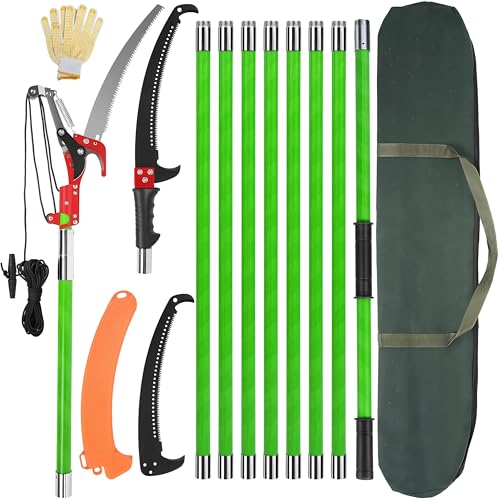
How high can a manual pole pruner actually reach?
A manual pole pruner reaches a cutting height of about 25 to 27 feet at the very top of the range, using a pole around 20 to 21 feet long plus your standing arm reach. Most homeowner models top out far lower — 16 to 18 feet of working height from a 12-to-16-foot pole — so hitting the mid-20s takes a dedicated long-reach saw or a sectional pole system built for it.Reach is simple arithmetic: pole length plus roughly 5 feet of raised-arm reach. A 21-foot telescoping saw therefore puts a cut around 26 feet up; a 30-foot extension pole can go higher still, though control drops sharply. Manufacturers muddy this by quoting either the pole length or the finished cut height as “reach”, so always confirm which figure you are reading before you buy.
How do you calculate the reach you need for a tall tree?
Estimate the height of your target branch, subtract your own standing arm reach of about 5 feet, and buy a pole that matches the difference — no longer. Guessing high wastes money and control; measuring first tells you exactly which model clears your trees.Measuring a branch height without climbing is easier than it sounds. Stand a known object — a 6-foot person, an 8-foot fence panel — beside the trunk and photograph it, then count how many object-heights reach the branch. A branch that sits about four times the height of a 6-foot helper is roughly 24 feet up, so a cut there needs about 19 feet of pole once you add your raised-arm reach.
Work from your tallest routine branch, not the single highest twig you might ever touch. If most of your cuts are at 18 feet and one branch is at 26, size the pole for 18 and leave the outlier to a professional — carrying a 21-foot pole for one branch makes every other cut harder. Remember, too, that reach quoted by makers may mean pole length or finished cut height; confirm which before you match it to your measurement, using the reach math in our manual pole pruner guide.
Telescoping poles or add-on sections for maximum reach?
Choose telescoping poles for fast, tool-free height changes and add-on sections when you need rigidity and reliability at full extension. Telescoping poles slide out and lock with collars, so you can drop from 20 feet to 8 feet in seconds; the trade-off is more flex and more locks that can slip under load. Sectional systems, favored by arborists, bolt fixed lengths together for a stiffer pole that holds a blade steady far overhead.For a homeowner pruning tall trees a few times a year, a telescoping saw is the convenient choice. For someone adding reach to a professional rope-and-pulley pruner setup, fiberglass extension sections give better control and last longer, at the cost of quick adjustment.
Which long-reach manual pruners hit 20 feet and beyond?
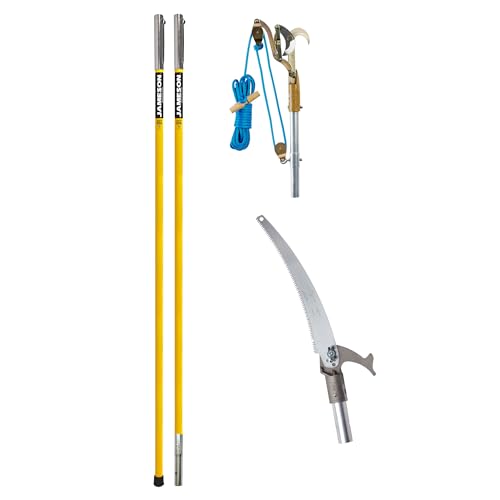
Three routes get a manual tool past 20 feet: a long telescoping saw, a sectional fiberglass system, or an extreme-reach extension pole. Each suits a different buyer, and the table names a representative model for each.| Route to 20 ft+ | Example | Cutting head | Note |
|---|---|---|---|
| Telescoping pole saw | Silky Hayauchi 179-39 | Pull-stroke saw only | ~21 ft pole; superb cut speed |
| Sectional fiberglass | Jameson FG package + sections | Rope pruner + tri-cut saw | Add lengths for reach; pro-grade |
| Extreme-reach pole | DocaPole 7–30 ft | Saw + pruner attachments | Up to ~30 ft; very flexible |
The Silky is the fastest cutter of the three but offers no rope pruner for small green cuts. The Jameson keeps both heads and the most control. The DocaPole reaches highest and costs least, but it is the hardest to aim at full height.
Why does a long pole flex, and how do you manage it?
A long pole flexes because leverage works against you: the further the head is from your hands, the more a small movement or the blade’s bite is amplified into a whipping tip. Manage it with a stiffer pole, a lighter head, and short, controlled strokes.Flex has three causes you can influence. Pole material comes first — fiberglass and sectional systems resist bending far better than a thin telescoping aluminium or composite pole at full extension. Extension length is next: a pole run out to its last collar flexes most, so if a shorter setting reaches the branch, use it. Head weight is the third — a heavy dual head at the end of a long lever wags more than a light saw blade.
Technique tames the rest. Brace the butt of the pole against your hip or stomach for a third point of contact, spread both hands well apart along the shaft for leverage, and cut in short strokes rather than long sweeps that set the tip swinging. Let the saw’s own weight start each pull. If the tip whips so much that you cannot keep the blade in the kerf, the pole is over-extended for that branch, and no amount of grip will fix it — shorten up or step back.
How do you stay steady and accurate at full extension?
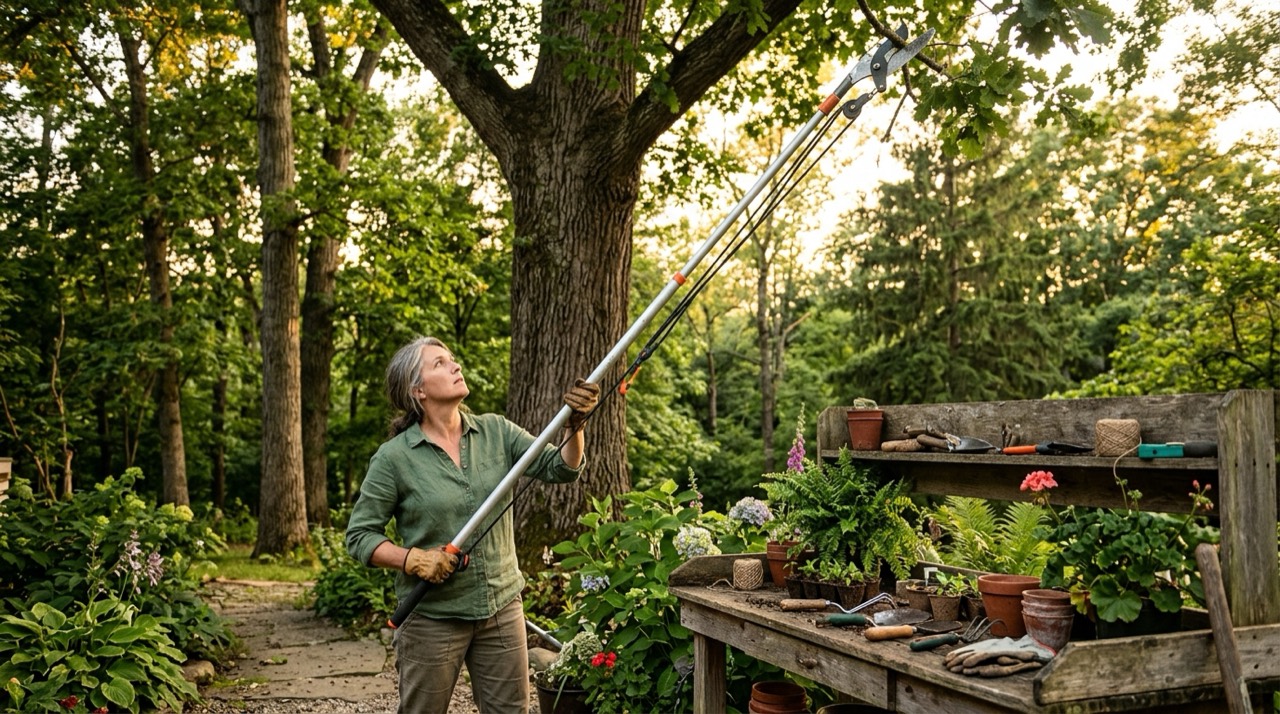
Brace the pole against your body, spread both hands along it, and cut in short strokes to control the flexing tip. At 20-plus feet even a stiff pole whips with every stroke, so plant your feet, tuck the pole butt into your hip or stomach for a third contact point, and let the saw’s own weight start each pull. Rest often — overhead work at full extension tires shoulders and neck fast, and a tired cut is an inaccurate one.Positioning matters as much as grip. Stand where a falling limb cannot reach you, clear a drop zone below, and never work directly beneath the cut. If you cannot place the blade accurately or the pole is too heavy to hold steady, the branch is beyond safe manual reach.
What extra gear and preparation help with high manual pruning?
Beyond the pole itself, high manual pruning is safer with a hard hat, wrap-around eye protection, gloves, and a cleared drop zone marked out before the first cut. None of it is optional once you are dropping limbs from 20 feet.- A hard hat is the single most important item. A limb falling from 25 feet carries real force and rarely drops straight, so a helmet and face shield protect your head and face from a branch that swings back.
- Wrap-around eye protection keeps falling bark, sawdust, and twigs out of your eyes while you look straight up into the cut.
- Work gloves improve grip on a long pole and protect your hands from the rope and rough bark.
- A cleared, marked drop zone matters more the higher you cut. Rake the ground clear, move anything a limb could damage, and keep children, pets, and bystanders well outside the fall path.
Preparation also means timing and light. Prune tall trees on a still day — even a light wind swings both the pole and the falling limb — and with the sun behind you so you can see the cut clearly rather than squinting into glare.
When does a tall-tree job exceed a manual pole pruner?
A tall-tree job exceeds a manual pole pruner when the branch is thicker than the saw can clear in a few minutes, higher than you can hold the pole steady, under tension, or anywhere near a power line. At that point the safe move is a professional, not a longer pole.Height is the first limit. Once a pole passes 20 feet it flexes and tires you so much that accuracy collapses; a cut you cannot place precisely is a cut you should not make. Diameter is the second: a limb that takes ten exhausting minutes with a manual blade overhead is past the point where a powered pole saw — or a professional — is the sensible choice. Tension is the third and most dangerous: a limb that is lodged, leaning, or bent under its own weight can spring violently when cut.
A certified arborist brings rope-and-harness access, insulated tools, and training that ground-based pruning cannot match. Large, tall, or storm-damaged trees, and anything overhanging a house or a line, are their work, not a homeowner’s. Knowing where a manual tool stops is not a failure — it is the difference between a tidy tree and a trip to hospital.
How do you transport and store a long pole system?
Store a long pole system collapsed, dry, and secured so the sections cannot slide and the blade cannot catch anyone. A 20-foot pole is awkward and, with an exposed saw blade, genuinely hazardous to carry carelessly.Retract every telescoping section and lock it, or break a sectional pole down into its component lengths, then wipe the metal parts to keep rust out of the collars and blade. Sheath or retract the saw teeth. Hang the pole horizontally on wall brackets or stand it upright in a corner of a dry shed, well out of a doorway. For transport, collapse it fully, cover the blade, and lash it down so it cannot roll or slide — the principles in our outdoor tool storage guide apply doubly to something this long and this sharp.
What are the dangers of high overhead cutting?
Overhead pole work carries three main dangers: contact with power lines, falling limbs, and operator fatigue. Power lines are the deadliest — never bring any pole within 10 feet of a line, as wet or dirty fiberglass can conduct, and leave line-adjacent branches to the utility. Falling limbs are unpredictable from 25 feet up, so a hard hat and eye protection are non-negotiable.Fatigue is the quiet risk. Holding a 20-foot pole overhead strains the shoulders and lower back, and accuracy fades quickly, raising the odds of a slip. Large, tall, or leaning trees, and anything near structures or lines, are a job for a certified arborist with rope-and-harness access rather than a ground-based pole. For repeated heavy high cuts a powered pole saw reduces the effort but not the danger — know when the safe move is to call a professional.