


What are loppers?
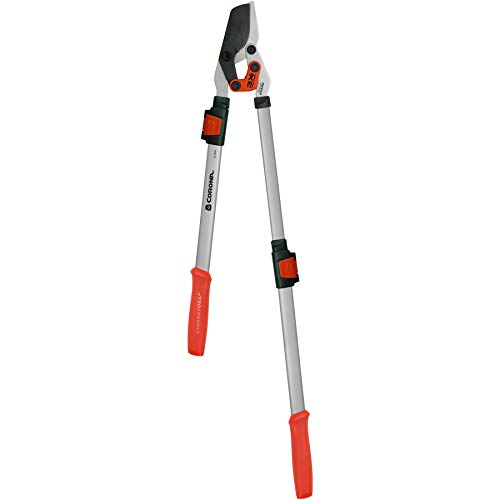
Loppers are long-handled pruning tools with two blades and two handles, made to cut branches from about half an inch up to roughly two inches thick. The long handles, usually 15 to 32 inches, supply leverage that finger-operated pruners cannot, so loppers sit squarely between hand pruners and a pruning saw.
Every lopper has a cutting head and two handles. The head is either bypass, with two curved blades that pass like scissors, or anvil, with one blade that closes onto a flat plate. Handles come in aluminum, steel, or composite, and some telescope for extra reach.
What are the main types of loppers?
The main types split by head and mechanism. Bypass loppers slice cleanly and suit living wood; anvil loppers crush and suit dead wood. Mechanisms range from a simple single pivot to compound or geared heads that multiply force, and ratchet heads that cut in stages for people with limited grip. Our anvil vs bypass comparison covers the choice in detail.
How are loppers different from hand pruners and pruning saws?
Loppers differ from the tools on either side of them mainly by the branch size they suit and the leverage they apply. Hand pruners are one-handed tools for twigs and stems under about half an inch, and a pruning saw uses teeth to cut branches too thick for any blade to shear, so loppers own the middle ground where two-handed leverage severs a branch in one squeeze.
The three tools compare as follows.
| Tool | Branch size | Action |
|---|---|---|
| Hand pruners | Under 1/2 in | One-handed scissor or anvil cut |
| Loppers | 1/2 to 2 in | Two-handed leverage cut |
| Pruning saw | 2 in and up | Toothed sawing cut |
Reaching for the right one of the three keeps cuts clean and avoids straining a tool past what it was built for.
What do people use loppers for?
People use loppers to prune trees, shrubs, and roses, cut back overgrowth, and clear deadwood and storm debris. They are a core tool in the outdoor hand and cutting tools kit, sitting alongside pruners and saws in most gardens. A bypass lopper handles the living-wood jobs, while an anvil or ratchet lopper takes on the brittle dead branches that would only bruise on a bypass head.
What size loppers should a beginner buy?
A beginner is best served by a mid-length geared bypass lopper of about 24 to 28 inches, which balances reach, power, and control for the widest range of common jobs. It cuts living wood cleanly, the gears take the strain out of thicker branches, and the moderate length stays manageable in dense growth. For picks by use case, see the best loppers roundup; for anything thicker than about two inches, step up to a saw, and wear work gloves for every session.
How do you use loppers safely?
Use loppers safely by cutting only within their rated capacity, keeping both hands on the handles, and wearing eye protection and gloves, since loppers are strong pinch and laceration tools. Most injuries come from forcing a stuck cut or steadying a branch inside the closing blades.
A few habits cover the risks.
- Wear work gloves and eye protection for every session.
- Keep your free hand well clear of the blade path, and never hold the branch inside the head.
- Watch for tensioned or bent limbs that can spring back when released.
- Leave large, high, or leaning limbs, and anything near power lines, to a trained arborist.
How do you keep loppers cutting cleanly?
Keep loppers cutting cleanly by wiping the blades after use, oiling the pivot, and sharpening the bevel whenever the cut starts to tear. A bypass head is sharpened on the beveled outer face only, while an anvil head is sharpened on both bevels, and a loose pivot bolt is tightened until the head closes firmly. The full routine, plus the files to use, is in our sharpening files and tools guide, and dry storage keeps the edge and pivot from rusting between jobs.
What are the parts of a lopper?
A lopper is built from a cutting head, a pivot, two handles, and their grips, and knowing the parts helps you choose and maintain one. The head does the cutting, the pivot sets how the blades meet, the handles supply leverage, and the grips and bumpers make the tool comfortable to use.
The main parts are described below.
- Cutting head: either a bypass blade and counter-blade or a single anvil blade and flat plate.
- Pivot bolt: the adjustable joint that keeps bypass blades meeting cleanly; tightened as it wears.
- Handles: 15- to 32-inch levers in aluminum, tubular steel, or composite, some telescoping for reach.
- Grips and bumpers: cushioned ends and shock-absorbing stops that spare your hands on each closing cut.
On serviceable models such as a Felco, the blade, spring, and pivot are replaceable, so a worn part is swapped rather than the whole tool discarded.

