


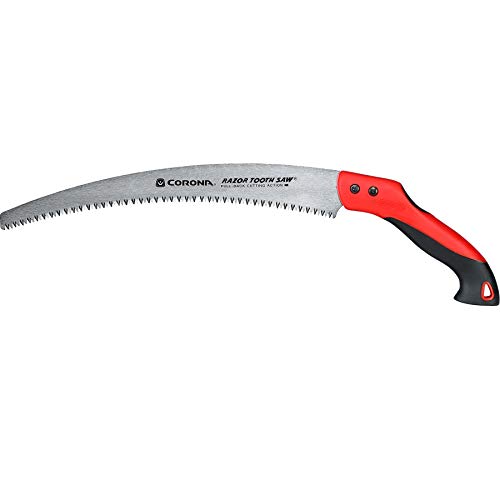

What is a pruning saw?
A pruning saw is a hand saw built for cutting living, green wood, with aggressive, widely set teeth and deep gullets that shed wet sawdust rather than packing solid the way a fine carpentry saw would. It cuts branches roughly 1 to 8 inches thick, taking over where hand pruners and loppers run out of capacity.
Most modern pruning saws cut on the pull stroke, Japanese style, which keeps the thin blade in tension so it cuts fast and straight with little effort. The teeth are usually impulse-hardened, staying sharp for years but resisting resharpening. Blades come curved or straight, and in folding or fixed-blade formats.
How is a pruning saw different from a regular saw?
A pruning saw differs from a carpentry saw in its teeth and its purpose. Its coarse teeth, around 6 or 7 per inch, are set and shaped to cut wet, fibrous, living wood, whereas a fine carpentry saw is made for dry, seasoned lumber and clogs almost immediately in green branches. A pruning saw’s blade is also often curved to bite on the pull.
That specialisation is why a pruning saw makes clean, fast cuts on branches that would bind and choke an ordinary handsaw.
When should you use a pruning saw?
Use a pruning saw when a branch is too thick for loppers, generally over about two inches, but you do not want the noise, weight, and hazard of a chainsaw. It is the right tool for shaping trees, removing deadwood, and clearing limbs around the garden. For the models worth buying, see the best pruning saws roundup and the full pruning saws guide. Leave large, high, or leaning limbs to a trained arborist.
What are the main types of pruning saw?
The main types of pruning saw are folding saws, fixed-blade saws, pole saws, and bow saws, each suited to a different reach and workload. Folding and fixed-blade saws cover almost all hand pruning, while pole and bow saws handle height and volume respectively.
A folding saw closes safely into its handle and suits occasional garden pruning; a fixed-blade saw such as the Silky Zubat rides in a scabbard and cuts faster for frequent use. For branches out of arm's reach, a manual pole pruner puts a small saw on the end of a pole, and a powered pole saw does the same job faster overhead. A bow saw is the cheap choice for bucking a pile of dead branches into firewood lengths, though its coarse blade tears living wood more than a purpose-made pruning blade.
What should you look for in your first pruning saw?
Look for a folding saw with a curved, impulse-hardened blade of about 240 mm, coarse teeth around 6 to 7 per inch, and a handle that locks the blade firmly open and closed. That specification covers the great majority of home pruning and is exactly where the most-recommended folding saws sit.
A first saw does not need to be the most expensive one. A mid-size folding blade cuts limbs up to roughly five inches, folds away safely, and takes a replacement blade when it eventually dulls, so it can serve for years. Avoid a fine-toothed general handsaw, which clogs in green wood, and avoid an oversized two-handed saw you will rarely need. Keep a pair of work gloves with it, and see the best pruning saws roundup for specific models.
A worked example: choosing a saw for a suburban garden
For a typical suburban garden with a few fruit trees and some shrubs, a single mid-size folding pruning saw is all most owners ever need. The reasoning shows how the earlier points come together in practice.
The branches in such a garden rarely exceed four or five inches, which a 240 mm folding blade cuts comfortably on the pull. The saw folds shut for safe storage in a shed drawer, and when its impulse-hardened teeth finally dull after several seasons, a replacement blade restores it rather than forcing a new purchase. Loppers and hand pruners handle everything thinner than the saw's minimum, so the three tools together cover the whole garden. The only reason to add a larger saw would be a mature tree with genuinely big limbs, and even then a large folding saw or a call to an arborist usually makes more sense than a second everyday tool.

