


Do pruning saws cut on the push or the pull stroke?
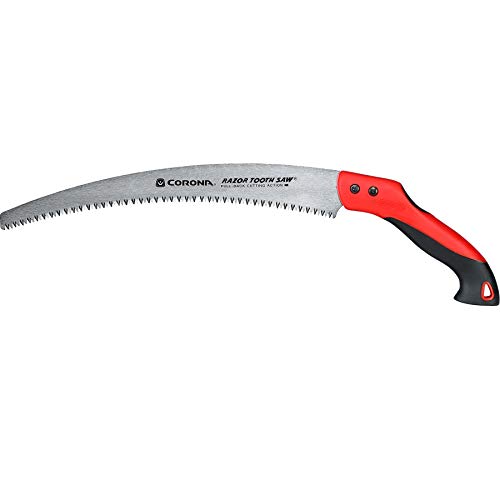
Most modern pruning saws cut on the pull stroke, in the Japanese tradition, because pulling the blade keeps it in tension. A blade held taut can be ground thinner and sharper without buckling, so it slices a narrow kerf, removes less wood, and takes less effort per stroke than a push saw. Silky, Corona RazorTOOTH, and most current brands are pull-cut designs.
On a pull-cut saw you let the saw do the work on the draw stroke and ease off on the push, rather than forcing it. This is why these saws feel fast and controlled even in green, fibrous wood.
Why does a pull-cut blade cut better?
A pull-cut blade cuts better mainly because tension lets it be thin. On the push, a thin blade wants to buckle, so push saws must be thicker and stiffer, which widens the kerf and raises the effort. Pulling removes that problem, allowing a fine, aggressive blade that tracks straight and clears sawdust efficiently.
The result, by owner accounts, is noticeably faster cutting with less fatigue, especially on the larger limbs a pruning saw is built for.
Are there still push-cut pruning saws?
Push-cut saws still exist, mostly in the coarse, replaceable-blade bow saw, which remains a cheap way to buck a pile of dead branches. A few Western-pattern pruning saws also cut on the push and suit anyone long used to that action. For most buyers, though, a pull-cut folding or fixed saw from the best pruning saws roundup is the faster, easier choice.
How should you hold and stroke a pull-cut saw?
Hold a pull-cut saw with a relaxed full-hand grip, start with light draws to seat the teeth, then pull through most of the blade on each stroke while easing off on the push. The blade cuts on the pull, so the draw stroke does the work and the push simply repositions it.
The technique that gets the most from a pull-cut blade is set out below.
- Grip the handle firmly but without tension, keeping your wrist and forearm in line with the blade.
- Set the teeth on the cut line and draw back gently two or three times to notch the wood so the blade cannot skate.
- Lengthen the stroke, pulling through as much of the blade as you can, and let the sharp teeth carry the cut.
- Ease the pressure on the forward push so the thin blade stays in tension and does not buckle.
- Keep the blade square; if it wanders, re-seat it rather than twisting it back on line.
Letting the saw do the work, rather than forcing it, is the whole art of a pull-cut blade, and it is why these saws feel fast with so little effort.
Does a curved blade change the pull cut?
A curved blade sharpens the pull cut by concentrating the teeth's contact and pulling them down into the wood as you draw, so it bites more aggressively than a straight blade of the same length. Most premium pull-cut saws are curved for exactly this reason.
The curve means the teeth engage at a slightly changing angle through the stroke, which helps them dig in and clear sawdust rather than skating. A straight pull-cut blade still works well and is a little easier to control for flush and finishing cuts, which is why some camp and general saws use one. Neither changes the basic rule that the cut happens on the pull; the curve simply makes each pull more effective on a thick limb. For the models using each style, see the best pruning saws roundup.
A worked example: starting a cut on a smooth limb
Starting a pull-cut on a smooth, barked limb is where the pull design shows its advantage, because a gentle draw seats the teeth without the blade jumping. The sequence is worth getting into muscle memory.
Rather than pushing hard to bite in, which makes any saw skate, you rest the teeth on the line and draw back lightly two or three times. The pull keeps the blade in tension and lets the sharp teeth cut a shallow notch that anchors the following strokes. From there each full pull lengthens the cut smoothly, and the blade tracks straight because it is never being forced. On a heavy limb this same gentle start leads into the three-cut method from the pruning saws guide, so the undercut can relieve the wood before the top cut drops it.

