Best Pruning Saw
Best Pruning Saw, ranked from aggregated owner ratings and reviews, not first-hand testing. Real pros, cons, and who each pick is best for.

Our Top 3 Picks
Quick Comparison
| Product | Best for | Buy | |
|---|---|---|---|
| Silky Gomboy 240 Folding Pruning Saw | Best Overall | See Amazon | View (paid link) |
| Corona RazorTOOTH RS 7265 Folding Saw | Best Value | See Amazon | View (paid link) |
| Silky Zubat 330 Professional Pruning Saw | Best Premium | See Amazon | View (paid link) |
| Fiskars Power Tooth Softgrip Folding Saw | Best for Beginners | See Amazon | View (paid link) |
| Bahco Laplander 396-LAP Folding Saw | Best Compact | See Amazon | View (paid link) |
| Silky Katanaboy 500 Folding Saw | Best Heavy-Duty | See Amazon | View (paid link) |
How do you choose the best pruning saw?
Choose a pruning saw by matching its blade length to the branches you cut, its tooth coarseness to how green the wood is, and its format, folding or fixed, to how often you prune. A 9- to 10-inch folding saw handles most home pruning; heavy or frequent cutting justifies a longer fixed blade.
The picks below are chosen from manufacturer specifications and aggregated owner feedback, not first-hand lab testing. No prices are shown here because they move constantly through the Amazon listing.
Folding or fixed blade for the way you prune?
Format is the first decision. A folding pruning saw closes safely into its own handle, rides in a pocket or pack, and suits anyone pruning a few trees a season; the Silky Gomboy, Corona RazorTOOTH, and Bahco Laplander all fold. A fixed-blade saw such as the Silky Zubat flexes less, cuts faster, and carries in a belt scabbard, which is why arborists and orchardists prefer it despite the exposed, sheathed blade.
If you only prune occasionally, a folding saw is the safer and more convenient buy. If you cut most weekends or work up a tree, the rigidity and speed of a fixed blade repay the extra care in storage. A folding saw also travels better between jobs, dropping into a pocket or a tool bucket without a loose edge, while a fixed blade needs its scabbard clipped to a belt every time it comes out. Neither format cuts meaningfully cleaner than the other; the difference is handling, not the wound left on the branch.
What blade length and tooth count suit your branches?
Blade length should be about twice the diameter of the branches you cut most, and tooth count should stay coarse for green wood. A 240 mm (9.5 inch) blade around 7 teeth per inch, like the Gomboy or a Corona folding saw, covers limbs up to roughly 5 inches; a 330 mm Zubat pushes into 6-inch wood; a 500 mm Katanaboy tackles small trunks.
Coarse teeth with deep gullets clear the wet sawdust that clogs a fine carpentry saw, so resist the temptation to buy a finer blade for a cleaner cut. The pruning-saw sweet spot sits around 6 to 7 teeth per inch on impulse-hardened steel.
Curved or straight blade, and does tooth shape matter?
A curved blade suits most pruning because its shape concentrates the teeth on the pull and bites harder with each stroke, while a straight blade is easier to control for flush cuts and undercuts. Tooth shape matters just as much: three-sided razor teeth cut aggressively in every direction.
Most premium saws, including the Silky Gomboy and Zubat and the Corona RazorTOOTH, use a curved blade with three-sided, impulse-hardened teeth that slice on the pull rather than tearing. A straight blade, common on the Bahco Laplander and camp saws, gives a little more precision for finishing a cut close to the collar and is easier to file if it is a non-hardened type. Neither is clearly better; the curve trades a touch of control for speed. What you should avoid is a fine, flat-filed tooth meant for seasoned timber, which loads up with wet fibre and stops cutting within a few strokes in living wood.
What handle, lock, and safety features should you check?
Check that the handle fills your hand, that a folding saw locks firmly both open and closed, and that a fixed blade comes with a proper scabbard. These features decide how safe and controllable the saw is far more than any headline spec, because a saw that folds shut on your fingers or slips in a wet grip is dangerous no matter how well it cuts.
The details worth checking before buying are listed below.
- Grip: a rubberised or co-moulded handle that stays secure with damp or gloved hands, sized so your whole hand wraps it without cramping.
- Two-position lock: on a folding saw, a catch that holds the blade rigidly open for cutting and locked closed for carry, with no wobble in either position.
- Scabbard: on a fixed-blade saw, a belt sheath that fully covers the teeth, since an exposed arborist blade is a serious hazard on a ladder or in a pack.
- Blade play: no side-to-side movement at the pivot, which would let the blade wander and bind.
A saw that locks positively and grips well is one you can use one-handed up a tree with the other hand steadying a limb, which is exactly when a slip matters most. Keep a pair of work gloves with the saw whichever format you choose.
How much should you spend, and what does a pruning saw cost to own?
Spend enough to get an impulse-hardened blade and a solid lock, which is where folding saws from Silky, Corona, and Bahco sit, and treat the replaceable blade as the real long-term cost. A quality pruning saw is a buy-once tool whose only running cost is a fresh blade every few seasons of hard use.
The cost of ownership is lower than it first looks, because the handle, lock, and scabbard outlast many blades. When impulse-hardened teeth finally dull, a replacement blade costs a fraction of a new saw and brings back full cutting speed, so a good handle can serve for a decade or more. A very cheap hardware-store saw with a riveted, non-replaceable blade looks like a saving until it dulls and has to be thrown away whole. For an occasional light-pruning gardener the cheapest capable folding saw is perfectly rational; for anyone cutting most weekends, the faster blade and the option to re-blade rather than rebuy make the mid-priced saw the better value over time. No prices appear here because they move constantly on the Amazon listing, so check the live figure before buying.
How do the best pruning saws compare?
The table below compares the picks by format, blade length, and the pruning each suits, so you can shortlist before reading the verdicts.
| Model | Type | Blade length | Teeth | Best for |
|---|---|---|---|---|
| Silky Gomboy 240 | Folding | ~240 mm (9.5 in) | ~7 TPI, impulse-hardened | All-round home pruning |
| Corona RazorTOOTH RS 7265 | Folding | ~254 mm (10 in) | ~6–7 TPI | Best value all-rounder |
| Silky Zubat 330 | Fixed | ~330 mm (13 in) | ~7 TPI | Arborists and heavy use |
| Fiskars Power Tooth Softgrip | Folding | ~178 mm (7 in) | Fine crosscut | Light garden work, beginners |
| Bahco Laplander 396-LAP | Folding | ~190 mm (7.5 in) | ~7 TPI | Camping and compact carry |
| Silky Katanaboy 500 | Folding | ~500 mm (20 in) | ~5.5 TPI | Big limbs and bush clearing |
Which pruning saw fits which kind of user?
The right saw depends on how often and how hard you prune: an occasional gardener wants a light, cheap folder, a keen home pruner wants a quality mid-size folding saw, and a professional wants a rigid fixed blade. Matching the saw to the user avoids both overspending and outgrowing the tool.
The sensible pick by user type is set out below.
| User | How they prune | Best-fit pick |
|---|---|---|
| Occasional gardener | A few small branches a year | Fiskars Power Tooth folding saw |
| Keen home pruner | Regular pruning, limbs to ~5 in | Silky Gomboy 240 or Corona RazorTOOTH |
| Value-focused buyer | Wants speed for less money | Corona RazorTOOTH folding saw |
| Arborist or heavy user | Long days, big limbs | Silky Zubat 330 fixed blade |
| Camper or bushcrafter | Packs light, cuts occasionally | Bahco Laplander 396-LAP |
| Acreage or trail clearer | Big limbs and small trunks | Silky Katanaboy 500 |
The pattern behind the table is simple: format and blade length follow workload. Light and infrequent means a short, cheap folder; frequent and heavy means a long, rigid blade you can re-blade rather than replace. Most gardeners land on a mid-size folding saw and never need anything more, keeping loppers and hand pruners for the thinner wood.
What mistakes should you avoid when buying a pruning saw?
The common buying mistakes are choosing a blade that is too fine, buying more saw than you need, ignoring whether the blade is replaceable, and overlooking the lock and scabbard. Each one either wastes money or leaves you with a saw that clogs, dulls, or feels unsafe in use.
The pitfalls to avoid are listed below.
- A fine-toothed blade sold as a general saw, which clogs in green wood. Insist on coarse pruning teeth, roughly 6 to 7 per inch.
- Too much saw, such as a two-handed Katanaboy for trimming a rose bed. Buy for your usual branch size, not the once-a-decade limb.
- A non-replaceable blade, which turns a dull saw into landfill. Confirm the model takes a genuine replacement blade.
- A weak or single-position lock, which lets a folding blade close on your hand. Check it locks both open and shut.
- No scabbard on a fixed blade, leaving an exposed edge in your pack or on your belt.
Avoiding these keeps the purchase to a saw you will actually reach for and keep for years. Read the full pruning saws guide for the three-cut method before you put a new saw to a heavy branch.
Which pruning saw is right for you?
Pick the Silky Gomboy 240 as an all-round folding saw for most gardens, the Corona RazorTOOTH folding saw for the best value, and the fixed-blade Silky Zubat 330 if you prune hard and often. Choose the Fiskars Power Tooth for occasional light work, the Bahco Laplander for camping, and the Silky Katanaboy 500 when limbs get genuinely big.
Whatever you choose, keep work gloves and eye protection with it, and read the pruning saws guide for the three-cut method before tackling a heavy branch. For limbs a hand saw cannot reach safely, compare a manual pole pruner or a powered pole saw.
Full Ranking, Reviewed

Best for All-round home pruning up to about 5 inches
- Around a 240 mm (9.5 in) curved blade for a long, efficient stroke
- Impulse-hardened teeth, roughly 7 per inch, that stay sharp for years
- Pull-cut Japanese design that keeps the thin blade in tension
- Rubberised handle and a positive lock that holds the blade rigidly open
- Cuts green wood remarkably fast for its size, by owner accounts
- Folds safely into the handle for pocket or pack carry
- Replaceable blade means the saw outlasts a single blade’s life
- Impulse-hardened teeth cannot practically be resharpened at home
- Costs more than a basic hardware-store folding saw
Verdict: The most widely recommended folding pruning saw for home use, blending a fast pull-cut blade with safe, pocketable carry.
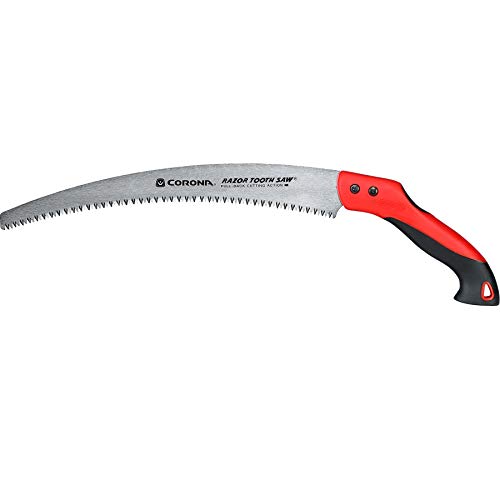
Best for A capable all-rounder at a lower price
- Around a 254 mm (10 in) curved blade for larger limbs
- Three-sided RazorTOOTH impulse-hardened teeth that cut on the pull
- Co-moulded handle with a blade lock in the open position
- Wide tooth set that clears green sawdust and resists binding
- Handles branches up to roughly 5 inches for a modest outlay
- Aggressive teeth cut quickly through fresh wood
- Widely available and a common first pruning saw
- Blade and lock feel a step below a Silky in refinement
- Longer blade is slightly less nimble on small twiggy growth
Verdict: The value benchmark in folding pruning saws, giving most of a premium saw’s cutting speed for noticeably less money.

Best for Arborists and anyone pruning hard and often
- Fixed 330 mm (13 in) curved blade for a fast, rigid stroke
- Impulse-hardened teeth around 7 per inch on a taper-ground blade
- Belt scabbard included for safe carry up a tree
- Non-slip rubber handle sized for a full-hand grip
- Rigid fixed blade cuts faster than a folding saw under load
- A long-standing favourite among professional arborists
- Replaceable blade keeps the saw going for many seasons
- Exposed blade must always ride in its scabbard for safety
- More saw than an occasional gardener needs
Verdict: The professional’s pick, a rigid fixed-blade saw that cuts big limbs fast and has earned a strong reputation among arborists.

Best for Occasional light garden pruning
- Around a 178 mm (7 in) folding blade for small branches
- Hardened, precision-ground teeth for clean cuts in green wood
- SoftGrip handle with a blade that locks open and closed
- Compact fold-flat design for a drawer or garden caddy
- Light, simple, and inexpensive for casual users
- Locks closed so it stores safely between jobs
- Backed by Fiskars’ long tool warranty
- Short blade struggles on branches over about 3 inches
- Cuts slower than a dedicated Silky or Corona blade
Verdict: An affordable, easy folding saw for gardeners who prune occasionally and do not need arborist-grade cutting speed.

Best for Camping, bushcraft, and compact carry
- Around a 190 mm (7.5 in) folding blade, roughly 7 teeth per inch
- Low-friction, rust-protected coating on the blade
- Locks both open and closed with a positive catch
- Light two-component handle sized for a pack
- Cuts both green wood and dry branches well for its size
- Locks closed for safe stowing in a pack or pocket
- A long-time favourite of campers and bushcrafters
- Short blade limits it to smaller branches
- Teeth are set for versatility rather than outright speed
Verdict: A tough, compact folding saw that packs small and doubles for camp and trail work as well as garden pruning.

Best for Big limbs, small trunks, and trail clearing
- Large 500 mm (20 in) folding blade with a coarse ~5.5 TPI set
- Two-handed handle for the reach and power of a small bow saw
- Impulse-hardened, taper-ground blade for fast deep cuts
- Folds down despite its length for transport and storage
- Cuts limbs and small trunks a normal pruning saw cannot
- Folding design makes a very large blade portable
- Owners report it rivals a chainsaw on modest logs
- Large and heavy, and overkill for routine pruning
- Two-handed use needs clear space and firm footing
Verdict: A folding saw with near-bow-saw reach, ideal when limbs get big but you want to leave the chainsaw in the shed.
Frequently Asked Questions
What is the best all-round pruning saw for a home garden?
A 9- to 10-inch folding saw suits most home gardens, and the Silky Gomboy 240 and Corona RazorTOOTH folding saw are the two most commonly recommended. Both cut green wood fast on the pull stroke and fold away safely. Choose the Gomboy for refinement or the Corona to save money.
Is a Silky pruning saw worth the extra money?
For frequent or heavy pruning, many owners say yes. Silky saws use thin, taper-ground, impulse-hardened blades that cut faster and straighter than budget saws and last for years. For occasional light pruning, a cheaper Corona or Fiskars does the job, so the premium mainly rewards regular users.
What size branch can these pruning saws cut?
A folding pruning saw with a 9- to 10-inch blade comfortably cuts branches up to about 5 inches, and a longer fixed blade like the Zubat 330 handles 6-inch wood. The 20-inch Katanaboy manages small trunks. As a rule, keep the branch diameter under half the blade length.
Do pruning saws come with replaceable blades?
Most quality pruning saws use replaceable blades, including the Silky Gomboy, Zubat, and Katanaboy and the Corona RazorTOOTH. Because impulse-hardened teeth cannot be resharpened at home, a fresh blade restores full cutting speed for a fraction of a new saw’s cost when the teeth eventually dull.