


What size branch can a pruning saw cut?
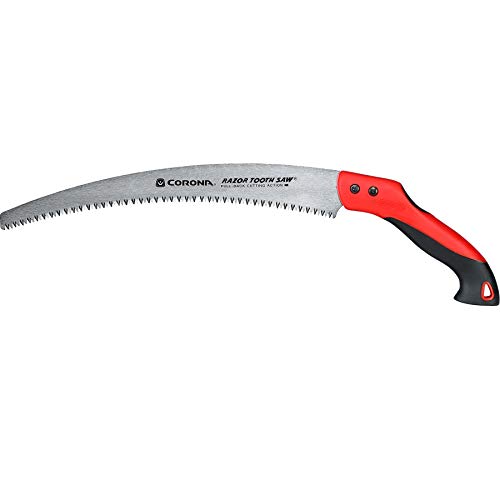
A pruning saw cuts branches from about 1 inch up to 8 inches or more, with blade length setting the practical limit. A 9- to 10-inch folding blade, such as a Silky Gomboy or Corona RazorTOOTH, comfortably takes limbs up to roughly 5 inches, a 13-inch fixed blade like the Silky Zubat pushes into 6-inch wood, and a 20-inch Silky Katanaboy manages small trunks.
The reliable rule is to keep the branch diameter under about half the blade length, so the stroke stays long enough for the teeth to keep clearing sawdust. A blade about twice the branch diameter cuts fastest and binds least.
What decides a pruning saw’s cutting capacity?
Blade length and tooth coarseness together decide capacity. A longer blade reaches through a thicker limb in each stroke, and coarser teeth with deeper gullets clear the wet sawdust that green wood produces. A short, fine blade stalls in thick branches, while a long, coarse one keeps eating through them.
Format matters too: a rigid fixed blade transfers more power into the cut than a folding one, which is why arborists reach for fixed saws on the biggest limbs.
When should you switch to a chainsaw?
Switch to a chainsaw when branches are consistently over about 8 inches, when you are felling or bucking, or when the sheer volume of cutting makes a hand saw impractical. For occasional big limbs, a large folding saw like the Katanaboy bridges the gap. Compare hand saws with a pole saw for height and a mini chainsaw for repeated thick cuts, and see the pruning saws guide for choosing a blade length.
How does blade length translate to branch size?
Blade length translates to branch size through a simple rule: keep the branch diameter under about half the blade length, so the stroke stays long enough for the teeth to keep clearing sawdust. A blade about twice the branch's diameter cuts fastest and binds least.
The rough mapping from common blade lengths to comfortable branch sizes is set out below.
| Blade length | Comfortable branch size | Typical saw |
|---|---|---|
| 7 in (180 mm) | Up to ~3 in | Fiskars, Bahco Laplander |
| 9–10 in (240–250 mm) | Up to ~5 in | Silky Gomboy, Corona RazorTOOTH |
| 13 in (330 mm) | Up to ~6 in | Silky Zubat |
| 20 in (500 mm) | Small trunks | Silky Katanaboy |
Push a saw much beyond these sizes and the cut slows, the blade binds, and the job stops being safe. When branches consistently exceed what the longest hand saw handles cleanly, it is time to switch tools rather than force the one you have.
Does the type of wood change what a pruning saw can cut?
Wood type changes the effort more than the maximum size: green, sappy wood cuts easily but gums the blade, while dry, dense hardwood is slower and harder on the teeth. A pruning saw is built for green wood, so it is happiest cutting living branches within its blade-length limit.
Soft, fast-growing species such as willow, poplar, and conifer cut quickly, though their sap loads the blade and calls for a clean afterwards. Dense hardwoods such as oak and many fruit woods take more strokes for the same diameter and dull the teeth a little faster. Fully seasoned deadwood is the hardest of all on a fine blade and can be better suited to a coarse bow saw. Within the saw's size range, though, any of these is cuttable; the wood simply changes how long it takes and how soon the blade needs cleaning.
A worked example: cutting a 4-inch apple limb
A four-inch apple limb is squarely within a 240 mm folding saw's range, and cutting it well shows how blade choice and technique combine. Apple is a fairly dense wood, so the coarse, sharp teeth of a pruning blade matter here.
Because the limb is over an inch thick, it needs the three-cut method: an undercut a foot out, a top cut to drop the limb, then a final cut at the collar. The 240 mm blade is comfortably more than twice the limb's diameter, so each pull draws a long, clearing stroke and the cut stays fast. Cutting apple in its dormant season keeps the wound clean and the tree unstressed. Afterwards the sappy blade gets a wipe and a light oil, and the saw folds away ready for the next limb. A longer fixed blade from the best pruning saws roundup would finish the cut a little faster but is not needed at this size.

