


How do you use a mini chainsaw safely?
You use a mini chainsaw safely by treating it as a real chainsaw: keep both eyes on the cut, hold it firmly, cut with the lower edge of the bar, and keep your free hand, legs, and bystanders out of the cutting path. Small size does not mean small risk.The biggest hazard is kickback, when the upper nose of the bar catches wood and snaps the saw back toward you. Feed the saw into the wood steadily rather than forcing it, watch for hidden branches the nose could strike, and never reach overhead or climb a ladder with a one-handed saw. Wear eye protection, work gloves, and sturdy footwear, and add hearing protection for longer sessions. These notes are general guidance, not a substitute for hands-on training.
What protective gear should you wear with a mini chainsaw?
You should wear cut-resistant gloves, wraparound eye protection, and sturdy closed footwear before every mini chainsaw session, adding hearing protection for longer jobs and a helmet with a face shield for any overhead limb work. Small saws still spin a fast, sharp chain that does not forgive a slip.The gear worth having, from essential to job-specific, is listed below.
- Cut-resistant work gloves for grip and hand protection.
- Wraparound eye protection or a face shield against flying chips.
- Sturdy closed boots, ideally with toe protection, never open shoes.
- Hearing protection for sessions beyond a few minutes, covered in our hearing and eye protection guide.
- Close-fitting clothing and tied-back hair so nothing loose can reach the chain.
For anything beyond the lightest pruning, add proper chainsaw chaps and PPE; the small cost buys real protection against the one mistake that matters.
How do you avoid kickback on a one-handed mini chainsaw?
You avoid kickback by keeping the bar's upper nose away from wood, cutting with the lower edge of the bar, and holding the saw firmly so a sudden jolt cannot twist it toward you. Kickback is the leading cause of chainsaw injury and is hardest to control on a one-handed saw.The habits that prevent most kickback are set out below.
- Cut with the lower edge of the bar, never the upper tip, which is the kickback zone.
- Watch for hidden branches or the ground the nose could strike as you finish a cut.
- Keep the chain sharp and correctly tensioned, since a dull or loose chain grabs.
- Feed the saw steadily and let the chain speed do the work rather than forcing it.
- Never cut overhead or from a ladder with a one-handed mini, where a kickback is unrecoverable.
A chain brake stops the chain fast if a kickback does happen, which is why it is worth having on any saw you buy.
How do you tension and oil a mini chainsaw chain?
You tension a mini chainsaw chain so it sits snug against the bar but still pulls freely by hand, and you keep the bar oiled through the saw's reservoir before and during use. A loose chain can derail, and a dry bar burns out fast, so both checks come before every session.The routine below keeps a mini saw cutting cleanly.
- Check the chain tension cold, adjusting until the chain hugs the bar with no sag underneath.
- Fill the bar-oil reservoir and confirm the automatic oiler is feeding oil onto the bar.
- Run the saw briefly off the wood to spread oil along the chain before cutting.
- Recheck tension after the first few cuts, since a new chain stretches as it warms.
A properly tensioned, well-oiled chain cuts faster, lasts longer, and is safer, so build these steps into your routine. Our chainsaw maintenance guide covers deeper upkeep for every size of saw.
How do you keep a mini chainsaw chain sharp?
You keep a mini chainsaw chain sharp with a correctly sized round file and a light, consistent stroke on each cutter, touching it up before it starts producing dust instead of chips. A sharp small chain cuts with almost no pressure; a dull one forces the motor and drains the battery.Watch the cut for the warning signs: fine sawdust instead of clean chips, a chain that wanders, or one that needs pushing all mean it is time to file. Match the file diameter to the chain pitch, keep the same angle on every tooth, and count your strokes so the cutters stay even. For the full method, see our chainsaw sharpening guide, which applies to mini and full-size chains alike.
How do you clean a mini chainsaw after each use?
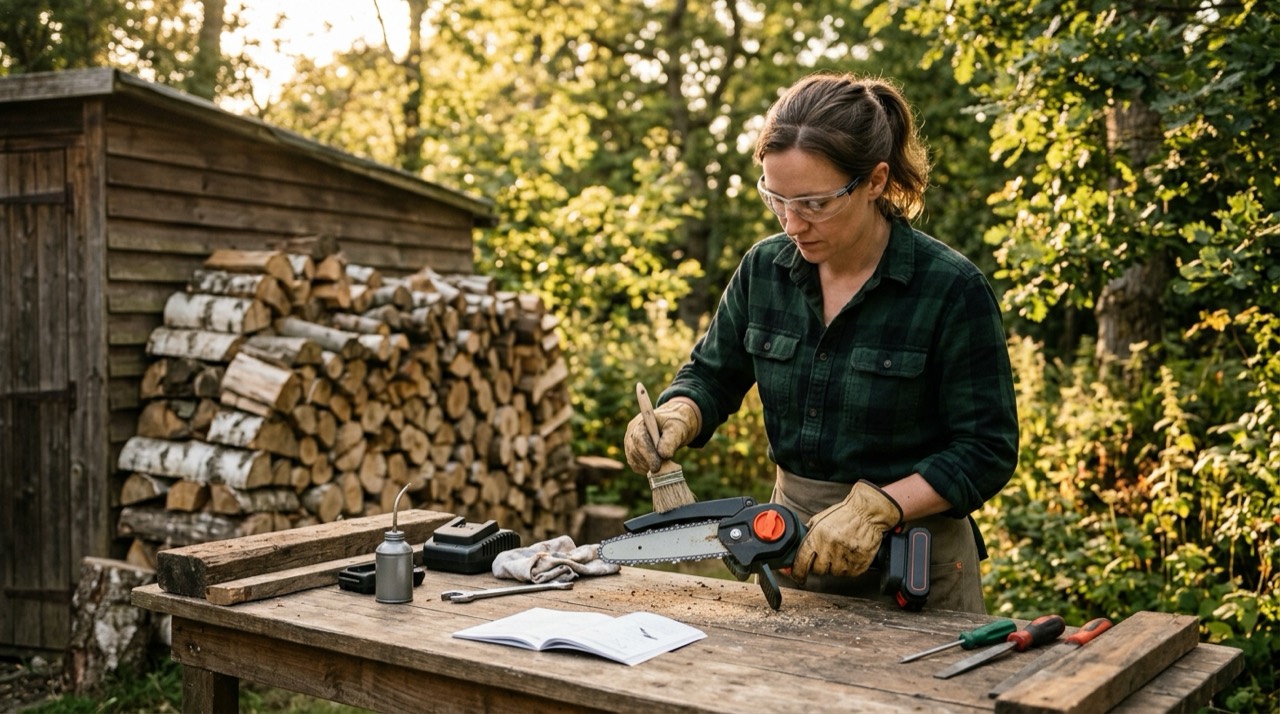
You clean a mini chainsaw after each use by clearing sawdust from the bar groove and sprocket, wiping the chain, and checking the oiler port, which keeps the saw cutting cleanly and the moving parts from clogging. A minute of cleanup does more for reliability than any single upgrade.The after-use routine is set out below.
- Remove the battery before touching the bar or chain.
- Brush sawdust and oily debris out of the bar groove and around the drive sprocket.
- Wipe the chain and bar down, checking the chain still moves freely.
- Confirm the oiler hole and reservoir cap are clear and clean.
- Fit the bar cover and store the saw dry.
Clogged sawdust holds moisture and starves the oiler, two quiet causes of premature wear, so make this the habit that ends every session. Deeper periodic upkeep is covered in our chainsaw maintenance guide.
How should you store a mini chainsaw and its battery?
You store a mini chainsaw clean and dry with the bar lightly oiled, and you store its lithium battery off the charger at a partial charge in a cool, dry place. Good storage protects both the saw and the pack between the short, occasional jobs minis are made for.Before putting the saw away, clear sawdust from the sprocket and bar groove, wipe the chain, and fit the bar cover if it has one. Lithium batteries last longest stored around half charge rather than full or empty, and away from heat and freezing cold. If the saw will sit unused for a month or more, top the battery to about half charge first and keep it out of a hot shed or a freezing garage, both of which age lithium cells faster. A saw and battery cared for this way start reliably the next time a branch needs cutting.
What do you do when a mini chainsaw stops cutting well?
When a mini chainsaw stops cutting well, the cause is almost always a dull chain, low bar oil, or a loose chain rather than a failing motor, so check those three first before assuming the saw is worn out. Most sudden drops in cutting speed trace back to a five-minute fix.The usual culprits and their fixes are listed below.
- Fine dust instead of chips: the chain is dull, so touch it up with a round file.
- Smoke or a burning smell: the bar is running dry or the chain is too tight, so check oil and tension.
- Chain slipping off or rattling: tension is too loose, so retension the cold chain.
- The saw bogging down in wood: the branch is too thick for the bar, so cut from both sides or use a larger saw.
- Short run-time: the battery is aging or the chain is dull, both of which force the motor.
If a sharp, oiled, correctly tensioned chain still cuts poorly, only then look at the bar and sprocket for wear.
When should you replace a mini chainsaw's chain or bar?
You should replace a mini chainsaw's chain when repeated sharpening no longer restores a clean cut or the cutters are filed down near their wear line, and replace the bar when its groove is worn, splayed, or burred enough to let the chain wander. Both are consumables, not lifetime parts.A chain that dulls almost immediately after filing, stretches past adjustment, or has cracked or missing cutters has reached the end of its life, and forcing it only stresses the bar and motor. A bar with a widened groove, a blued or burnt rail, or an uneven wear pattern stops holding the chain straight, which shows up as crooked cuts. Buying a bar and chain from a known maker keeps replacements easy to find; our chainsaw chains guide covers matching pitch and gauge. Replacing a worn chain early is cheaper than the bar or sprocket it can otherwise damage.
What common mistakes shorten a mini chainsaw's life?
The most common mistakes that shorten a mini chainsaw's life are running the bar dry, cutting with a dull or loose chain, forcing the saw through oversized wood, and leaving the battery on the charger or fully drained for months. Each is easy to avoid with a quick pre-cut check.Forcing a mini saw through wood thicker than its bar overheats the motor and wears the chain fast, so respect its limits and send bigger jobs to a gas chainsaw or a larger battery saw. A minute of oil, tension, and sharpness checks before each session prevents most of the failures owners report.