


When does a lawn mower blade need sharpening?
A mower blade needs sharpening when the grass looks torn, frayed, or ragged at the tips instead of cleanly cut, or after roughly 25 hours of mowing. A dull blade tears the grass rather than slicing it, leaving a whitish, stressed lawn that dries out and browns more easily.Most homeowners sharpen two or three times a season, and immediately after the blade hits a rock, root, or buried debris. Sharpening is straightforward with basic tools, and pairs with the wider service routine in our lawn mower maintenance guide.
What angle should you sharpen a lawn mower blade to?
Sharpen a mower blade to its original factory bevel, which is usually between about 30 and 45 degrees, rather than to a fine knife edge. The factory angle balances a clean cut against edge durability, and following it means you remove the least metal and keep the blade in service longer.There is no need to measure the angle precisely; matching the existing bevel by eye is accurate enough. Keep the edge at a butter-knife sharpness rather than a razor, because a mower blade cuts grass by impact and airflow, not by slicing like a knife, so a fine edge only chips on the first stone. Take the same amount off each cutting end so the blade stays balanced.
How do you remove a mower blade safely?
Remove the blade only after making the mower safe, because the blade is heavy and sharp and the engine must never start while your hands are underneath. Disconnect the spark plug wire, or pull the battery and safety key, then deal with the fuel before tipping.Work in order:
- Disconnect the spark plug wire, and on electric mowers remove the battery or safety key.
- Empty the fuel tank or run it dry, so petrol cannot leak into the air filter when you tip the mower.
- Tip the mower with the air filter and carburettor side up, never with the filter side down.
- Wedge a block of wood against the blade to stop it turning, mark its down-facing side, then unbolt it.
Wear stout gloves throughout, because even a dull blade can cut.
How do you sharpen a mower blade?
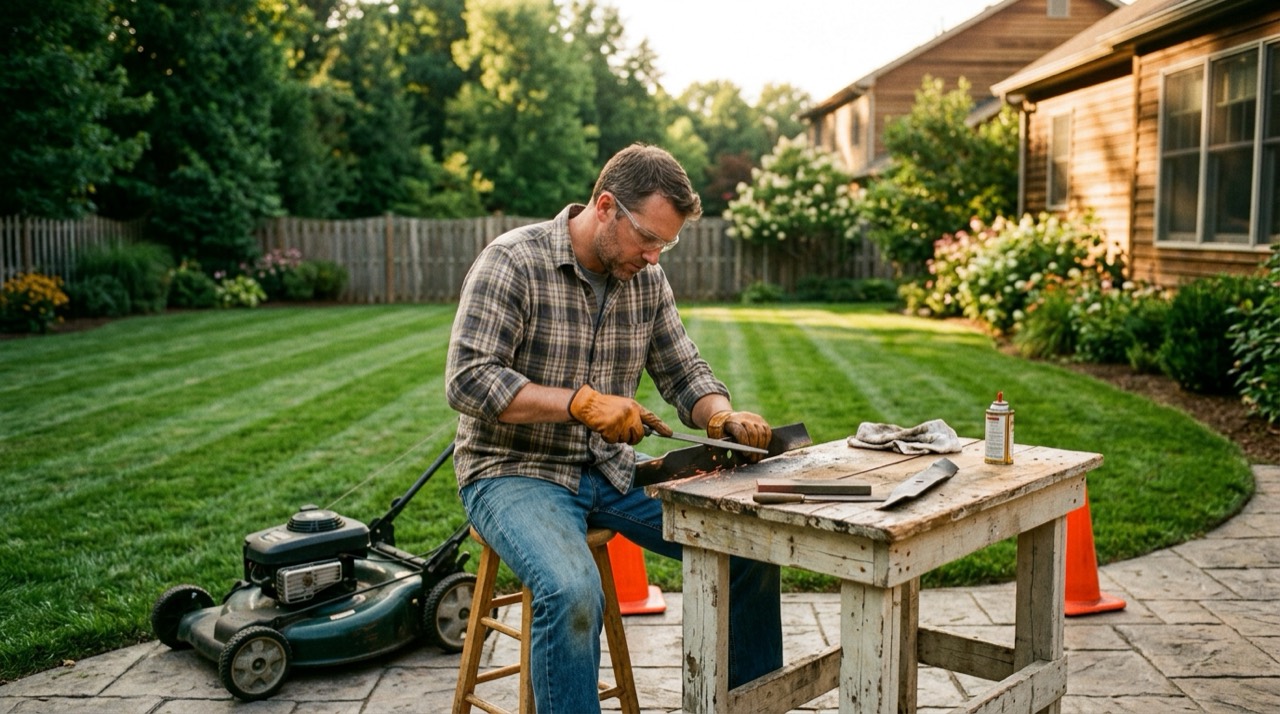
Sharpen the blade by restoring the existing angle on its cutting edges to a clean, even bevel, roughly as sharp as a butter knife rather than a razor. A razor edge chips and dulls almost immediately, while a slightly blunt working edge lasts far longer.You can use a hand file, a drill-mounted sharpening stone, or a bench grinder, following the same steps:
- Clamp the blade in a vice with a cutting end up and accessible.
- Follow the original bevel angle, usually around 30 to 45 degrees, on both cutting ends.
- File or grind in one direction along the edge, keeping the strokes even on each end.
- Remove the same amount of metal from both ends so the blade stays balanced.
- Stop when the edge is uniform and free of nicks; a light burr is normal.
Sharpening tools are compared in our sharpening files and tools guide.
Should you sharpen a mower blade with a file, grinder, or drill sharpener?
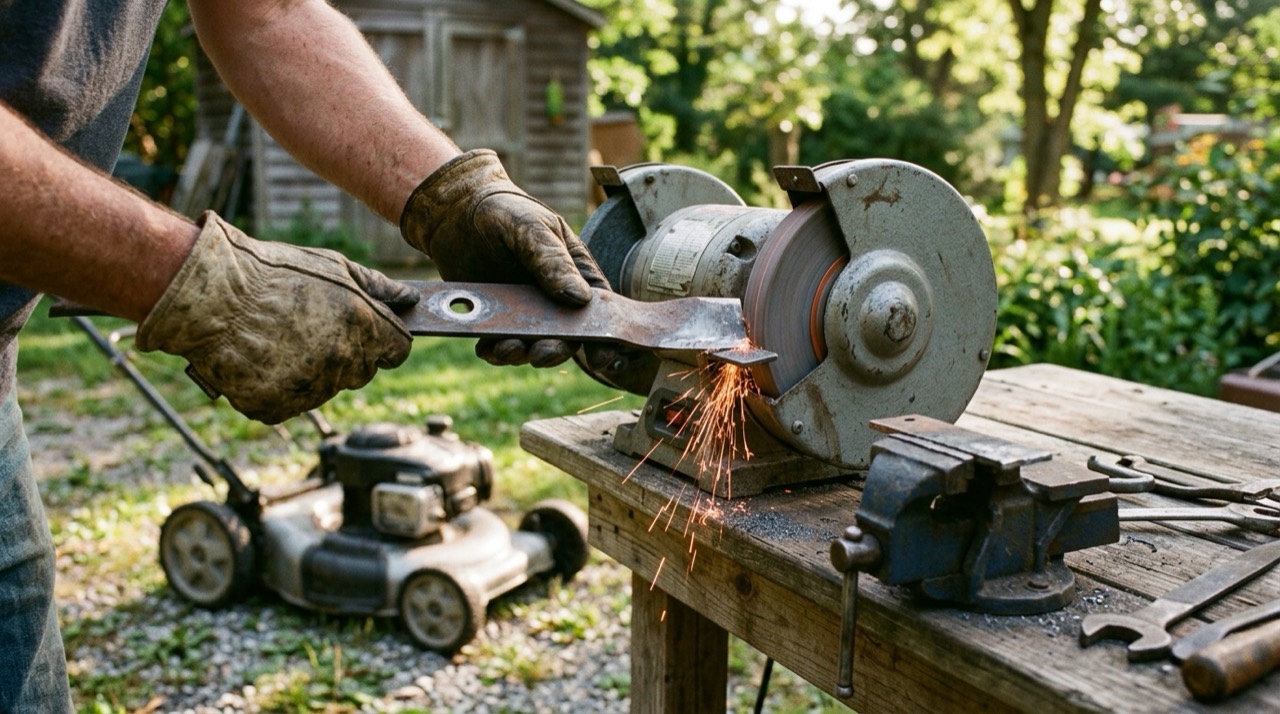
Any of a hand file, an angle or bench grinder, or a drill-mounted sharpening stone will sharpen a mower blade; the right choice depends on how dull the blade is and how much control you want. A file gives the most control, a grinder is fastest for a nicked blade, and a drill sharpener sits between the two.The table below compares the three common methods.
| Method | Best for | Watch out for |
|---|---|---|
| Hand file | Light touch-ups, most control | Slow on a badly nicked edge |
| Drill-mounted stone | Quick regular sharpening | Holding the guide angle steady |
| Angle or bench grinder | Nicked or very dull blades | Heat bluing the steel; removes metal fast |
Whichever you use, keep the steel cool. A grinder that overheats the edge until it turns blue draws the hardness out of the metal, and the blade then dulls far faster. Sharpening tools are compared in our sharpening files and tools guide.
How do you balance a mower blade?
Balance the blade after sharpening by checking that both ends weigh the same, because an unbalanced blade vibrates hard, wears the engine's crankshaft bearings, and cuts unevenly. Balancing takes seconds and matters as much as the edge itself.Hang the blade on a nail through its centre hole, or use a cone-style blade balancer:
- Set the blade on the nail or balancer and let it settle.
- Watch which end drops, as that end is heavier.
- Grind a little more metal from the heavy end, staying on the sharpened bevel, not the flat.
- Re-check until the blade sits level and neither end dips.
A blade that balances level runs smooth and protects the engine.
How do you refit the blade and finish up?
Refit the blade the right way up, because a mower blade only cuts and lifts correctly in one orientation. The stamped side, often marked "this side down" or "grass side", must face the ground, matching the mark you made on removal.Finish in order:
- Seat the blade against its mount in the correct orientation, using your removal mark.
- Tighten the blade bolt firmly to the manual's torque, because a loose blade is dangerous.
- Stand the mower upright and wipe up any spilled oil or fuel.
- Reconnect the spark plug wire, or refit the battery and safety key, and test on a clear patch.
How long does a sharpened mower blade stay sharp?
A sharpened mower blade typically holds a usable edge for around 20 to 25 hours of mowing, or roughly half a season on an average lawn, before the cut starts to look ragged again. Sandy soil, frequent stone strikes, and long or tough grass all dull a blade faster.Keep a second blade sharpened and ready, so you can swap a dull blade for a sharp one in minutes and sharpen the dull one at your leisure. Rotating two blades halves the number of times you tip the mower and keeps a keen edge on the lawn all season. Replace rather than sharpen once a blade is cracked, deeply gouged, or thinned by repeated grinding, since a weakened blade can fracture at speed.
What safety gear do you need to sharpen a mower blade?
Wear cut-resistant gloves and eye protection to sharpen a mower blade, because you are gripping a heavy steel edge and a grinder throws sparks and metal grit. The blade is the most dangerous part of the mower even when it is off the machine, so treat it with the same care on the bench as under the deck.- Cut-resistant gloves protect your hands while you hold and file the blade.
- Wraparound eye protection or a face shield guards against sparks and flying grinding debris.
- A dust mask is sensible when grinding, since the dust carries metal and old grass.
- A clamp or vice frees both hands and stops the blade slipping.
Always disconnect the spark plug wire, or remove the battery and safety key, before you take the blade off in the first place. Gloves and eyewear are covered in our work gloves guide.
What mistakes ruin a mower blade?
The mistakes that ruin a blade or spoil the cut are easy to avoid once you know them. The most common are listed below.- Grinding a thin, razor edge that chips and dulls within one mow.
- Skipping the balance check, which causes vibration and bearing wear.
- Refitting the blade upside down, so it barely cuts or bags.
- Grinding away so much metal that a cracked, worn blade should have been replaced instead.
- Overheating the edge on a grinder until it blues, which softens the steel.
- Working under the deck without first disconnecting the spark plug wire.
Replacement blades and sharpeners are in our best lawn mower maintenance picks. This is general guidance based on manufacturer advice and owner experience, not a substitute for your mower's manual.