




What blade should you put on a brush cutter?
Match the blade to the material you are cutting: a multi-tooth grass blade for dense grass and reeds, a two- or three-tooth brush knife or tri-blade for woody weeds and brambles, and a toothed circular saw blade for saplings and small trees. The blade, far more than the engine, decides what you can safely and cleanly cut.Brush cutter blades bolt to the machine's gearhead output shaft in place of the nylon line head, and most machines accept several blade types within their power class. The right choice balances cutting ability against kickback risk: more aggressive blades cut tougher material but push back harder when they hit something solid. This blade guide expands the overview in our main brush cutter guide, so start there if you are choosing the machine itself.
When do you use a grass or weed blade?
Use a grass or weed blade for dense grass, reeds, nettles, and soft-stemmed weeds that overwhelm nylon line but are not woody. These flat metal blades carry many teeth, from eight up to forty or more, and slice fibrous growth cleanly with the lowest kickback of any blade.Grass blades are the safest metal blade and the natural first upgrade from a line head. More teeth give a finer, cleaner cut on soft growth, while fewer, larger teeth clear coarse weeds faster. Because they generate little thrust, they suit newer users building confidence with a bladed machine. They are the wrong tool for anything woody, though: hit a sapling with a thin grass blade and you risk bending teeth or a sharp kick. Keep them for the green, leafy material a string trimmer cannot manage.
When do you need a tri-blade or brush knife?
Reach for a two- or three-tooth brush knife when you are cutting woody weeds, brambles, saplings up to about an inch, and tough tangled growth. These thick, heavy blades have few large teeth that bite into stems a grass blade would only bruise, trading finesse for durability and chopping power.Tri-blades and brush knives are the workhorses of general clearing because they shrug off impacts that would damage a fine grass blade. Many are reversible or symmetrical, so when one edge dulls you rotate or flip the blade to a fresh edge before eventually replacing it. The trade-off is more blade thrust: with fewer teeth, each one hits harder, so cut with the left-front of the blade and keep a firm two-handed grip on the handlebar. For heavier brambles and mixed scrub, a brush knife on a 30cc-plus machine is the practical everyday choice.
When is a saw blade or circular blade the right choice?
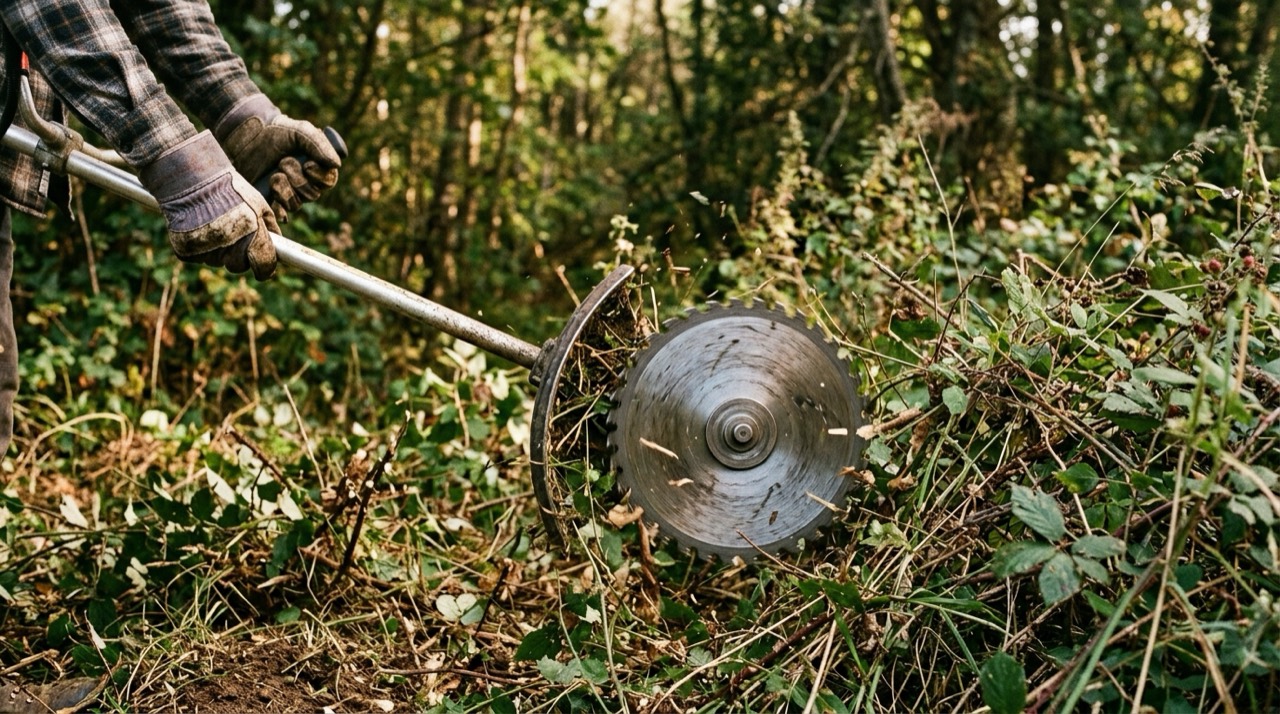
Fit a toothed circular saw blade when you need to cut standing saplings and small trees, typically up to three to four inches depending on the machine's power. These chainsaw-toothed or chisel-tooth discs, often eighty teeth or carbide-tipped, cut wood like a small saw and turn a clearing saw into a sapling-felling tool.Saw blades cut the most of any brush cutter blade and, predictably, carry the highest kickback risk. Contact in the wrong part of the arc can throw the whole machine violently, so saw blades belong on powerful bike-handle machines with a full harness and an experienced operator. The list below sums up when each blade earns its place.
- Grass blade: dense grass, reeds, and soft weeds, lowest thrust, safest.
- Brush knife or tri-blade: woody weeds, brambles, and thin saplings, moderate thrust.
- Saw blade: standing saplings and small trees, highest thrust, experienced users only.
For trees beyond a few inches, or anything leaning or overhead, switch to a chainsaw or a mini chainsaw instead of forcing a brush cutter.
What is blade thrust, and how do you avoid it?
Blade thrust, also called blade push, is the sudden sideways or backward lurch a spinning metal blade makes when it strikes something solid in the wrong part of its arc. It is the main hazard of any bladed brush cutter, and the more aggressive the blade, the harder it thrusts.Thrust happens because the teeth grab wood or metal and, unable to cut through instantly, drive the whole machine in the direction the contact point is travelling. On a blade spinning counter-clockwise, contact on the right side (roughly the twelve-to-three-o’clock zone) throws the machine violently back toward you, while contact on the left-front feeds cut material safely away. The rules that keep thrust under control are set out below:
- Cut only with the left-front section of the blade, the eight-to-eleven-o’clock zone on a counter-clockwise blade.
- Keep a firm two-handed grip on the bike handlebar and let the harness carry the weight so the machine cannot twist out of your hands.
- Clear rocks, wire, and hidden fence posts before cutting, because striking metal or stone causes the hardest thrusts.
- Cut standing stems near the base and let the blade’s speed do the work rather than forcing it through.
- Choose the least aggressive blade that will do the job, since fine, many-toothed blades thrust less than coarse saw blades.
A saw blade at full RPM striking a hidden wire can wrench a machine sideways instantly, which is why saw blades belong only on harnessed bike-handle machines and experienced operators. Full PPE and a correctly balanced harness are what turn an unavoidable occasional thrust into a non-event rather than an injury.
How many teeth should a brush cutter blade have?
Choose tooth count by material: high-count grass blades of thirty to eighty teeth slice soft growth finely, few-tooth brush knives of two to four teeth chop woody stems, and saw blades of sixty to eighty-plus teeth cut standing wood. More teeth give a finer, lower-thrust cut on soft material, while fewer, larger teeth bite harder into tough stems.The pattern is a trade-off between finesse and durability. A many-toothed grass blade leaves a clean finish on reeds and nettles but its fine teeth bend or shatter on wood. A two- or three-tooth brush knife survives impacts that would ruin a grass blade, at the cost of a coarser cut and more thrust per tooth. A high-count saw blade cuts wood cleanly but demands the most power and control. Match the count to the toughest material you cut regularly, and keep a spare blade of a different type for when the ground changes.
Should you choose a steel or carbide-tipped blade?
Choose plain steel blades for general clearing and easy field sharpening, and carbide-tipped blades when you frequently cut near dirt, sand, or gritty saplings that blunt steel fast. Carbide holds an edge far longer but costs more, is brittle on impact, and needs a diamond file or professional sharpening.Steel grass and brush blades are the everyday choice: cheap, tough, and quick to touch up with a flat file between jobs, so most owners keep several. Carbide-tipped saw blades earn their price where abrasive conditions dull steel within an hour, such as cutting scrub at ground level in sandy soil. Their weakness is impact, since a carbide tooth can chip or fly off if it hits a rock or wire, so they demand the same clear-the-ground discipline as any saw blade. Whichever you run, retire a blade the moment you find cracks, missing teeth, or lost carbide, because a failing blade can disintegrate at speed.
How do you match blade diameter and bore to your machine?
Match blade diameter, centre-bore size, and mounting to your machine’s approved list, never just to what physically fits. An oversized blade overspeeds at the rim and overloads the engine, while a wrong bore or missing adaptor lets the blade sit off-centre, vibrate, and work loose under load.Every machine specifies a maximum blade diameter and a shaft-bore size (commonly 20mm or 25.4mm), often with a stepped adaptor ring for different blades. Fitting a blade larger than the maximum raises tip speed beyond the guard’s and machine’s design, increasing thrust and the risk of a thrown blade. Always confirm the centre bore seats snugly on the shaft with no play, use the correct guard for a bladed head, and check the blade runs true before cutting. When in doubt, fit only blades the manufacturer lists for your model, and see our main brush cutter guide for how blade choice ties into machine power.
How do you mount and balance a brush cutter blade safely?
Mount a brush cutter blade with the engine off and the spark plug lead disconnected, seating the blade squarely on the gearhead's thrust washer, adding the retaining plate, and torquing the nut firmly by hand tools only. A loose, off-centre, or wrong-way blade vibrates, cuts poorly, and can fly off under load.The table below matches common blades to their material and the main caution for each.
| Blade type | Typical teeth | Best material | Main caution |
|---|---|---|---|
| Grass/weed blade | 8 to 40+ | Dense grass, reeds, soft weeds | Not for woody stems |
| Brush knife / tri-blade | 2 to 4 | Woody weeds, brambles, thin saplings | Higher thrust on impact |
| Saw blade | 60 to 80+ | Saplings and small trees | Highest kickback risk |
Always confirm the blade's centre bore matches the machine's shaft, use the correct guard for a bladed head, and lock the shaft with the supplied pin while you tighten. Check that the blade spins true with no wobble before you start, and replace any blade with cracks, bent teeth, or missing carbide. Our sharpening files and tools guide covers keeping edges keen, and full PPE is non-negotiable with any metal blade.