




Should an arborist choose a battery or gas top-handle saw?
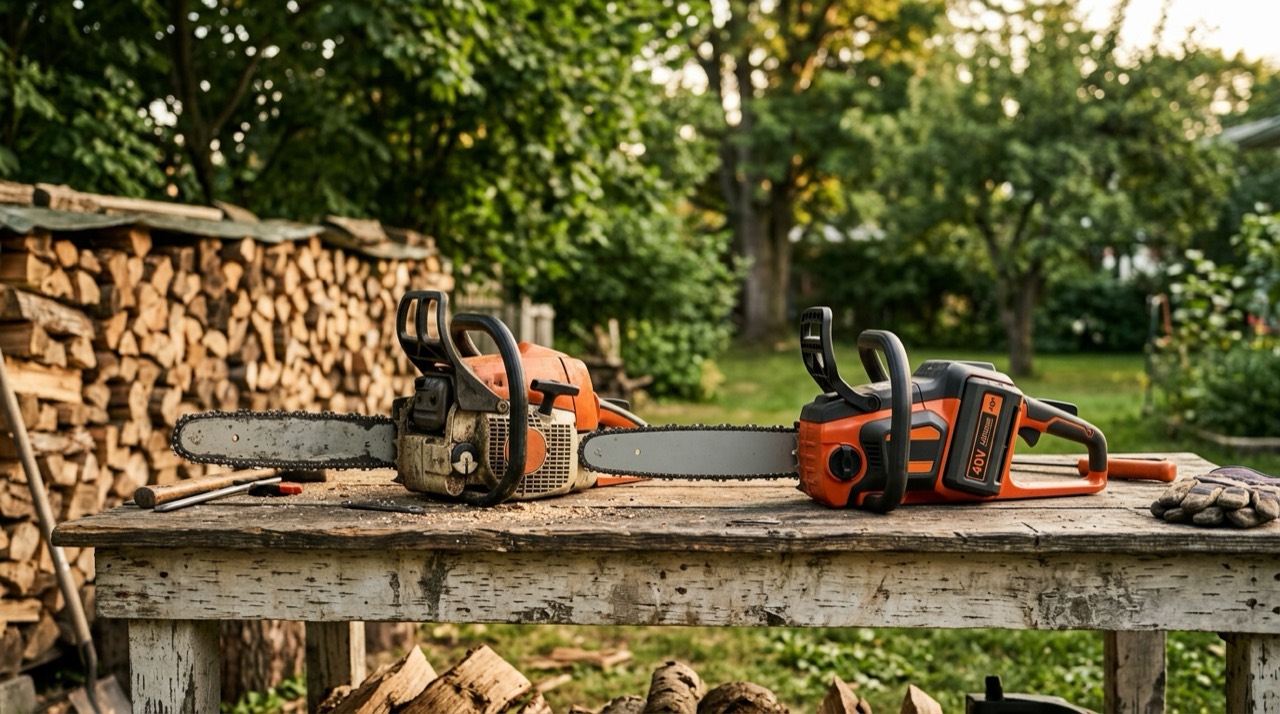
An arborist should choose a battery top-handle for quiet, low-vibration pruning close to people and buildings, and a gas top-handle for the longest runtime and the heaviest removals. Many working climbers now carry both and switch depending on the day's work.The decision rarely comes down to raw power alone, because both types cut small limbs easily. It turns on runtime, noise, weight with a battery fitted, and how the saw feels held at arm's length for hours. This guide sits alongside our wider arborist chainsaw guide and helps you weigh the two power sources before you shortlist specific models.
How do battery top-handle saws perform in the tree?
Battery top-handle saws perform very well for pruning and limb removal, offering instant throttle, low vibration, and no exhaust fumes drifting into the climber's face. For fine, repetitive cutting in a canopy, that responsiveness and quiet are genuine advantages, not just comfort features.The limits are runtime and recharge logistics. A pack lasts a stretch of active cutting rather than a full day, so crews carry spares and a charger on the truck. Weight shifts too, since the battery sits in the saw rather than a tank of fuel, and a bigger pack means more to hold aloft. Leading battery top-handles such as the Stihl MSA 220 T, Husqvarna 540i XP, and Milwaukee M18 FUEL are covered in our best top-handle picks.
How do noise and vibration compare between battery and gas top-handles?
Battery top-handle saws are markedly quieter and smoother than gas, which is more than a comfort issue aloft: lower noise aids communication with the ground crew, and lower vibration reduces the hand-arm fatigue that leads to mistakes late in the day. Gas saws remain louder and buzzier by nature.The practical effects show up across a working day:
- A quiet battery saw lets a climber hear instructions and hazards without shouting over the engine.
- Reduced vibration eases hand-arm strain, a real occupational concern for full-time climbers.
- No exhaust means no fumes drifting into the climber's face in a still, enclosed canopy.
- Gas saws still call for hearing protection, covered in our hearing and eye protection guide, on every job.
For pruning close to homes, hospitals, or schools, the quiet of a battery saw can also be the difference between an acceptable job and a noise complaint, which is why many urban crews have shifted their pruning work to battery.
How does weight really compare once a battery is fitted?
Weight comparison depends entirely on the battery. The lightest gas top-handles, near 5 to 6 pounds bare, can undercut a battery saw once a large pack is installed, while a battery saw with a small pack can be lighter but runs for a shorter time. There is no single winner.A few points make the trade-off concrete:
- A gas saw's weight is fixed, and its fuel is light, so it stays consistent through the tank.
- A battery saw's weight rises with pack size, and a bigger pack means both more runtime and more to hold aloft.
- Swapping to a small pack saves weight but forces more frequent changes.
Climbers balance saw weight against how long they need to cut between the ground and the next reposition. For fine pruning, a light saw and a small pack often win; for longer stretches aloft, the extra pack weight buys runtime. Our battery chainsaw guide covers how pack capacity trades against weight in more detail.
When does a gas top-handle saw still win?
A gas top-handle saw still wins when the day is long, the removals are heavy, and swapping batteries would slow the crew. A tank of fuel and a couple of spares keep a gas saw cutting continuously, which is why gas remains the traditional standard for production tree work.Gas saws also deliver strong, sustained power in a very light body, with the Echo CS-2511T among the lightest and the Stihl MS 201 T C-M and Husqvarna T540 XP II as the pro workhorses. Serviceability is another quiet advantage, since a gas saw can be field-repaired and kept running for many seasons on basic parts, where a failed battery pack usually means buying a costly replacement. The trade-offs are noise, exhaust near the face, more vibration, and the upkeep of two-stroke fuel, filters, and plugs, the same routine covered for larger saws in our gas chainsaw guide.
What maintenance does each power source demand?
Gas and battery top-handles need very different upkeep. A gas saw asks for fuel mixing, air filters, spark plugs, and carburettor care, while a battery saw mostly needs its packs charged and looked after. Both still need the same bar, chain, and sharpening attention every day.The routines diverge like this:
- Gas saws need fresh two-stroke mix, clean filters, and occasional plug and carburettor work, detailed in our chainsaw maintenance guide.
- Battery saws avoid all fuel-system upkeep but depend on healthy packs stored and charged correctly.
- Both need a sharp, correctly tensioned chain and a clean, oiled bar to cut safely.
A gas saw can usually be field-repaired and kept running for many seasons on basic parts, while a failed battery pack means an expensive replacement rather than a repair. That difference in serviceability is part of why some production crews still keep gas in the kit even as they add battery saws for pruning.
What does going battery cost across a climbing kit?
Going battery costs more upfront once you add packs and a charger, but it saves on fuel, two-stroke oil, and much of the engine maintenance a gas saw demands. The honest comparison has to count batteries as a consumable, because packs wear out and are expensive to replace.The saving that matters most to many crews is not money but effort: no mixing fuel, no stale-fuel starting problems, and far less servicing. It is worth planning charging around the working day, though, because a flat pack with no spare stops the climb, whereas a can of fuel is quick to top up between cuts. If your work is mostly pruning near homes, that low-fuss running often justifies the platform, and if you already own tools on a battery system such as Stihl AP or Milwaukee M18, sharing packs across saws and tools tips the maths further toward battery, a point explored in our battery chainsaw guide.
Which power source suits pruning near homes and people?
Battery top-handle saws suit work near homes, gardens, and busy public spaces best, because they are quiet, produce no exhaust fumes, and start with a trigger rather than a pull. For an arborist pruning a street tree or a garden close to windows, those traits matter as much as cutting power.Battery saws win this setting because:
- Their low noise reduces disturbance and complaints in residential and urban work.
- No exhaust means nothing drifting into open windows or the climber's face in still air.
- Instant, fuel-free starting suits the stop-start rhythm of careful pruning.
Gas saws still have a place for longer removals away from noise-sensitive areas, but for the fine, frequent cutting that defines urban tree care, a battery saw such as the Stihl MSA 220 T is often the better neighbour. Whichever you choose, the climbing training and PPE come first, a point our arborist chainsaw guide never lets go of.
How should a crew decide between battery and gas?
A crew should decide by looking honestly at the work it does most, the batteries or fuel it can keep on hand, and the tools it already owns. There is rarely one right answer, which is why many established crews run both and match the saw to the day.A simple way to weigh it:
- If most work is fine pruning near homes, lean battery for quiet, clean, low-fuss running.
- If most work is long removals far from noise limits, lean gas for runtime and field serviceability.
- If the crew already owns tools on Stihl AP, Husqvarna 36V, or Milwaukee M18, sharing packs tips the maths toward battery.
- If downtime is costly and charging is hard on site, gas or a large battery kit with spares keeps you cutting.
The best top-handle chainsaw picks include strong options in both camps, so the decision is about fit, not about one power source being universally better than the other.
Which top-handle saws lead each camp?
In gas, the Stihl MS 201 T C-M and Husqvarna T540 XP II lead the professional field, with the 25cc Echo CS-2511T as the ultralight choice for fine pruning. In battery, the Stihl MSA 220 T, Husqvarna 540i XP, and Milwaukee M18 FUEL top-handle are the names that recur on modern crews.Each of these shares the safety essentials that any top-handle must have: a chain brake, effective anti-vibration, and a secure lanyard point, run with a sharp low-kickback chain from our chainsaw chains guide. Match the model to the batteries or fuel you can realistically keep on hand, and never let the choice of power source distract from the training that actually keeps the work safe. Based on manufacturer specs and aggregated trade feedback, these are the saws working arborists reach for, and whichever power source you pick, the climbing training and PPE come first.