Top Handle Chainsaw Vs Rear
Top Handle Chainsaw Vs Rear, ranked from aggregated owner ratings and reviews, not first-hand testing. Real pros, cons, and who each pick is best for.

Our Top 3 Picks
Quick Comparison
| Product | Best for | Buy | |
|---|---|---|---|
| Stihl MS 201 T C-M | Best Overall | See Amazon | View (paid link) |
| Husqvarna T540 XP II | Best Value | See Amazon | View (paid link) |
| Echo CS-2511T | Best Compact | See Amazon | View (paid link) |
| Stihl MSA 220 T | Best Premium | See Amazon | View (paid link) |
| Husqvarna 540i XP | Best Heavy-Duty | See Amazon | View (paid link) |
| Milwaukee M18 FUEL Top Handle | Editor's Pick | See Amazon | View (paid link) |
Top-handle vs rear-handle chainsaws: which should you buy?
Buy a rear-handle chainsaw if you cut on the ground, which is almost everyone, and a top-handle saw only if you are a trained arborist working aloft on rope and harness. The handle layout, not the power, is what separates these two classes and decides which is safe for you.The picks above put professional top-handle saws alongside two-handed rear-handle saws so the trade-offs are visible in real models. The sections below compare the two layouts on control, safety, and the jobs each is built for, so you land on the right class before choosing a specific saw.
What is the real difference between top-handle and rear-handle saws?
The real difference is grip position and how the saw is meant to be held. A top-handle saw places the rear grip on top so a climber can balance and cut with one hand, while a rear-handle saw spaces its grips front and back for firm two-handed control on the ground.That layout ripples through the whole saw. The table below summarises how the two classes compare on the factors that matter when you choose.
| Attribute | Top-handle | Rear-handle |
|---|---|---|
| Intended use | Trained climbers aloft | Two-handed ground cutting |
| Handling | One-handed, compact | Two-handed, stable |
| Typical bar | 10-16 in | 14-24 in and up |
| Kickback control | Lower (one hand) | Higher (two hands) |
| Best buyer | Certified arborist | Homeowners and most pros |
How do top-handle and rear-handle saws differ in weight and balance?
The two classes differ mostly in how their weight is arranged rather than how much they weigh. A top-handle saw balances over a single hand so a climber can control it aloft, while a rear-handle saw spreads its mass between two well-separated grips for stability on the ground.That difference in balance drives how each feels in use:
- A top-handle saw can be held at arm's length and worked one-handed, which is essential in a tree and hazardous on the ground.
- A rear-handle saw sits naturally in two hands, letting you brace against the cut and absorb kickback with your whole body.
- The lightest top-handles, around 5 to 6 pounds bare like the Echo CS-2511T, feel nimble aloft but offer no real advantage once you are standing on the ground.
For anyone cutting with both feet planted, the two-handed balance of a rear-handle saw from our gas chainsaw guide is the safer and less tiring choice.
Why do the two classes run such different bar lengths?
The two classes run different bars because they do different jobs: top-handle saws carry short 10 to 16 inch bars for light, controllable one-handed cutting, while rear-handle saws run 14 to 24 inches or more to reach through larger wood on the ground.A short bar suits the canopy for good reasons:
- It keeps the saw light and the nose clear of adjacent branches in a tight space.
- It reduces the leverage a kickback can generate at the tip.
- It matches the small powerhead a climbing saw is built around.
A longer bar suits the ground because two-handed control can manage it and the wood is bigger. If a top-handle saw's short bar feels limiting, that is usually a sign the work belongs on the ground with a rear-handle saw, sized with help from our chainsaw bars guide. Oversizing a climbing saw's bar simply adds nose weight and kickback risk without turning it into a felling saw.
Which chainsaw is safer for ground use?
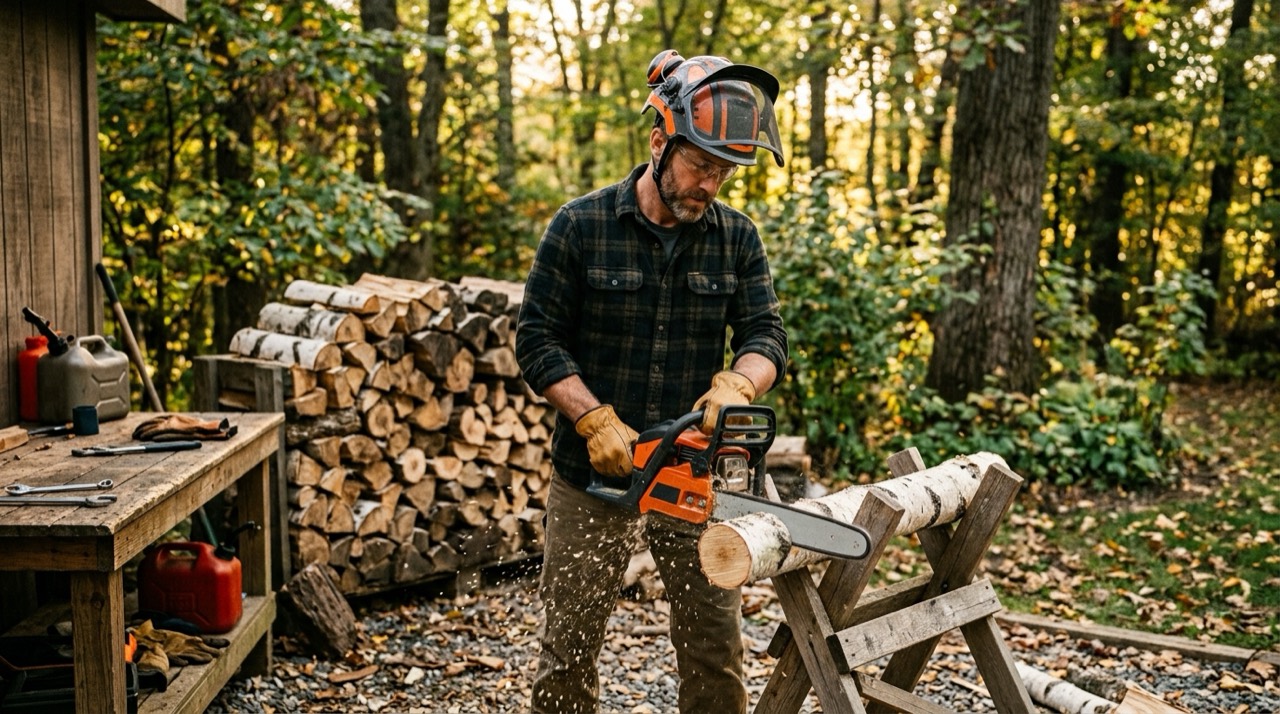
A rear-handle chainsaw is far safer for ground use, because two hands on well-separated grips give you the leverage to control kickback and hold the cut steady. Top-handle saws remove that leverage by design, which is why one-handed use on the ground is strongly discouraged and, in some settings, restricted.If your cutting happens with both feet on the ground, whether firewood, limbing, or small felling, a rear-handle saw from our gas chainsaw guide or battery chainsaw guide is the correct and safer choice. A top-handle saw's advantages only appear once you are roped into a tree. Ground users also benefit from the rear-handle stance itself, since standing behind the saw with two hands lets you brace against the cut and step back cleanly, control a one-handed climbing saw was never meant to offer.
When is a top-handle chainsaw the right tool?
A top-handle chainsaw is the right tool only when a trained arborist needs to prune or dismantle a tree from within the canopy, holding on with one hand and cutting with the other. In that specific situation, its compact one-handed balance is exactly what the job demands.Outside climbing work there is little reason to own one, and the one-handed layout that helps aloft becomes a liability on the ground. Our best top-handle chainsaw picks cover the professional models climbers rely on, and the wider arborist chainsaw guide explains the training the work requires.
What jobs suit a rear-handle saw that a top-handle should never attempt?
A rear-handle saw handles the heavier ground jobs a top-handle saw is not built for: felling, bucking firewood, and cutting large sections lowered from a tree. These tasks need the sustained power and two-handed control that a small one-handed climbing saw cannot safely provide.Jobs that belong to a rear-handle saw include:
- Felling standing trees, where a planned escape path and two-handed control are essential.
- Bucking logs and processing firewood, covered further across our chainsaws hub.
- Sectioning large limbs on the ground after they are lowered from the canopy.
- Any sustained cutting where a bigger engine, like the Husqvarna (paid link) 455 Rancher's, earns its keep.
The rule is simple: if your feet are on the ground, reach for a rear-handle saw. The top-handle saw is a specialist tool for the one situation where a hand must stay free to hold the tree.
Which saw is easier to maintain and live with?
Both classes share the same basic upkeep, a sharp chain, correct tension, a clean bar, and fresh fuel or a charged pack, but a rear-handle homeowner saw is generally the easier tool to live with. It is used less intensively than a climber's daily saw and is more forgiving of occasional maintenance.The practical differences are small but real:
- A professional top-handle saw is sharpened and tensioned many times a day, so it rewards a disciplined routine.
- A homeowner rear-handle saw can go longer between touch-ups because it cuts less often.
- Both benefit from the same care covered in our chainsaw maintenance guide and sharpening guide.
Whichever you own, a sharp chain does more for safety and ease of use than any feature on the saw, because a dull chain forces you to push, and pushing is where control slips away from you.
Do you actually need both a top-handle and a rear-handle saw?
Most people need only a rear-handle saw, because almost all cutting happens on the ground. A trained arborist working aloft needs a top-handle saw for the canopy and typically owns a rear-handle saw as well for felling and ground processing.Deciding what to own comes down to the work:
- Homeowners and most pros: a single two-handed rear-handle saw from our battery chainsaw guide covers firewood, limbing, and small felling.
- Certified climbers: a top-handle saw for the tree plus a rear-handle saw for the ground, matching each layout to where the cutting happens.
- Occasional light pruning: often no chainsaw at all, since a manual pole pruner or pruning saw does the job safely.
Buying a top-handle saw as a first or only saw, drawn by its compact size, gets the priority backwards. The safe default is a rear-handle saw, with a top-handle added only when trained climbing work genuinely calls for one.
What safety gear and training does each saw need?
Both saw types demand cut-resistant leg protection, gloves, eye and hearing protection, and a chain brake, but a top-handle saw adds the whole climbing system: a helmet with a chin strap, a harness, ropes, and formal arborist training with aerial-rescue readiness. The stakes rise sharply once you leave the ground.Match any saw to jobs you are trained for, keep the chain sharp with help from our sharpening guide, and gear up with proper chainsaw chaps and PPE and a climbing helmet. Keep both hands on a rear-handle saw wherever the grips allow, plan an escape path before any felling cut, and never cut a limb under tension without releasing that tension safely first. These comparisons rest on manufacturer specs and aggregated owner feedback, not first-hand testing, and climbing work near power lines or large limbs belongs to a qualified professional.
Full Ranking, Reviewed

Best for Certified arborists wanting an all-round climbing saw
- Around 35cc engine paired with a 12-14 inch bar
- M-Tronic engine management for easier starting and consistent tuning
- Light, balanced body designed for one-handed use aloft
- Anti-vibration handles and a secure lanyard ring
- A long-standing professional standard for tree work
- Strong, steady power for a top-handle saw
- Widely supported by Stihl servicing dealers
- Premium price for a small saw
- Dealer-only servicing in many areas
Verdict: The saw many working arborists measure others against, balancing power, weight, and control for daily climbing use.

Best for Production pruning and repeated removals
- Around 38cc engine with a 14 inch bar
- High power-to-weight ratio for its class
- AutoTune-style engine management for altitude and fuel changes
- Side-access chain tensioning for quick field adjustment
- Strong cutting for a light top-handle saw
- Good value against comparable pro saws
- Comfortable for a full day of pruning
- Still a professional-priced tool
- Needs two-stroke fuel mixing and upkeep
Verdict: A capable, well-priced professional top-handle that gives up little to the class leaders for most climbing work.

Best for Climbers who want the lightest possible gas saw
- Around 25cc engine, one of the lightest gas top-handles sold
- Compact body of roughly 5 to 6 pounds bare
- Short 12 inch bar for tight canopy work
- Long Echo consumer warranty for a pro-style saw
- Exceptionally light and easy to hold aloft
- Nimble for fine pruning in tight spaces
- Backed by a strong warranty
- Limited power for larger limbs
- Short bar restricts cutting reach
Verdict: A featherweight gas saw for fine pruning where every ounce held overhead counts against you.
Best for Quiet, fume-free canopy work on the Stihl AP system
- Battery top-handle on Stihl's AP professional platform
- Brushless motor with instant throttle response
- Very low vibration and no exhaust near the face
- Runs on batteries shared with other AP tools
- Near-silent and fume-free for enclosed canopies
- Instant power with no warm-up or mixing
- Low vibration reduces climber fatigue
- Battery runtime limits long removals
- Premium price once batteries are added
Verdict: A refined battery top-handle for arborists who value quiet, clean running, ideal for pruning close to buildings and people.

Best for The most demanding battery limb work
- Professional 36V battery top-handle saw
- Strong, sustained torque for a cordless saw
- Low weight with the compatible battery fitted
- Shares batteries across Husqvarna's pro battery range
- Strong cutting for a battery top-handle
- Quiet and low-maintenance
- Fits a wider pro battery ecosystem
- Best value only with spare batteries
- Runtime still trails gas for all-day removals
Verdict: The battery top-handle to reach for when limb work gets demanding but you still want quiet, fume-free running.

Best for Tree crews already invested in M18 tools
- 14 inch bar driven by a brushless motor
- Runs on the wide M18 tool battery platform
- Rugged build aimed at daily jobsite use
- Tool-free chain tensioning for field work
- Shares batteries with a large M18 tool range
- Pro-grade cordless cutting
- Durable for continuous crew use
- Heavier than the lightest top-handles
- Best value only for existing M18 owners
Verdict: A strong battery top-handle that makes obvious sense for crews already carrying M18 packs on the truck.
Frequently Asked Questions
Is a top-handle or rear-handle chainsaw better for a homeowner?
A rear-handle chainsaw is better for almost every homeowner, because its two-handed grip gives the control and kickback safety you need for ground cutting. Top-handle saws are specialist climbing tools for trained arborists, and their one-handed design is a hazard for the ground work most homeowners actually do.
Is it legal to use a top-handle chainsaw on the ground?
Using a top-handle chainsaw on the ground is legal for most private owners in many places, but it is strongly discouraged and often restricted in professional settings under standards like ANSI Z133. The saws are designed for one-handed use aloft, and ground use removes the two-handed control that keeps you safe.
Can you put a longer bar on a top-handle chainsaw?
You can sometimes fit a slightly longer bar within the manufacturer's rated range, but you should not oversize it. Top-handle saws are built around short 10-16 inch bars for light, controllable one-handed use, and a long bar adds nose weight, invites kickback, and exceeds what the small powerhead is designed to drive.
Do professional arborists use rear-handle chainsaws too?
Professional arborists use rear-handle chainsaws constantly, for felling, ground processing, and larger cuts where two-handed control and more power are needed. The top-handle saw is only for work inside the tree, so a typical crew carries both and matches the layout to whether they are on the ground or aloft.