

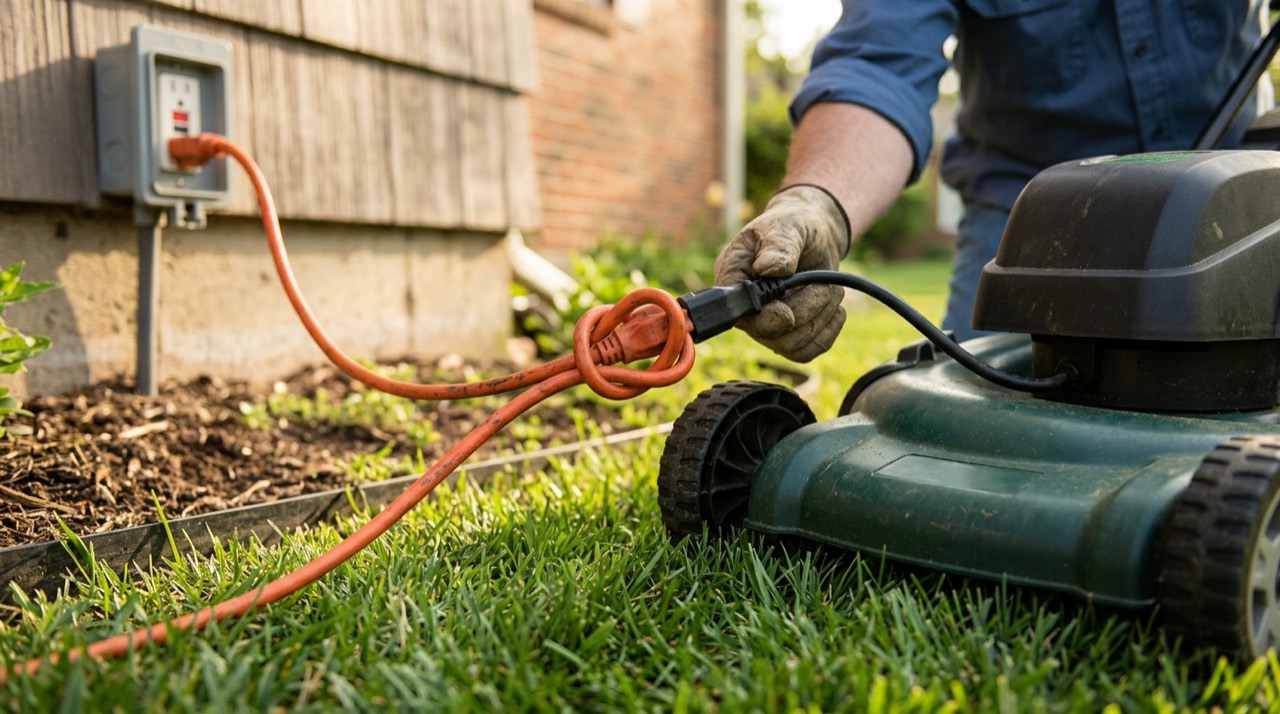


How do you run a corded electric mower safely?
Run a corded electric mower safely by plugging into a GFCI-protected outlet, using a heavy outdoor-rated extension cord no longer than the mower allows, and mowing in a pattern that always draws the cord away from the deck. Those three habits prevent almost every corded-mower accident.
A corded mower adds one hazard a gas mower does not have: a live electrical cable lying in wet grass beside a spinning blade. Manage the cord well and a corded mower is one of the safest, simplest tools in the yard. The rest of this guide covers the cord, the outlet, and the mowing patterns that keep the two apart.
What gauge and length of extension cord do you need?
Use a heavy, outdoor-rated extension cord in 12- or 14-gauge, and keep the total run at or under the length the manufacturer specifies, usually around 100 feet. A thinner or longer cord starves the motor, makes it run hot, and can trip breakers.
Cord gauge matters because the motor pulls real current, and thin wire drops voltage over distance. The lower the gauge number, the thicker the copper and the more power reaches the mower. The guidance below reflects typical manufacturer and electrical-safety advice.
- Up to about 50 feet: a 14-gauge outdoor cord handles most corded mowers.
- 50 to 100 feet: step up to a 12-gauge cord to avoid voltage drop.
- Beyond 100 feet: avoid it; the motor overheats, so move to a nearer outlet or a battery mower.
Always choose a cord marked for outdoor use (often “W” rated) with a grounded three-prong plug, and inspect it for nicks or cracked insulation before each mow. A damaged cord goes in the bin, not back on the lawn.
What features make an extension cord safe for mowing?
Beyond gauge and length, a mowing cord should be outdoor-rated, have a grounded three-prong plug, and ideally lock to the mower's plug so a tug cannot pull it apart. These features keep power flowing safely while the cord drags across grass and around corners.
The features that separate a safe mowing cord from a risky one are listed below.
- Outdoor rating — a cord marked for outdoor use (often a “W” in the type code) with weather- and abrasion-resistant insulation.
- Grounded three-prong plug — the ground pin is a safety feature; never cut it off or use a two-prong adapter to force a fit.
- A locking or cord-retention connection — a plug that clips to the mower's inlet, or the handle's cord hook, stops the lead unplugging mid-mow.
- A high-visibility color — a bright orange or yellow cord is easy to keep track of against green grass, so you are less likely to mow over it.
- A single continuous length — one cord of the right length beats several short ones chained together, which add resistance and loose connections that can pull apart or spark.
A cord reel or a simple over-the-shoulder loop keeps the slack managed so it never wanders under the deck. Inspect the whole length before each mow and retire any cord with nicks, cracked insulation, or a bent ground pin rather than trusting tape to make it safe.
Why does a corded mower need a GFCI outlet?
A GFCI outlet cuts power within milliseconds when it senses current leaking to ground, which is exactly what happens if the cord is damaged or a connection gets wet. It is your primary defense against a fatal shock while mowing.
Ground-fault protection is essential because you are handling electricity outdoors, on grass that may be damp, with a metal-decked machine. If your outdoor socket is not already a GFCI, use a plug-in GFCI adapter at the outlet, or have an electrician fit one. Test the GFCI's trip button before the season starts. Never defeat the third grounding prong or use a two-prong adapter to force a fit. For a full picture of yard-tool protection, our electric lawn mower guide covers where corded models fit against battery and gas.
How do you keep the cord and connections dry?
Keep the plug-to-cord connections up off wet grass and never let them sit in a puddle, because water bridging a connection is exactly the fault a GFCI is there to catch. Dry connections and a GFCI outlet together are what make electric mowing safe on a damp morning.
The riskiest point on the whole setup is where two plugs meet, so give that junction attention. Hang the outlet-end connection off the ground on a hook or a dry step rather than laying it in the grass, and use a waterproof cord-connector cover or a simple twist-and-tuck to shield the join from dew and spray. Avoid mowing at all when the grass is soaking; light dew is the wet limit for any electric mower. If a connection does get wet, stop, unplug at the wall, and dry it before carrying on. Storing the cord coiled and dry between mows, rather than leaving it out in the weather, also keeps water out of the plug pins where it can cause a fault next time.
What mowing pattern keeps the cord clear of the blade?
Mow in a pattern that starts nearest the outlet and works away from it, so the cord always trails behind the mower and never crosses in front of the deck. The two reliable patterns are striping away from the socket and mowing in a spiral outward.
Cord management is a learned habit, not luck. Drape the lead over the shoulder on the outlet side, or clip it to the handle's cord-retention hook so a tug never yanks the plug. The steps below keep the cord safe on every pass.
- Plug in and set the reel or coil at the outlet, not out in the yard.
- Start at the outlet end and mow the strip closest to it first.
- Turn away from the cord at each row end so the lead folds behind you.
- Sweep the cord clear with your foot before reversing direction.
- Watch the plug and stop if the lead ever runs toward the deck.
If the cord does get cut, stop immediately, unplug at the wall before touching the lead, and replace the cord. Pair the job with hearing and eye protection, keep children and pets indoors while you mow, and unplug the mower before you ever reach under the deck. These are general safety practices; always follow your mower's own manual.
When should you unplug a corded mower?
Unplug a corded mower any time your hands go near the blade or the deck, and any time you step away. Pressing the safety bar stops the blade, but only pulling the plug removes power for certain, which is the rule before adjusting height, clearing clippings, or inspecting the underside.
Treat the plug as the real off switch. The situations that call for unplugging are listed below.
- Before tipping the mower to sharpen, change, or check the blade.
- Before clearing a clogged deck or freeing a jam of wet clippings.
- Before crossing a hard path or driveway where you might set the mower down.
- Whenever you walk away, even briefly, so a child or pet cannot start it.
A corded mower that is plugged in is a live machine, so never leave one unattended on the lawn with the cord connected.
What protective gear should you wear, and who should get help?
Wear sturdy closed shoes, eye protection, and hearing protection when you mow, and keep children and pets indoors until you finish. A corded mower is quiet compared with gas, but the blade still throws debris and the cord adds a trip hazard worth dressing for.
The basic gear is simple: closed leather or sturdy shoes protect your feet from the deck and thrown objects, safety glasses guard against flung stones and grit, and light hearing and eye protection covers the motor and blade noise over a long mow. Long trousers help against debris, and gloves improve grip on the handle and cord.
Some situations call for extra caution or a different tool. Steep or slippery slopes are hazardous with a trailing live cord, and a battery lawn mower or a professional service is safer there. Anyone unsteady on their feet should not drag a cord across uneven ground. And if a job involves cutting near the cord's own path, standing water, or ground you cannot see clearly, stop and reassess rather than pressing on. None of this replaces the instructions and warnings in your mower's own manual, which always take priority.