


What can you attach to a riding lawn tractor?
A riding lawn tractor accepts a wide range of attachments that turn it into a year-round machine: baggers and mulching kits for grass, tow-behind carts and spreaders for hauling and feeding, dethatchers and aerators for lawn care, and blades or blowers for snow. Most bolt on or hitch to the rear in minutes, which is a big part of a tractor's value over a walk-behind mower.
The main attachment families are listed below, grouped by the job they do.
- Grass handling: rear baggers, mulching kits, and side-discharge chutes.
- Ground care: tow-behind dethatchers, core aerators, and rollers.
- Hauling and feeding: utility carts, broadcast spreaders, and sprayers.
- Winter and rough work: front blades, snow blowers, tire chains, and wheel weights.
Not every attachment fits every tractor, so check your model's hitch type, drive setup, and weight limits before buying.
Which grass-handling attachments matter most?
Grass-handling attachments decide what happens to the clippings, and the right one depends on your lawn. A rear bagger collects clippings for a clean finish and is ideal in autumn leaf season, though it needs emptying and adds bulk. A mulching kit closes the deck to cut clippings fine and drop them back as free fertiliser, which suits regular mowing of dry grass.
Side discharge, the default on most decks, simply throws clippings out to the side and is fastest for tall or infrequent mowing. Many owners switch between bagging and mulching by season. Whichever you use, sharp blades and correct cutting height matter more than the attachment; our lawn mower maintenance guide covers keeping the deck and blades in shape.
How do you choose between bagging, mulching, and side discharge?
Choose bagging for a clean finish and leaf collection, mulching to feed clippings back as free fertiliser, and side discharge for speed on tall or infrequent growth. Most decks switch between the three with a kit, so many owners change mode by season rather than picking one forever.
The three grass-handling modes are compared below.
| Mode | What it does | Best for | Trade-off |
|---|---|---|---|
| Bagging | Collects clippings in a rear catcher | Autumn leaves, a tidy finish | Needs emptying, adds bulk |
| Mulching | Cuts clippings fine and drops them back | Regular mowing of dry grass | Struggles in tall or wet grass |
| Side discharge | Throws clippings out to the side | Tall or infrequent mowing | Leaves visible rows on the lawn |
Bagging gives the neatest look and is unbeatable in leaf season, but the catcher fills quickly and has to be emptied. Mulching returns nitrogen to the soil and saves trips to the compost heap, provided you mow often enough that the clippings stay short and dry. Side discharge asks the least of the engine and is fastest when grass has got away from you. Whatever the mode, a sharp blade and the right cutting height matter more than the attachment, which is why blade care leads every routine.
What can you tow behind a lawn tractor?
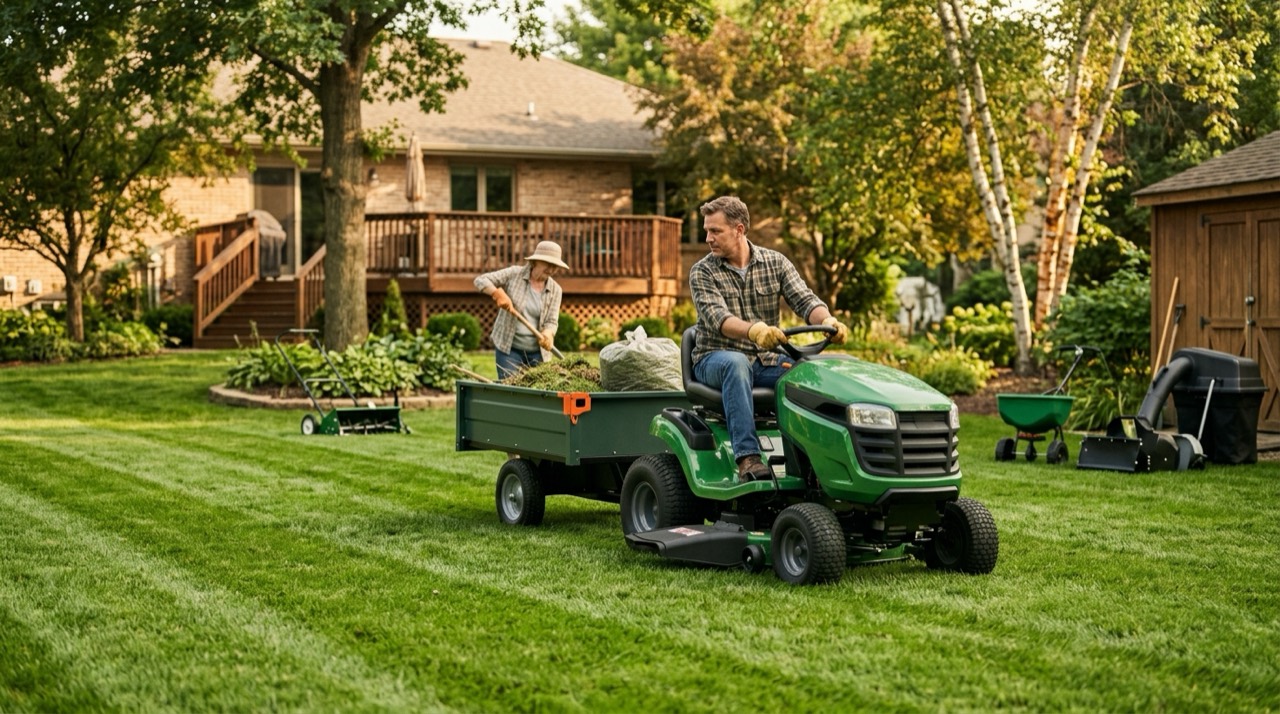
A lawn tractor tows a surprising amount of lawn-care and hauling gear through its rear hitch. A utility cart carries soil, mulch, firewood, and tools around a big property; a broadcast or drop spreader lays seed, fertiliser, and ice melt evenly; and a tow-behind sprayer covers large areas with weed or pest treatment.
Lawn-renovation attachments hitch on the same way. The common tow-behinds are listed below.
- Utility carts for hauling soil, mulch, and firewood.
- Broadcast and drop spreaders for seed, fertiliser, and salt.
- Dethatchers to rake matted thatch out of the lawn surface.
- Core aerators that pull plugs to relieve compacted soil.
- Lawn rollers for levelling and improving seed contact.
Watch the tractor's stated towing and tongue-weight limits, and load carts evenly so the front wheels keep steering and braking traction.
What do hitch types and compatibility mean for attachments?
Compatibility comes down to the hitch, the deck, and the tractor's weight rating, so an attachment made for one model rarely bolts straight onto another. Most tow-behind gear connects to a standard rear hitch pin, while baggers, mulching kits, and blades are matched to a specific deck size and mounting pattern.
Before buying, check three things: the hitch style your tractor uses, the deck width a grass attachment is cut for, and the towing and mounting weight limits in the manual. A bagger built for a 42-inch deck will not seal against a 46-inch one; a front blade needs the mounting brackets and often the front weight the maker specifies. Tow-behind carts, spreaders, and dethatchers are the most universal, since a rear pin hitch is fairly standard, but even they have tongue-weight limits. When in doubt, buy the attachment the tractor's own brand lists for your model, or confirm the fit before you order — a mismatched attachment is at best useless and at worst unsafe.
Can a lawn tractor handle snow and winter jobs?
A lawn tractor can handle light snow and yard work in winter with the right attachments, which is a major reason owners of big properties choose one over a mower alone. A front dozer blade pushes snow off drives and paths, a two-stage snow blower attachment clears deeper falls, and tire chains plus rear wheel weights add the traction the tractor needs to push a load.
There are limits. A garden tractor with a stronger frame handles winter work far better than a light entry rider, and deep or heavy snow is still a job for a dedicated snow blower or a professional. Store the mowing deck and attachments somewhere dry between seasons; our outdoor tool storage guide covers keeping bulky gear organised and rust-free.
How do wheel weights and tyre chains improve traction?
Wheel weights and tyre chains add the grip a light tractor needs to push a blade, pull a loaded cart, or climb a damp slope. Weights bolt to the rear wheels to plant them harder, while chains bite through snow and mud to stop the tyres spinning; together they turn a mowing machine into a capable hauler.
Rear wheel weights lower the machine's effective centre of gravity a little and press the driven wheels down, which improves both traction and stability under a heavy tow or a front blade. Tyre chains matter mainly for winter and wet, boggy ground, where bare turf tyres simply slip. Add both in the amounts the maker specifies rather than improvising, since too much weight strains the transmission and axles. Ground-engaging work like plowing or heavy towing is where a garden tractor's stronger frame really pays off, and even then you keep speeds low and turns gentle so the added weight does not upset the machine.
Which tractor attachments are worth buying, and which are not?
The attachments most owners get real value from are a utility cart, a bagger or mulching kit, and a spreader; the ones that disappoint are heavy ground-engaging tools on a light rider that cannot pull them. Match the attachment to what your tractor is actually built to do.
A utility cart is the single most useful add-on for anyone with a big property, turning the tractor into a hauler for soil, mulch, and firewood. A bagger or mulching kit earns its place on almost any lawn, and a broadcast spreader makes feeding and over-seeding quick. Where owners waste money is fitting plows, tillers, or big snow blowers to a light entry tractor that lacks the frame, weight, and traction to use them; those jobs belong to a garden tractor or a dedicated machine. Buy the attachments that suit your tractor's class and your actual chores, and skip the ones that ask a light rider to do heavy work — the best riding mower picks note which classes tow and mount the most.
How do you attach and use tractor attachments safely?
Attach and use tractor accessories with the engine off, the blades disengaged, and the parking brake set, then follow each attachment's own manual for hitching and weight limits. Ground-engaging and towed gear changes how the tractor balances, so add the wheel weights the maker specifies and keep speeds low, especially on slopes and while turning with a loaded cart.
Never exceed the stated towing weight, never carry passengers on a tractor or in a cart, and keep bystanders clear of any powered attachment. Wear work gloves and eye protection when fitting blades and augers. These are general guidelines; your tractor's and attachment's manuals set the binding limits, and heavy ground-engaging work may call for a garden tractor rather than a light rider. When you are comparing machines by attachment capability, our best riding mower picks note which classes tow and mount the most.