Best Robot Lawn Mower
Best Robot Lawn Mower, ranked from aggregated owner ratings and reviews, not first-hand testing. Real pros, cons, and who each pick is best for.

Our Top 3 Picks
Quick Comparison
| Product | Best for | Buy | |
|---|---|---|---|
| Husqvarna Automower 430X | Best Overall | See Amazon | View (paid link) |
| Segway Navimow i110N | Best Value | See Amazon | View (paid link) |
| WORX Landroid M WR140 | Best Compact | See Amazon | View (paid link) |
| EGO Power+ Robotic Mower | Best Premium | See Amazon | View (paid link) |
| Gardena Sileno Minimo | Best for Beginners | See Amazon | View (paid link) |
| WORX Landroid Vision | Editor's Pick | See Amazon | View (paid link) |
How to choose the best robot lawn mower
The best robot lawn mower is the one matched to your lawn size, slope, and how much installation you are willing to do. Decide first between a buried boundary wire and a wire-free system, then confirm the model is rated for more area than you actually have.Robot mowers reward a careful measurement up front. Pace out your lawn, note the steepest bank, and check whether the front and back connect, because a machine cannot cross a driveway on its own without a guide wire or a second zone. The picks below span wire-guided workhorses and newer wire-free models, so there is a sensible option whether you want proven reliability or the simplest possible setup.
Do you need a boundary wire or a wire-free robot mower?
Boundary-wire mowers are the most reliable in shade and under trees, while wire-free RTK and vision mowers save you the biggest job at install. If your lawn has heavy tree cover that blocks the sky, a wire model is the safer bet; if it is open, a wire-free model skips the digging entirely.A boundary wire is pegged or buried once and then ignored for years, guiding the mower around the edge and back to its dock. Wire-free RTK models like the Navimow read satellite positioning through a base antenna that needs a clear view of the sky, and vision models like the Landroid Vision use a camera instead. Neither wire-free approach likes dense overhead canopy, so match the system to your lawn, not just the marketing.
How much lawn can each model cut, and on what slope?
Rated coverage area and maximum slope grade decide whether a mower can finish your lawn without leaving stripes. Small robots suit yards up to around 500 square metres, mid-range models up to a quarter acre, and the larger picks here up to roughly 0.8 acre, with slope limits from about 25 to 45 percent.Always choose a model rated above your measured area, because garden beds, tight passages, and complex shapes reduce the real figure. The comparison table below lines up every pick by navigation type, rated area, slope ability, and the buyer it fits, so you can shortlist at a glance before reading the individual verdicts.
The five attributes that separate these robot mowers are set out in the table below.
| Model | Navigation | Rated area | Max slope | Best for |
|---|---|---|---|---|
| Husqvarna Automower 430X | Boundary wire + GPS | ~0.8 acre | ~45% | Reliable mid-size lawns |
| Segway Navimow i110N | Wire-free RTK | ~0.25 acre | ~30% | Skipping the boundary wire |
| WORX Landroid M WR140 | Boundary wire | ~0.25 acre | ~35% | Small yards on a budget |
| EGO Power+ Robotic Mower | Wire-free LiDAR + GPS | Mid-size | Moderate | Wire-free without antennas |
| Gardena Sileno Minimo | Boundary wire | ~500 m² | ~25% | First-time owners |
| WORX Landroid Vision | Wire-free camera | Small to mid | Moderate | Camera-guided setup |
How do you keep a robot mower secure and connected?
Robot mowers guard against theft with a PIN lock, an alarm, and GPS tracking on premium models, so a stolen machine is hard to reuse and easier to locate. Keep the mower registered in its app and the firmware current so tracking and geofencing keep working.Connectivity matters day to day as well as against theft, because the app is how you set schedules, adjust cutting height, and see error alerts. Wire-free RTK models depend most on a stable signal, so site the base antenna with a clear sky view and away from walls. Once set up, a robot mower is close to hands-off, but a few minutes registering it properly pays off if it ever wanders or walks.
How do you match a robot mower to your lawn's shape and obstacles?
Match a robot mower to your lawn by looking beyond square metres to its shape, the width of any passages, and how many separate areas it has. A long thin lawn, a garden full of beds, or a plot split into zones all demand more from the navigation than an open rectangle of the same size.Narrow passages between lawn areas are a common sticking point, because a wide machine cannot follow a gap it does not fit through; models such as the WORX (paid link) Landroid and Gardena (paid link) Sileno advertise corridor or narrow-passage modes for exactly this. Count your separate mowing areas too, since a lawn divided by a path or driveway may need a guide wire, a second zone, or manual carrying between areas. Flower beds, ponds, and trees are handled with no-go zones you set once, so map these obstacles before you buy and confirm your shortlisted model supports enough of them.
What cutting height and features matter when choosing a robot mower?
The features worth weighing are the cutting-height range, a rain sensor, app scheduling, obstacle avoidance, and how the mower trims its edges. These decide how the lawn looks and how little you have to intervene once the machine is running.The attributes that separate one robot from another in daily use are set out below.
- Cutting height: a wide adjustable range lets you keep the lawn low in summer and longer in heat or drought.
- Rain sensor and weather timer: pauses cutting in wet weather so the mower does not clog or rut soft ground.
- App scheduling and alerts: sets times, adjusts height, and reports errors from your phone rather than the machine.
- Obstacle avoidance: bump sensors or cameras that steer around furniture and beds instead of nudging them.
- Cut-to-edge design: a deck that trims closer to borders reduces the strip you finish with a string trimmer.
What does a robot mower cost to buy and run over its life?
A robot mower's price tracks its capability, so a small wire-guided model is the cheapest way in, mid-range wire-guided and basic wire-free models sit higher, and large RTK or all-wheel-drive machines cost the most. Running costs are modest whichever tier you choose.Beyond the purchase price, budget for pivoting blades every one to two months, a boundary wire and pegs on wire-guided models, and a replacement battery every three to five seasons. There is no fuel, oil, spark plug, or filter to buy, which keeps the yearly running cost low against a petrol mower. If you would rather compare the whole field before settling on a tier, our best robot lawn mowers round-up spans entry to premium picks, and the best robotic lawn mower for large lawns guide focuses on the high-capacity end.
How do you install and set up your chosen robot mower?
Install a robot mower by siting the charging base, defining the lawn boundary, marking no-go zones, and setting a schedule, a one-time job that takes a couple of hours on a simple lawn. A wire model adds the step of pegging the perimeter wire; a wire-free model has you walk the boundary in the app instead.The setup sequence that applies across brands is set out below.
- Place the charging base on level ground near a power point, with a clear straight run for the mower to dock.
- Lay and peg the boundary wire around the lawn edge, or walk the perimeter in the app for a wire-free model.
- Set no-go zones around beds, ponds, and trees, and position a wire-free antenna with a clear view of the sky.
- Connect the mower to the app, update its firmware, and set a PIN so it cannot be started or stolen easily.
- Choose a cutting schedule and height based on your lawn size and how fast the grass grows, then run a test cut.
Which robot mower is right for your lawn?
The right robot mower comes down to your lawn's size, slope, and tree cover, so choose a compact wire-guided model for a small or shaded yard, a wire-free RTK model for an open mid-size lawn, and an all-wheel-drive machine for anything steep. Match rated area above your measured lawn every time.A small courtyard or a lawn under mature trees suits a proven wire model like the Gardena Sileno Minimo or WORX Landroid, which ignore the lack of sky view. An open, sky-visible lawn is where a wire-free Segway Navimow or a camera-guided Landroid Vision saves you the most installation effort. For real banks and rough ground, prioritise slope ability and look to the all-wheel-drive picks in our best robotic lawn mower for large lawns guide, and see the full robot lawn mower guide for sizing headroom.
Full Ranking, Reviewed

Best for Medium to larger suburban lawns up to roughly 0.8 acre
- Guided by a buried boundary wire with GPS-assisted mapping for even coverage
- Rated for lawns up to around 3,200 square metres (about 0.8 acre)
- Climbs slopes up to about 45 percent within the mowed area
- Connects to a phone app with GPS theft tracking and geofencing
- Proven, weatherproof platform with a strong dealer and support network
- Handles slopes and complex lawn shapes that trip up cheaper models
- Quiet enough to run overnight without disturbing neighbours
- Requires a boundary wire to be laid and buried at install
- Priced well above basic small-yard robots
Verdict: The 430X is the dependable default for a medium suburban lawn, pairing reliable wire-guided navigation with GPS tracking and slope ability most rivals cannot match.

Best for Owners who want to skip the boundary wire on a small to mid-size lawn
- Navigates by satellite RTK positioning, so no boundary wire is buried
- Covers lawns up to about 1,000 square metres (roughly a quarter acre)
- You set virtual boundaries by walking the perimeter in the app
- Slim body fits narrow passages between lawn zones
- Wire-free setup avoids the biggest installation headache
- App-defined boundaries are easy to redraw as the garden changes
- Compact and quiet for small and mid-size yards
- RTK antenna needs a clear view of the sky to hold its position
- Handles gentler slopes than premium wire-guided rivals
Verdict: The Navimow i110N delivers wire-free convenience at a sensible price, ideal for open lawns where you would rather draw the boundary in an app than dig one in.
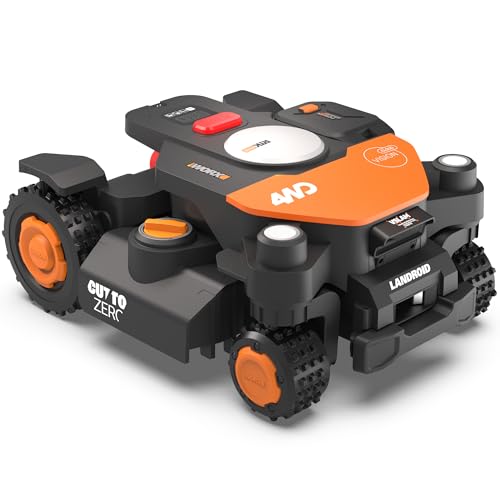
Best for Small suburban yards where a compact, affordable robot is enough
- Cuts small lawns up to about a quarter acre using a buried boundary wire
- AIA path algorithm steers down narrow lawn corridors without extra wire
- Cut-to-edge deck design trims closer to borders than many robots
- Optional plug-in modules add features such as anti-collision sensing
- One of the more affordable ways into robotic mowing
- Small footprint suits tight yards and narrow gates
- Modular add-ons let you upgrade capability over time
- Boundary wire must be laid before first use
- Smaller battery and coverage than mid-range models
Verdict: The Landroid M WR140 is a budget-friendly starting point for a small lawn, with a compact body and a clever narrow-passage algorithm that belie its price.

Best for Owners wanting wire-free LiDAR navigation and the EGO battery ecosystem
- Navigates without a boundary wire using LiDAR and GPS sensor fusion
- Maps the lawn on a guided first run, then follows systematic passes
- Obstacle sensing steers around furniture, garden beds, and toys
- Sits within EGO's wider 56-volt cordless outdoor tool range
- Wire-free and antenna-free thanks to onboard LiDAR mapping
- Systematic striping pattern rather than random bouncing
- Appealing for households already invested in EGO batteries
- Sits at the premium end of the price range
- Newer platform with a shorter real-world track record
Verdict: Based on published specs, the EGO Power+ Robotic Mower is the pick for owners who want precise wire-free LiDAR navigation and already trust the EGO ecosystem.

Best for First-time robot owners with a small, simple lawn
- Designed for small lawns up to around 500 square metres with a boundary wire
- Simple Bluetooth app setup aimed squarely at first-time owners
- Narrow body with a CorridorCut mode for tight passages
- Weatherproof build from the Husqvarna-owned Gardena line
- Straightforward setup and a friendly app for newcomers
- Compact and quiet, well suited to courtyard-sized lawns
- Backed by Husqvarna Group engineering and support
- Rated only for small lawns, so no headroom for large plots
- Short-range Bluetooth control rather than full remote connectivity on the base model
Verdict: The Sileno Minimo is the gentle on-ramp to robotic mowing, giving small-lawn owners a proven, no-fuss machine from a trusted maker.
Best for Owners who want wire-free setup without RTK antennas
- Uses an AI camera to distinguish grass from obstacles and cut without a wire
- Needs neither a boundary wire nor a satellite base antenna
- Cut-to-edge deck reduces the strip left along borders
- Suits small to mid-size lawns depending on the model's capacity
- No wire and no antenna, the simplest install of any approach here
- Camera adapts to a garden that changes through the season
- Trims closer to edges than many wire-guided robots
- Camera navigation needs adequate daylight to see the lawn
- Vision-only guidance is a newer approach still maturing
Verdict: The Landroid Vision is the most intriguing wire-free option here, replacing wires and antennas with a camera that learns your lawn, ideal for open, well-lit yards.
Frequently Asked Questions
Do robot lawn mowers really cut the grass well?
Robot lawn mowers cut very well on suitable lawns because they mow little and often, keeping grass dense and even. The main compromise is a small uncut strip at the lawn edge and around obstacles, which you finish with a string trimmer or edger.
Can one robot mower cut a front and back lawn?
One robot mower can cut separate front and back lawns only if the two connect by a passage the machine can follow, or you set a second zone and carry or guide it across. If a driveway fully divides them, most owners run one mower per lawn or move it manually.
How long do robot lawn mowers last?
Robot lawn mowers commonly last around ten years with light maintenance, though the battery usually needs replacing every three to five seasons. Keeping blades sharp, contacts clean, and the machine stored indoors over winter extends its working life.
Do you still need to mow if you have a robot mower?
You rarely need to mow with a robot, but you will still trim the very edge and around obstacles the mower leaves, and clear leaves in autumn. Most owners keep a string trimmer or a manual mower for those finishing jobs.