




How does a boundary-wire robot mower know where to mow?
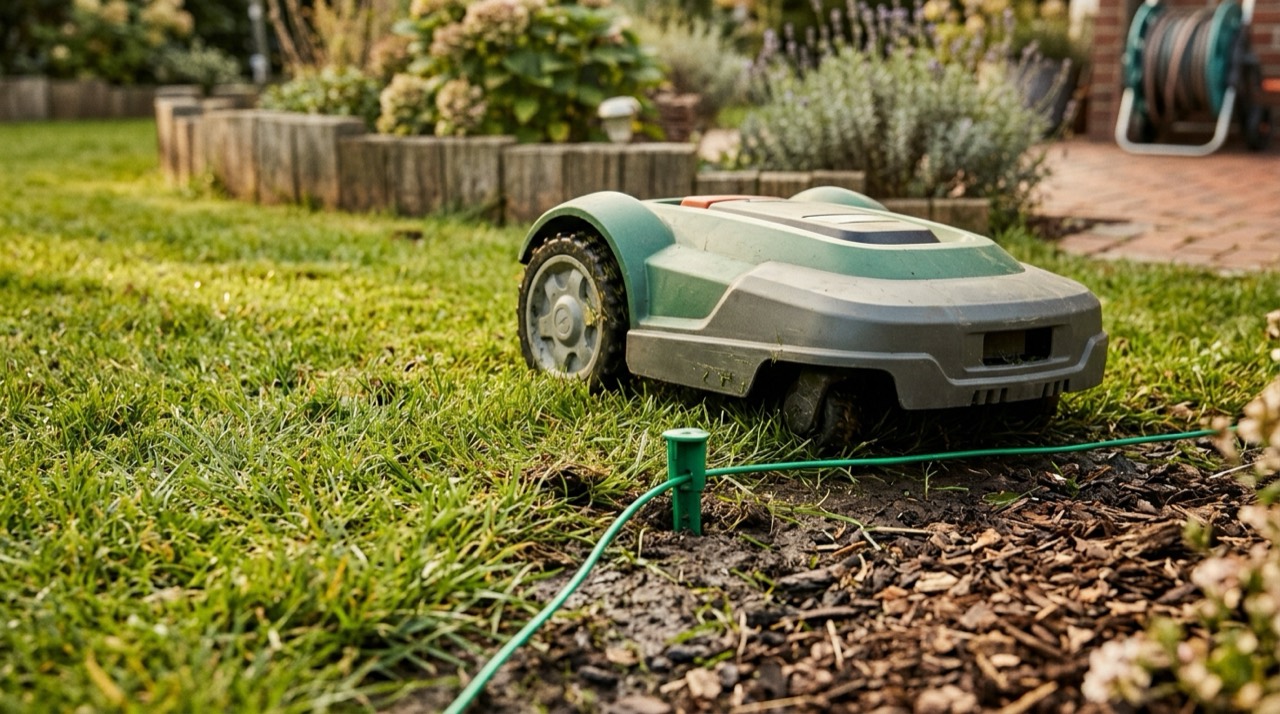
A boundary-wire robot mower stays on the lawn by following a low-voltage wire you peg or bury around the edge. The wire carries a signal from the charging base, the mower senses it, and it turns back whenever it reaches the perimeter, keeping the machine on grass.Boundary wire is the oldest and most proven system, used across most of the Husqvarna Automower and WORX Landroid ranges. A guide wire can also be run across the lawn to help the mower find its way back to the dock and to reach distant zones. The big advantage is reliability: the wire works in deep shade, under dense tree canopy, and at night, none of which trouble it. The drawbacks are the install effort and the single point of failure, because a cut or corroded wire stops the mower until you trace and repair the break. For most owners the wire is laid once and forgotten, but a large or complex lawn can mean a long day of pegging.
What is GPS-RTK navigation, and why does it skip the wire?
GPS-RTK navigation lets a robot mower position itself to within a couple of centimetres using satellite signals corrected by a fixed base antenna, so no boundary wire is needed. You draw the lawn boundary by walking the perimeter once in the app, and the mower stays inside that virtual fence.RTK stands for real-time kinematic positioning, and it is the system behind wire-free models such as the Segway Navimow and Mammotion Luba. The appeal is obvious: no digging, no wire to break, and boundaries you can redraw in software as the garden changes. The catch is that RTK needs a clear view of the sky, because tall buildings, walls, and heavy tree cover block or reflect the satellite signal and can leave the mower confused near the canopy. Sites with open sky suit RTK best, which is why it shines on large, unobstructed lawns and struggles under mature trees. Many RTK models add a camera as backup for exactly those shaded spots.
How do camera and LiDAR robot mowers see the lawn?
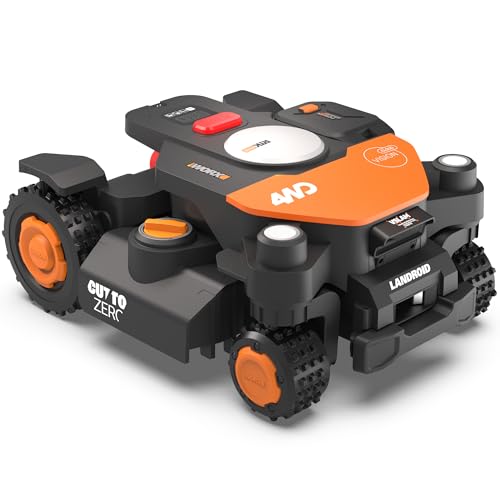
Camera and LiDAR robot mowers navigate by sensing the lawn directly, so they need neither a buried wire nor a satellite antenna. A vision model like the WORX Landroid Vision uses an AI camera to tell grass from obstacles, while a LiDAR model like the EGO Power+ Robotic Mower maps its surroundings with laser distance sensors.Vision and LiDAR are the newest approaches and the simplest to install, because there is nothing to bury or mount beyond the charging base. The mower learns the lawn on a guided first run and then recognises edges, beds, and objects as it works. The trade-offs are still being ironed out: cameras need adequate daylight to see clearly, and both systems rely on software that is maturing faster than the wire-based competition has over decades. For an open, well-lit lawn without heavy canopy, they offer the tidiest setup of all, and they avoid the sky-view limits that constrain pure RTK.
How accurate is each robot mower navigation system?
Accuracy varies by system: a boundary wire keeps the mower reliably inside a fixed edge, GPS-RTK positions the machine to within a couple of centimetres, and camera or LiDAR vision judges edges and obstacles from what it sees. All three keep the mower on the lawn, but they differ in how precisely they repeat a path.A boundary wire does not know where the mower is on the lawn, only that it has reached the edge, which is why older wire models bounce in a semi-random pattern rather than mowing neat stripes. RTK positioning knows the machine's location precisely, so RTK mowers can follow systematic, overlapping passes and return to the same spot each time. Vision systems fall in between, reading edges and objects well in good light but depending on software that is still improving. For most lawns the practical difference is the pattern and edge neatness rather than whether the grass gets cut.
How do you install each robot mower navigation system?
Installation effort is the sharpest difference between the systems: a boundary wire is the biggest job, RTK asks you to walk the perimeter and mount an antenna, and vision needs only a guided first run. The right one depends on how much setup work you are willing to trade for reliability.How each system is set up is compared below.
| Navigation | Setup steps | Time and effort |
|---|---|---|
| Boundary wire | Peg or bury wire around the whole edge, then dock | Highest, scales with lawn size |
| GPS-RTK | Mount the antenna with clear sky, walk the perimeter in the app | Moderate, mostly a single walk |
| Camera / LiDAR | Place the base, run a guided first lap | Lowest, nothing to bury or mount |
A wire install rewards patience, because pegging the wire the right distance from hard edges prevents scalping and dropped wheels, and a large lawn can take a full afternoon. RTK and vision shift the effort into software, so most of the work is drawing or driving the boundary once and letting the app remember it. None of the three needs revisiting often once it is set, but a wire is the only one that can physically break and demand a repair.
What happens when a robot mower loses its way?
Each system fails in its own way: a cut boundary wire stops the mower until repaired, an RTK model pauses or drifts when it loses the satellite signal, and a vision mower slows or stops in poor light. Knowing the failure mode helps you site and maintain the machine to avoid it.A break or corroded joint anywhere in a boundary wire halts the mower and can take time to trace, which is the main drawback of an otherwise dependable system. An RTK mower that passes under a dense tree or beside a tall wall can lose its fix and either wait for the signal or wander until it recovers, which is why open sky matters. A camera-guided model needs enough daylight to see the lawn, so it may not run at dawn, at dusk, or under heavy shade. Matching the system to your lawn's conditions is what keeps these failures rare.
Can robot mowers combine navigation systems?
Yes, many robot mowers combine systems to cover each other's weak spots, most often pairing RTK positioning with a backup camera. The blend keeps the mower working where a single system would falter, such as the shaded corners of an otherwise open lawn.Segway's VisionFence camera add-on for the Navimow is a clear example, sharpening obstacle detection and helping the mower hold its place where the satellite signal weakens. Wire models have long combined a boundary wire with GPS assistance, using the wire for the edge and GPS to spread coverage evenly and track the machine against theft. These hybrids cost more but suit gardens that mix open lawn with trees or structures, where no single system is ideal across the whole plot.
How does navigation affect the mowing pattern and lawn finish?
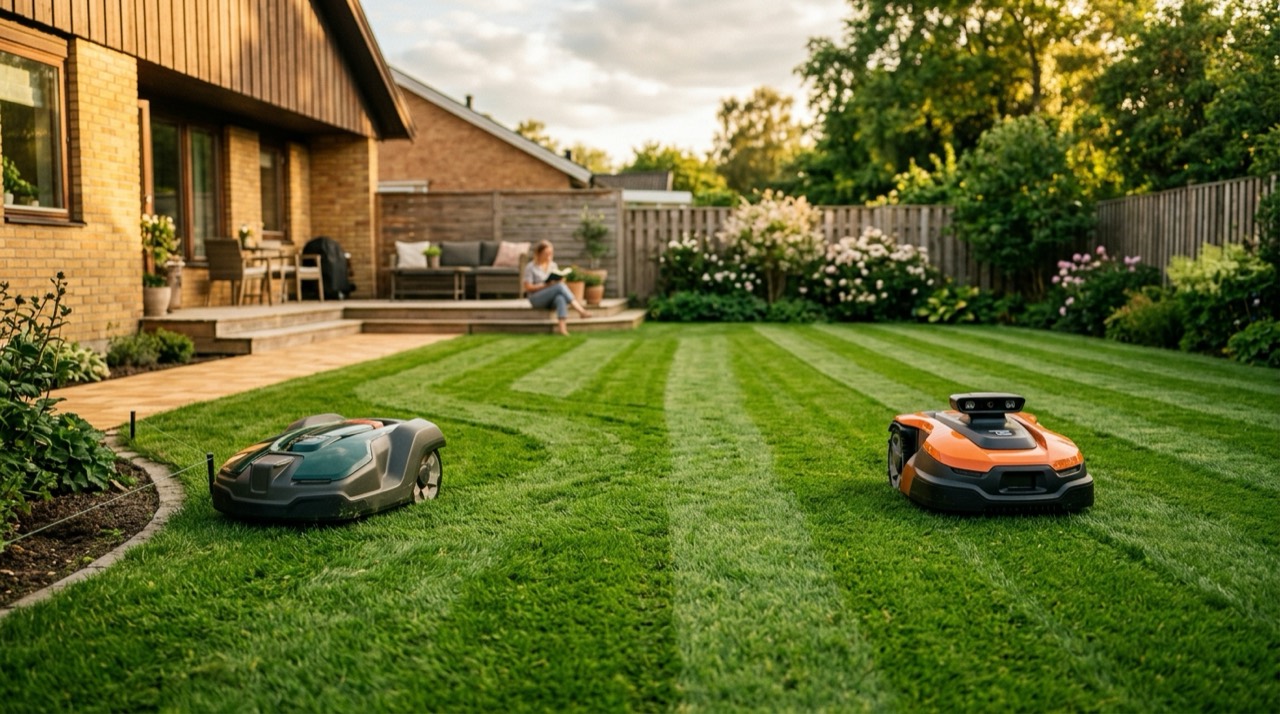
Navigation shapes the finish: wire mowers that bounce randomly give an even but pattern-free cut, while RTK and vision mowers that track their position can mow systematic, striped passes. Both approaches keep the grass healthy, but the look and edge neatness differ.Random mowing covers a lawn thoroughly over many sessions but leaves no visible stripes and can miss awkward corners for a while. Systematic mowing follows planned rows for a tidier, more predictable finish and reaches corners sooner, which owners of large or formal lawns tend to prefer. Whichever pattern a mower uses, all of them leave a small uncut strip at the very edge that you finish with a string trimmer or a lawn edger.
Which robot mower navigation system should you choose?
Choose a boundary wire for shaded or tree-covered lawns, GPS-RTK for large open lawns with clear sky, and camera or LiDAR vision for a simple wire-free setup on an open, well-lit block. Your lawn's openness to the sky is the deciding factor.The three systems are compared by setup, reliability, and best-fit lawn in the table below.
| Navigation | Install effort | Best lawn type | Main limitation |
|---|---|---|---|
| Boundary wire | High (peg or bury) | Shaded, tree-covered, complex | Wire breaks stop the mower |
| GPS-RTK | Low (walk perimeter) | Large, open, sky-visible | Needs a clear sky view |
| Camera / LiDAR | Lowest (guided run) | Open, well-lit lawns | Newer, light-dependent tech |
Once you have matched a system to your lawn, our best robot lawn mowers round-up pairs each pick to a navigation type, and the wider robot lawn mower guide covers sizing, safety, and setup. For big blocks, the best robotic lawn mower for large lawns picks focus on high-capacity RTK and all-wheel-drive machines.