


Corded electric or battery: which electric chainsaw fits your yard?
Corded electric and battery chainsaws both skip the fuel and engine upkeep of gas saws, but they solve different problems: corded gives you unlimited steady power tied to an outlet, while battery gives you go-anywhere freedom limited by a charge. The right choice comes down to how far your cutting is from power and how long your sessions run.Both are quiet, fume-free, and low-maintenance, so the decision is rarely about noise or emissions. Instead it turns on range, runtime, and cost, and this guide compares the two so you can pick before you read our electric chainsaw picks or step across to the battery chainsaw guide. Neither replaces a gas chainsaw for felling large trees, but for the everyday pruning, limbing, and firewood most homeowners do, one of these two electric saws is usually the smarter buy.
How do corded and battery chainsaws compare on power and runtime?
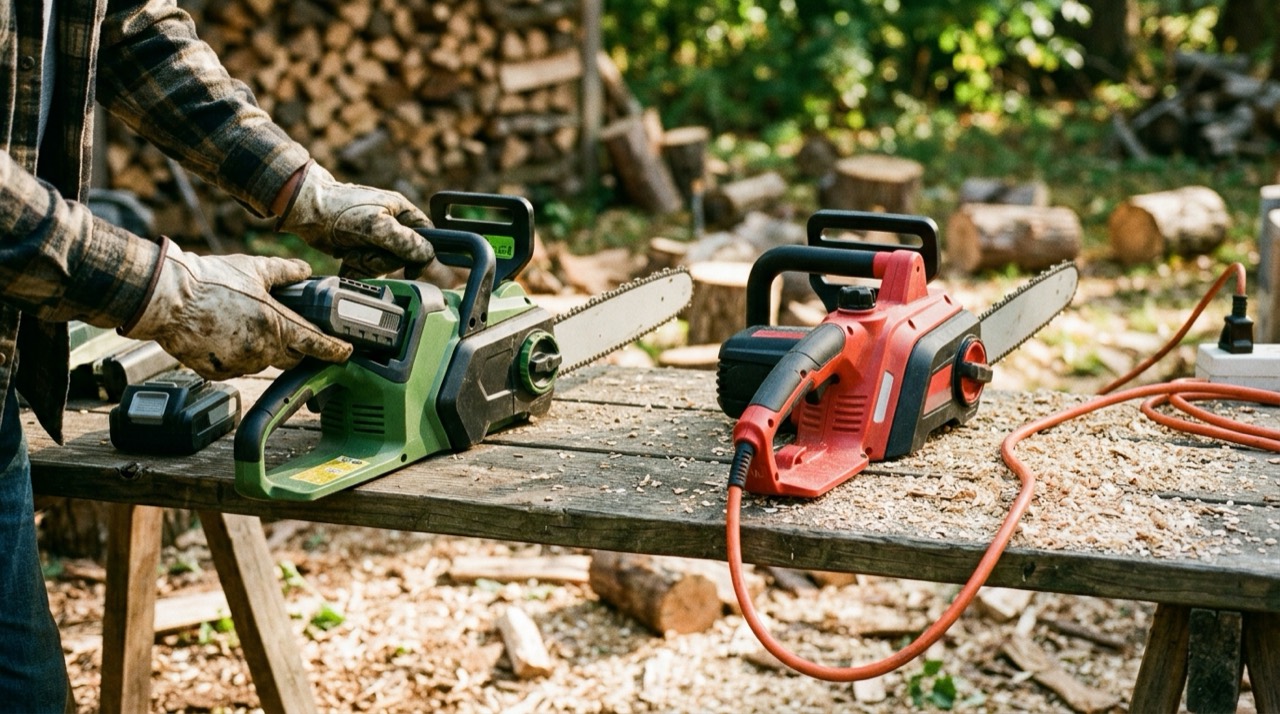
Corded electric chainsaws deliver constant power for as long as they are plugged in, never fading as a job drags on, which makes them strong for long, steady cutting near the house. Battery saws match or beat corded power in short bursts, but their output and runtime fall as the pack drains, and heavy cutting empties a battery fast.Runtime is the sharpest difference between the two. The table below summarises how they stack up on the factors owners care about most.
| Attribute | Corded electric | Battery |
|---|---|---|
| Runtime | Unlimited while plugged in | Limited by battery charge |
| Range | Tied to cord and outlet | Go anywhere |
| Power under load | Steady, fade-free | Strong in bursts, then fades |
| Upfront cost | Lowest | Higher, batteries add cost |
| Best setting | Near the house | Across the whole property |
How do corded and battery chainsaws compare beyond power?
Beyond power and runtime, corded and battery chainsaws differ on weight, readiness, and storage, and these everyday factors often decide which saw an owner actually reaches for. A corded saw carries no heavy battery, so it can be lighter in the hand, while a battery saw carries its power source on board and gains weight with bigger packs.Both electric types are far quieter than a gas saw and produce no exhaust, which makes either a good neighbour in a suburban street. Readiness differs, though: a corded saw is ready the moment you plug it in, whereas a battery saw is only ready if the pack is charged, and a flat battery means a wait at the charger. The summary below weighs the factors that rarely make the spec sheet.
- Weight: a corded saw has no battery mass, though its motor and cord add some; a battery saw grows heavier as pack capacity rises.
- Readiness: corded is instant on plug-in; battery depends on a charged pack and often a spare.
- Noise and fumes: both are quiet and fume-free, unlike a gas chainsaw.
- Storage: corded stores indefinitely; battery packs prefer a partial charge and a cool spot.
For an owner who values grabbing a saw and cutting with no thought to charge state, the corded saw's constant readiness is a quiet but real advantage over a cordless one.
Which electric chainsaw costs less to own?
Corded electric chainsaws cost the least to own of any chainsaw type, because they need no fuel and no batteries, and batteries are the single most expensive consumable in cordless tools. A corded saw's running costs are limited to bar oil, the occasional chain, and a one-time extension lead.Battery saws carry a hidden cost, since packs lose capacity over years of charging and eventually need replacing at a significant fraction of the tool's price. A second pack, often needed to cut without waiting on a charger, adds to that outlay from the start. If you already own batteries in a brand's ecosystem, a bare-tool cordless saw narrows the gap, but for a first saw bought outright, corded is almost always cheaper. Whichever you pick, keeping the chain sharp with our chainsaw sharpening guide does more for cutting speed than any headline spec.
How much does battery replacement add to the cost?
Battery replacement is the hidden line item that makes a corded electric chainsaw cheaper to own over its life, because a cordless saw's packs lose capacity with age and eventually cost a meaningful share of the tool's price to replace. A corded saw has no equivalent cost, ever.Most owners also buy a second pack from the outset so they can keep cutting while one charges, which adds to the cordless outlay before the first cut. Over years, packs that are charged and drained repeatedly hold less runtime, so a saw that once cut a full session on a charge will manage less as the pack ages. None of this touches a corded saw, whose only consumables are bar and chain oil, the occasional chain, and a sharpening file.
The gap narrows only if you already own batteries in a brand's platform and buy a bare-tool cordless saw, sharing packs with a trimmer or blower. For a first saw bought outright, though, corded remains the lowest-cost route into electric cutting, which is why our best electric chainsaw picks lean corded for value buyers.
When is a battery chainsaw the better electric saw?
A battery chainsaw is the better electric saw when your trees are spread across a large property, when trailing a cord is impractical, or when you want to carry the saw to wherever a branch falls. Cordless freedom is worth the higher price for owners who cut in several spots rather than one.Battery models also suit anyone already invested in a cordless tool platform, since sharing packs across a trimmer, blower, and saw spreads the battery cost. For light, occasional pruning, a compact battery saw or even a tool from our mini chainsaw guide can be handier than dragging out a cord.
Which electric chainsaw is better for cutting firewood?
For cutting firewood near the house, a corded electric chainsaw is usually the better electric choice, because firewood work is long and continuous, exactly where a battery drains fastest and a corded saw holds steady. A 15-amp corded saw will process a pile of rounds without a single pause for charging.Battery saws can certainly cut firewood, but a heavy session can empty a pack quickly, and bucking a whole stack may need several batteries or a mid-job charge. If the woodpile sits within reach of an outlet, the corded saw's unlimited runtime and lower cost make it the natural firewood tool. Pair it with the right firewood tools and a sturdy stand, and keep the chain sharp, since a keen chain matters more to firewood speed than the choice between corded and battery. When the rounds are too large for a corded saw's fixed power, that is a job for a gas chainsaw rather than either electric type.
Which electric chainsaw is better for pruning and reaching high branches?
For light pruning and reaching up into a tree, a battery saw or a dedicated pole tool often edges out a corded saw, simply because a trailing cord is awkward overhead and away from the outlet. Cordless freedom is most valuable exactly where a corded saw is least convenient.That said, a light corded pruning saw is fine for low branches close to the house, and it costs less than a comparable cordless one. For work up in the canopy, a pole saw keeps your feet on the ground, and for the smallest jobs a tool from our mini chainsaw guide can be handier than either full-size saw. Match the tool to the reach: corded for low, near-house pruning where the cord is no bother, cordless or pole tools when you move around the tree or work overhead.
When should you stick with a corded electric chainsaw?
Stick with a corded electric chainsaw when your cutting happens near the house, when sessions run long, and when you want the lowest possible cost to buy and run. For a suburban yard with an outlet in reach, corded power removes the two biggest cordless worries, runtime and battery replacement.Corded saws are also the simplest to store, since there is no battery to condition and no engine to drain, so the saw is ready whenever you plug it in. If that matches your yard, our best electric chainsaw picks rank the corded saws worth buying, and our full electric chainsaw guide covers amps, bar length, and safe use in more depth. Whichever power source you choose, budget for chainsaw chaps and PPE, because the chain is just as sharp on every model.
A worked example: choosing an electric saw for a quarter-acre block
Consider a common case: a quarter-acre suburban block with a few established trees, an outdoor outlet on the house wall, and a yearly need to cut fallen limbs and a little firewood. Here a 15-amp corded saw with a 16 to 18 inch bar is the straightforward pick, since almost all the cutting happens within a cord's reach and the sessions are short.The owner spends the least up front, never buys a battery, and gets fade-free power for the firewood. The one inconvenience is trailing the cord to the far corner of the block, solved with a single heavy-gauge lead. Swap the block for a rural acre with trees spread wide and no outlet nearby, and the maths flips: the cord becomes a constant nuisance, and a battery chainsaw or, for heavier felling, a gas chainsaw earns its higher price. The lesson is that geography and workload, not brand or spec, decide the right electric saw.