


Choosing and using an extension cord with a corded chainsaw
The extension cord is the single most overlooked part of running a corded electric chainsaw, and the wrong lead can leave a powerful saw cutting weakly and running hot. The cord must be an outdoor-rated lead of the right gauge for the saw's amp draw, kept as short as practical, and managed so it never crosses the chain.Getting the cord right costs a few dollars and a little planning, and it makes the difference between a saw that pulls through wood at full power and one that stalls in the cut. This guide covers gauge, length, safe setup, and cord management so your saw performs the way its amp rating promises. For choosing the saw itself, see our electric chainsaw picks.
What gauge extension cord does an electric chainsaw need?
An electric chainsaw needs a heavy outdoor extension cord, and the higher the amps, the thicker the wire, meaning a lower gauge number. As a rule, a 14-gauge cord suits shorter runs on most saws, while a 12-gauge cord is the safer choice for 15-amp saws or runs over about 50 feet.Wire gauge decides how much voltage reaches the motor, and a cord that is too thin drops voltage under load. The rough guide below matches cord gauge to saw and length.
- 16-gauge: only for very short runs on small 8 to 10 amp pruning saws.
- 14-gauge: general use on 12 to 14 amp saws over shorter distances.
- 12-gauge: 15-amp saws, or any saw on a run beyond roughly 50 feet.
- 10-gauge: long runs where you need to keep a powerful saw at full voltage.
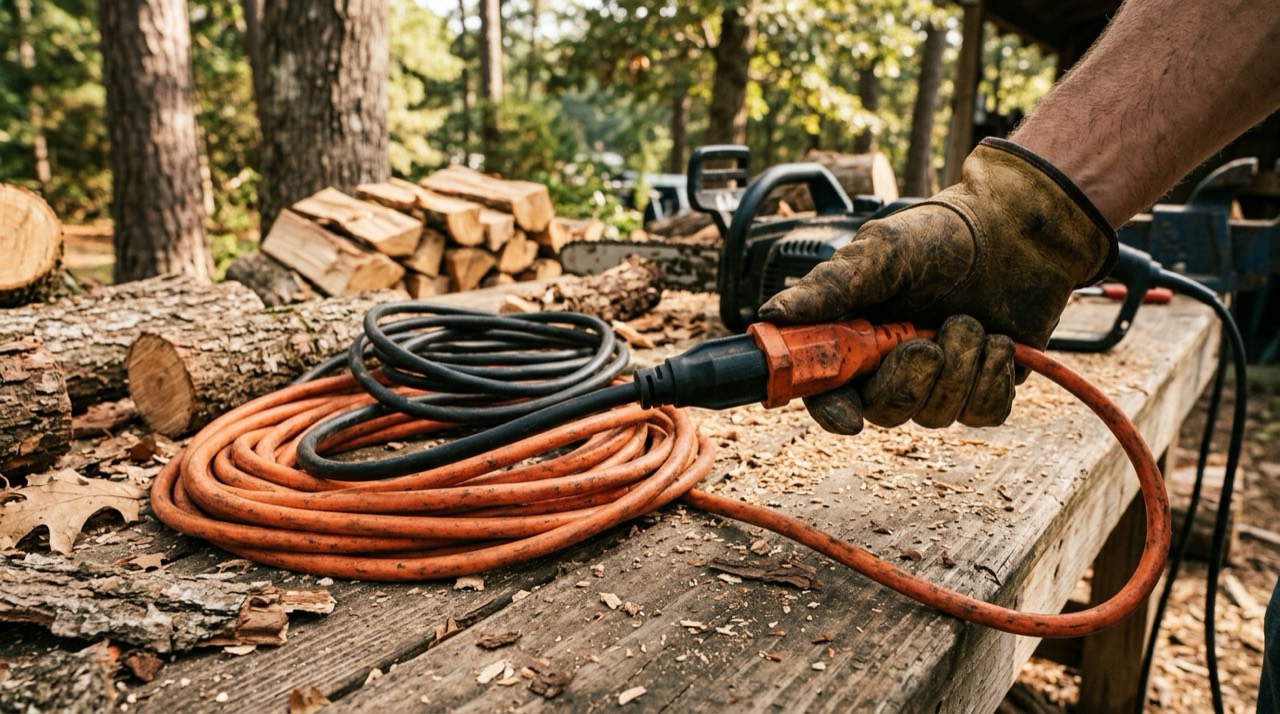
Always use a cord marked for outdoor use with a weather-resistant jacket, and check the amp and wattage rating printed on the cord against your saw.
Why does cord gauge and length change how a corded saw cuts?
Cord gauge and length change cutting power through voltage drop: a thin or long cord has more electrical resistance, so less of the outlet's voltage reaches the motor, and a motor starved of voltage makes less torque. That is why the same saw can pull strongly on a short heavy lead yet bog down on a long thin one of otherwise similar rating.The effect is easy to miss because it bites hardest at the worst moment. A chainsaw motor draws its heaviest current exactly when it is working hardest, mid-cut, and that is when voltage drop is largest. A cord one size too thin might feel fine on a light branch and then stall the saw in a firewood round. Resistance rises with length and falls with a thicker, lower-gauge wire, which is the whole reason the guidance is a shorter, thicker cord rather than a longer, thinner one. Under-voltage also makes the motor run hotter, shortening its life over time, so the right cord protects the saw as well as the cut. When no practical cord keeps a saw at full voltage where you need to work, that is the point to consider a battery chainsaw instead.
How long can the extension cord be?
The extension cord should be as short as the job allows, because every extra foot drops a little more voltage, and most manufacturers advise keeping the total run under about 100 feet. A shorter, thicker cord always beats a longer, thinner one for delivering full power to the motor.Voltage drop is why a saw can cut strongly on a short lead yet bog down on a long one of the same gauge. If you need to reach farther, step up to a thicker gauge rather than simply chaining leads together, since each connection adds resistance and a point of failure. When even a heavy long cord will not reach, that is the signal to consider a battery chainsaw instead.
What kind of extension cord should you buy for a chainsaw?
The right extension cord for a chainsaw is an outdoor-rated lead with a weather-resistant jacket, a gauge matched to the saw's amps, and a length no longer than the job needs. Buying to a short checklist avoids the two failure modes: a cord that is unsafe outdoors, and one that is too thin to carry the load.Look for these features when choosing a lead:
- An outdoor jacket that resists sunlight, moisture, and abrasion, not a light indoor cord.
- A gauge suited to the saw: 14-gauge for shorter runs on mid-amp saws, 12-gauge for 15-amp saws or longer runs.
- A moulded, tightly fitting plug and socket, since loose connectors overheat and pull apart under load.
- A bright jacket colour that shows against grass and mulch, so you can always see where the cord lies.
- A single continuous length rather than several short leads joined, because each join adds resistance and a point of failure.
Buy the shortest cord that reaches your furthest regular cut, and keep a heavier long lead only for the occasional far job. Matching the cord to the saw is as much a part of the setup as fitting the chain, and it is covered again in our main electric chainsaw guide.
How do you set up a corded chainsaw safely?
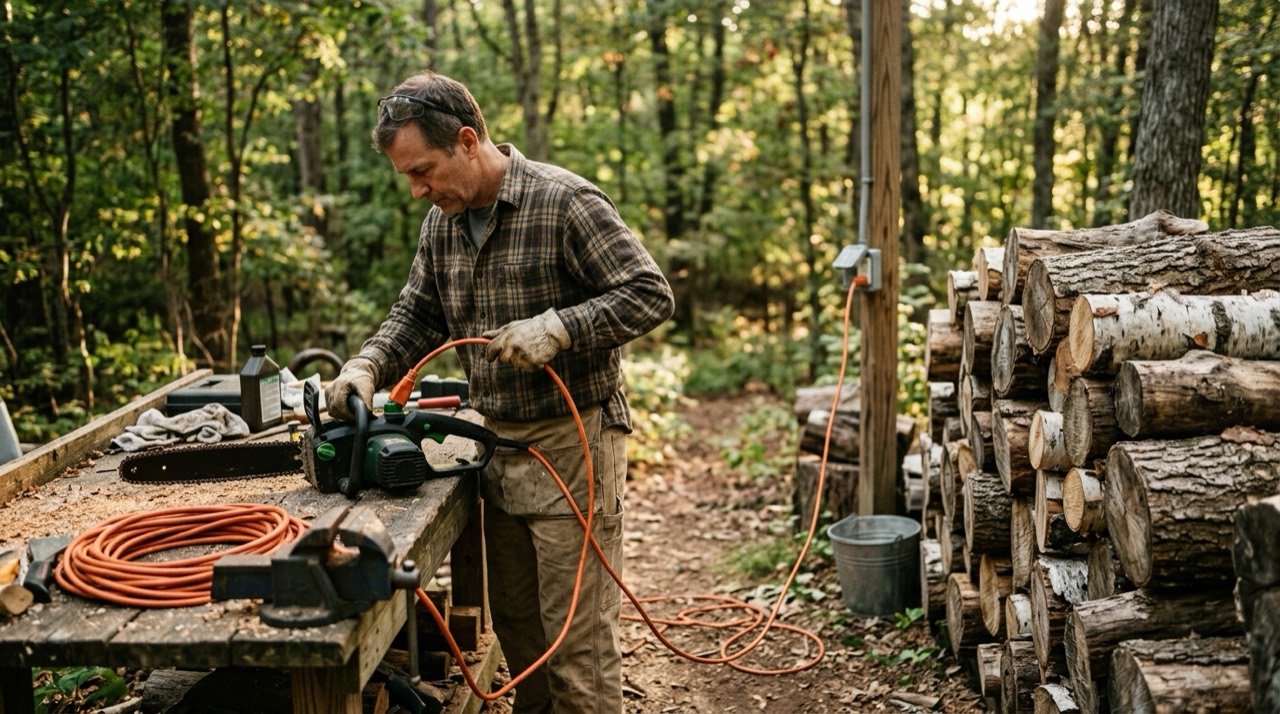
Setting up a corded chainsaw safely starts at the outlet: plug into a GFCI-protected socket, or use a portable GFCI adaptor, so the circuit cuts power instantly if the cord is damaged or wet. Never run the saw in wet conditions, since water and mains electricity are a dangerous combination.Before cutting, take these steps in order so the cord cannot become a hazard.
- Inspect the full length of the cord for cuts, nicks, or exposed wire, and set aside any damaged lead.
- Connect the saw's plug to the extension cord and secure them with the saw's cord retainer or a simple loop knot.
- Plug the extension cord into a GFCI outlet and confirm the saw's chain brake is engaged.
- Drape the cord over your shoulder or behind you so it trails away from the bar.
Keeping the connection secured stops the plug pulling apart mid-cut, which is both frustrating and unsafe.
What are the electrical safety rules for a corded chainsaw?
The core electrical safety rules for a corded chainsaw are simple: use a GFCI, never cut in the wet, and retire any damaged cord. Mains electricity and a hand-held cutting tool outdoors demand more caution than an indoor appliance, and these rules address the ways that combination goes wrong.Follow them every time you cut:
- Plug into a GFCI-protected outlet or a portable GFCI adaptor, so the circuit cuts power the instant it detects a fault to earth.
- Never run a corded saw in rain, on wet grass, or where the cord could sit in water, because water bridges the current and defeats the insulation.
- Inspect the full cord before each session and retire any lead with cuts, nicks, or exposed conductor rather than taping it up.
- Unplug the saw before clearing a jam, checking the chain, or leaving it unattended, so it cannot start unexpectedly.
- Keep connectors up off wet ground and out of puddles, using a hook or a dry board if needed.
These habits sit alongside the physical safety gear every saw demands, so pair them with chainsaw chaps and PPE and proper hearing and eye protection. As with any saw, felling and any work near power lines belongs to trained professionals.
How do you keep the cord clear of the chain?
Keeping the cord clear of the chain is a matter of always working with the lead behind you and to the side of your cutting arm, never in front of or below the bar. Plan each cut so the saw moves away from the cord, and reposition the lead rather than reaching across it.A cut cord is one of the most common corded-saw accidents, and it can cause a shock as well as ruining the lead. The habits below keep the cord safe.
- Route the cord over the shoulder opposite your cutting hand.
- Move the whole cord, not just a loop, when you change position.
- Keep slack behind you so the plug never pulls tight mid-cut.
Full protective gear still applies, so pair safe cord habits with chainsaw chaps and PPE and the guidance in our main electric chainsaw guide. As with any saw, leave felling and any work near power lines to trained professionals.
How do you store and look after a chainsaw extension cord?
Looking after an extension cord keeps it safe and extends its life: coil it loosely, store it dry and out of sunlight, and check it for damage each time you use it. A cord is cheap next to the saw, but a neglected one becomes a shock and fire hazard as its jacket cracks and its conductors fray.Coil the cord in large loops or a figure-eight rather than tight bends that stress the wire, and hang it rather than leaving it in a heap where it can be crushed or chewed. Keep it out of prolonged sun, which hardens and cracks the jacket over seasons, and store it beside the saw in dry outdoor tool storage so the two are always ready together. Before each use, run the cord through your hands to feel for nicks or soft spots, and replace rather than repair a lead that has been cut or crushed. A cord in good order is part of the saw performing to its rated power, not an afterthought.