Best Bow Saw
Best Bow Saw, ranked from aggregated owner ratings and reviews, not first-hand testing. Real pros, cons, and who each pick is best for.

Our Top 3 Picks
Quick Comparison
| Product | Best for | Buy | |
|---|---|---|---|
| Bahco 10-24-23 ERGO Bow Saw | Best Overall | See Amazon | View (paid link) |
| Fiskars Bow Saw (21-inch) | Best Value | See Amazon | View (paid link) |
| Bahco 317 Bow Saw (30-inch) | Best Heavy-Duty | See Amazon | View (paid link) |
| Agawa Canyon BOREAL21 Folding Bow Saw | Best Compact | See Amazon | View (paid link) |
| Truper 30264 Bow Saw (21-inch) | Best for Beginners | See Amazon | View (paid link) |
| Sven-Saw 15-Inch Folding Saw | Editor's Pick | See Amazon | View (paid link) |
How to Choose a Bow Saw
Choose a bow saw by matching blade length to the wood you cut, the tooth pattern to whether that wood is green or seasoned, and the frame to where the saw will live. Get those three right and almost any reputable saw will serve you for years, because the blade is a cheap, replaceable wear part.
What blade length suits your wood?
Blade length decides both reach and speed. A 21-inch saw is the do-everything size for branches, prunings, and light firewood, and it is the easiest to control. A 24-inch frame adds stroke for steady firewood cutting, and a 30-inch frame clears big rounds fastest but is heavy and awkward for anything overhead or delicate. As a rule, size up if you mostly buck firewood and size down if you mostly trim the garden.
Frame depth counts too. The clearance between the blade and the top of the bow limits how thick a round you can push all the way through, so a deep D-shaped frame takes a fatter log than a shallow, flat one of the same blade length.
Green-wood or dry-wood teeth?
Tooth pattern is the choice most buyers get wrong. Green-wood (raker) blades pair cutting teeth with scoop-shaped rakers that clear wet sawdust, so they power through living branches and fresh logs without clogging. Dry-wood (peg) blades use finer rows of simple teeth and cut cleaner in seasoned hardwood. Coarseness runs from roughly 4 to 9 teeth per inch — fewer, larger teeth for fast green cuts, finer teeth for dry timber. Keep one blade of each; swapping them is a one-minute job.
What frame depth and weight should you look for?
Frame depth — the gap between the blade and the top of the bow — sets the thickest round you can push all the way through, so a deep D-shaped frame swallows a fatter log than a shallow one of the same blade length. Weight then decides how long you can swing it.
A deep 30-inch frame might clear an 8-inch round but weighs enough to tire your shoulder on overhead cuts, while a light 21-inch frame is effortless to steer but tops out on smaller wood. There is no single right answer — it is a trade between capacity and fatigue. If you cut mostly at waist height on a sawhorse, lean toward depth and capacity; if you reach up into shrubs and small trees often, favour a lighter, shallower frame you can hold steady with one hand while the other guides the branch.
Does frame comfort matter?
Comfort matters more than buyers expect on a saw you swing for an hour. A cushioned ergonomic handle and a knuckle guard save your hand from bark, thorns, and the frame itself, and a tool-free cam lever lets you change or re-tension the blade without hunting for a wingnut. Powder-coated or blade-coated steel sheds sap and slows rust between jobs.
Full-size or folding?
Frame style comes down to where the saw travels. A rigid steel frame cuts straighter and faster at the woodpile, while a folding take-down saw packs flat for camping, the truck, or a pack and shields its blade until tensioned. Buy steel if the saw stays home; buy folding if it comes with you.
Which bow saw suits your property?
Match the saw to the amount and type of wood your property throws at you, not to the biggest frame on the shelf. A courtyard garden, a suburban block, a rural acreage, and a backpacking kit each reward a different size and style, and buying for the wrong one leaves you either over-tooled or out-matched.
- Small yard or courtyard — a 21-inch frame such as the Fiskars (paid link) handles occasional prunings and the odd bit of firewood, and stores in a narrow shed.
- Suburban block with a fireplace — a comfortable 21- to 24-inch ERGO saw covers year-round branch work and moderate firewood without tiring your hand.
- Rural acreage or heavy firewood — a 30-inch Bahco 317 clears a season of rounds fastest, backed up by a chainsaw for anything the frame cannot swallow.
- Camping, hunting, or overlanding — a folding saw like the Agawa Canyon BOREAL21 or the compact Sven-Saw (paid link) packs flat and still delivers a real cut.
If your needs straddle two of these, size toward the heavier job: a slightly large saw is only a little more tiring, while a saw that is too small simply cannot make the cut at all.
How much should you spend on a bow saw?
Plan on roughly $15 to $25 for a basic yard saw, $30 to $45 for a comfortable ergonomic model, and $50 to $70 for a premium folding or professional Swedish saw. Bow saws are inexpensive tools, so the jump from cheapest to best is small in absolute terms and usually worth it.
At the budget end, a painted-frame saw like the Truper (paid link) 30264 cuts perfectly well but skips the knuckle guard and cushioned grip. The mid tier — the Bahco 10-24-23 ERGO or the Fiskars 21-inch — adds a wrapped handle, hand protection, and a smoother tensioner, which is where most homeowners land. The premium tier buys either a heavy-duty 30-inch frame for volume firewood or a folding aluminium saw such as the Agawa Canyon BOREAL21 for the pack. Because blades are the real running cost and they are cheap, spending an extra $20 up front on comfort pays back over years of use rather than adding to a recurring bill.
How long does a bow saw last?
A quality bow saw frame lasts decades, because the part that wears out — the blade — is designed to be unbolted and replaced rather than repaired. Treat the frame as a lifetime purchase and the blade as a consumable, and the running cost stays very low.
Expect a green-wood blade to stay sharp through anywhere from one heavy firewood season to several light years of yard work, depending on the wood and how much grit it meets. Replacement blades are cheap and widely stocked, so budgeting one or two spares a year covers most households. The frame itself only fails if it is bent by prying or left to rust through, both of which storage indoors and a wipe of oil prevent. Over a decade, the total cost of owning and feeding a bow saw is a fraction of a single tank of chainsaw fuel and bar oil — one reason a bow saw earns its place even in a shed that already has powered tools.
What should you buy alongside a bow saw?
Buy a spare blade and a blade guard with any new bow saw, plus basic protection. Keeping one green-wood and one dry-wood blade means you are never stopped by a dull or wrong-tooth blade mid-job, and a guard protects both the teeth and your hands in storage. Add work gloves for grip and splinter protection and eye protection against flying chips. A little bar and chain oil wiped down the blade after use keeps rust away between weekends, and a hook or tool rack keeps the blade off damp concrete. None of it is expensive, and it roughly doubles how long the saw stays sharp and usable.
What mistakes do first-time bow saw buyers make?
The two most common buying mistakes are chasing the biggest frame and ignoring the blade type. A 30-inch saw looks like better value, but it is heavy, awkward on branches, and slower to control than a 21-inch saw for anyone who is not bucking firewood in volume.
The other trap is assuming the factory blade suits every job. Most saws ship with a coarse green-wood blade, which is perfect for living branches and fresh logs but leaves a rough, grabbing cut in dry, seasoned hardwood. Buying a matching dry-wood blade at the same time — and keeping both on hand — costs little and removes the single biggest cause of a disappointing cut. Finally, do not skip the guard and basic work gloves; an unprotected blade dulls against shed clutter and an unguarded hand meets thorns and bark on every pull stroke.
The points above are summarised for our picks in the table below, so you can line up length, tooth type, and best use at a glance.
| Bow saw | Blade length | Frame type | Best for |
|---|---|---|---|
| Bahco 10-24-23 ERGO | ~23 in | Tubular steel, ergo handle | All-round yard and firewood |
| Fiskars Bow Saw | 21 in | Coated steel tube | Value branch and light firewood |
| Bahco 317 | 30 in | Deep tubular steel | Heavy firewood bucking |
| Agawa Canyon BOREAL21 | 21 in | Folding aluminium | Backpacking and camp wood |
| Truper 30264 | 21 in | Painted steel tube | Budget occasional use |
| Sven-Saw 15-inch | 15 in | Folding aluminium | Ultralight backcountry |
Whatever you pick, pair it with work gloves and eye protection, and steady your wood on a sawhorse or log stand. For the cutting method itself, see our bow saw technique guide, and for the tools that split what you cut, browse splitting axes and mauls.
Full Ranking, Reviewed

Best for Homeowners who want one saw for branches and firewood alike
- Tubular steel frame with a cushioned ERGO handle and knuckle guard
- Cam-lever tension system that swaps blades without tools
- Ships with a coarse green-wood (raker) blade around 23 inches long
- Powder-coated frame that resists sap build-up and rust
- Comfortable grip and knuckle protection over long cutting sessions
- Fast, tool-free blade changes between green and dry blades
- Widely stocked replacement blades keep it running for years
- Factory green-wood blade leaves a rougher cut in dry hardwood
- 23-inch frame is bulky to carry on a backpacking trip
Verdict: A dependable, comfortable all-rounder most yards never need to upgrade from.

Best for Budget-minded gardeners cutting branches and light firewood
- 21-inch coated blade with hardened teeth for green and dry wood
- Steel tubular frame with a tension lever on the nose
- Low-friction blade coating that reduces sap sticking
- Enclosed handle that shields knuckles from bark and thorns
- Light in the hand and easy for occasional users to control
- Coated blade sheds sap and slows rust between jobs
- Priced well below professional Swedish saws
- Hard-point teeth are made to be replaced, not filed sharp
- Shorter stroke than a 30-inch saw on big rounds
Verdict: A tidy, affordable saw that covers the everyday pruning and firewood jobs most homes have.
Best for People bucking a season's worth of firewood rounds
- 30-inch tubular frame for a long, fast cutting stroke
- Deep frame clearance that takes rounds up to roughly 8 inches
- Lever tensioner that keeps the long blade tracking straight
- Coarse raker blade suited to green and freshly felled wood
- Long stroke clears firewood far quicker than a 21-inch saw
- Deep throat handles bigger rounds before you reach for a chainsaw
- Rugged frame stands up to repeated woodpile use
- Heavy and unwieldy for overhead or fine pruning cuts
- Too large to be practical for camping or the truck
Verdict: The saw to grab when the job is a stack of firewood rather than a few branches.

Best for Backpackers and overlanders who want a full-size cut from a flat pack
- Folds flat to protect the 21-inch blade and stow in a pack
- Aluminium and composite frame that keeps weight near a pound
- Quick-change system accepting wood and pruning blades
- Blade tensions as the frame unfolds, with no wingnut to lose
- Full 21-inch cutting capacity from a packable folding frame
- Light enough for canoe trips and long hikes
- Tool-free blade swaps in the field
- Costs more than a basic steel yard saw
- Composite frame flexes more than rigid tubular steel on hard cuts
Verdict: The bow saw for people who carry their tools on their back and still want a real cut.
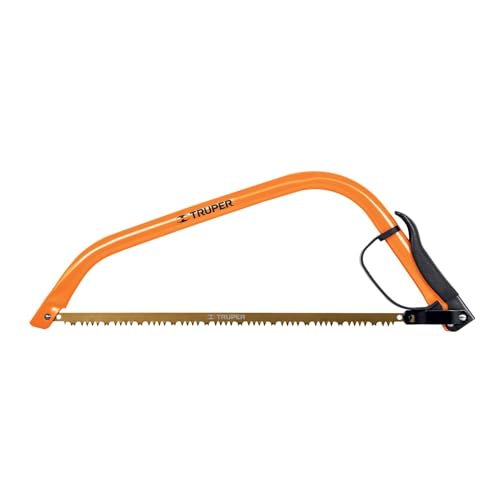
Best for First-time buyers wanting a simple, cheap saw for occasional cleanup
- 21-inch steel frame with a straightforward lever tensioner
- Basic raker blade for general branch and green-wood cutting
- Painted frame with a simple over-hand grip
- Standard blade size that is easy to find as a replacement
- Very affordable entry into frame saws
- Light and uncomplicated for new users
- Common blade size keeps replacements cheap
- No knuckle guard, so mind your hand on the pull stroke
- Plain handle is less comfortable over long sessions
Verdict: A no-frills starter saw that handles the occasional branch without spending much.

Best for Campers and hunters who want a proven, pocketable take-down saw
- Aluminium handle that the blade folds into for safe carry
- Assembles into a rigid triangular bow in seconds
- 15-inch blade suited to camp wood and small limbs
- Long-running, simple design with very few parts
- Packs down flat and weighs only a few ounces
- Rigid triangle frame cuts above its size
- Durable design with little to break or lose
- 15-inch blade limits it to smaller wood
- Blade sits exposed during assembly until it is tensioned
Verdict: A classic backcountry saw that has earned its place in packs for good reason.
Frequently Asked Questions
What length bow saw is best for firewood?
A 24- or 30-inch bow saw is best for firewood because the longer blade gives a faster, longer stroke and a deeper frame clears bigger rounds. A 21-inch saw still works for smaller splits and branches, but you will make more strokes per cut.
Can you sharpen a bow saw blade or should you replace it?
Most modern bow saw blades have induction-hardened (often dark-coloured) teeth that are made to be replaced, not filed. Softer, silver-toothed peg blades can be sharpened with a triangular file and re-set, but because replacement blades are inexpensive, most owners simply fit a fresh one when cutting slows.
What is the difference between a green-wood and a dry-wood blade?
Green-wood (raker) blades add scoop-shaped raker teeth that clear wet sawdust, so they cut living branches and fresh logs without clogging. Dry-wood (peg) blades use finer rows of plain teeth and give a cleaner cut in seasoned, hard timber. Keeping one of each covers both.
Is a bow saw better than a folding saw for camping?
For camp firewood a folding bow saw usually cuts faster than a folding pull-saw because the tensioned blade tracks straight and cuts on both strokes. A folding pull-saw is lighter and better for pruning-style cuts. Many campers carry a take-down bow saw for wood processing and a small folding saw for detail work.