Reel Mower Vs Rotary
Reel Mower Vs Rotary, ranked from aggregated owner ratings and reviews, not first-hand testing. Real pros, cons, and who each pick is best for.

Our Top 3 Picks
Quick Comparison
| Product | Best for | Buy | |
|---|---|---|---|
| Fiskars StaySharp Max Reel Mower (18-inch) | Best Overall | See Amazon | View (paid link) |
| American Lawn Mower Company 1204-14 Reel Mower (14-inch) | Best Value | See Amazon | View (paid link) |
| Scotts Outdoor Power Tools 2000-20 Reel Mower (20-inch) | Best Heavy-Duty | See Amazon | View (paid link) |
| Great States 415-16 Reel Mower (16-inch) | Best for Beginners | See Amazon | View (paid link) |
| Earthwise 1715-16EW Reel Mower (16-inch, 7-blade) | Best Premium | See Amazon | View (paid link) |
| American Lawn Mower Company 1815-18 Reel Mower (18-inch) | Editor's Pick | See Amazon | View (paid link) |
Should you buy a reel mower or a rotary mower?
Choose a reel mower for a small, level, fine-bladed lawn you will mow often, and a rotary mower for anything larger, taller, hillier, or weedier. The reel gives a cleaner, quieter, engine-free cut on the right lawn; the rotary gives power and speed that a manual reel simply cannot match on tough or overgrown grass.This decision is really about your lawn, not the machines. Below is a plain comparison of the two cutting methods, followed by picks that represent each side — top manual reels for the reel camp, and gas, battery, and corded rotary mowers for the powered camp — so you can match the tool to your yard. All notes come from published specifications and aggregated owner feedback, not first-hand testing.
How reel and rotary mowers compare
The table sets the two mower types side by side on the factors that usually decide the choice.| Factor | Reel (manual) | Rotary (powered) |
|---|---|---|
| Cutting action | Scissor cut, cleanest finish | Impact cut, can tear tips |
| Best grass height | Short, ~0.5-2.5 in | Taller, ~1.5-4 in |
| Grass types | Fine, low: Bermuda, zoysia, bentgrass | Almost all, incl. tall fescue, St. Augustine |
| Effort | You supply the power | Engine or motor supplies power |
| Noise | Near silent | Loud (gas) to moderate (battery) |
| Maintenance | Occasional sharpen and adjust | Blade, plus oil and plugs on gas |
| Best lawn size | Small, level, under ~1/4 acre | Any size, including slopes |
| Sticks and weeds | Jams and rides over them | Cuts through them |
When does a reel mower win?
A reel mower wins on small, short, fine lawns where cut quality, quiet, and zero emissions matter. If you keep a warm-season lawn low and mow twice a week in season, a reel leaves a cleaner finish than any rotary, costs almost nothing to run, and stores in a corner. The best manual reels are ranked on our best reel mowers page.When does a rotary mower win?
A rotary mower wins whenever the grass gets ahead of you. Tall spring growth, weed stalks, coarse grasses, bigger yards, and slopes all defeat a manual reel, and a powered blade drives straight through them. Self-propelled rotary models carry themselves so the size of the yard stops mattering. Compare powered options on the gas lawn mowers and battery lawn mowers guides.Which powered type should a rotary buyer pick?
Battery rotary mowers now suit most homeowners: they start instantly, run quietly, and share batteries across a tool range, with enough power for a typical lawn. Gas still leads for large or very tough lawns that need long unbroken run time, while corded electric is the cheapest way into powered mowing for a small yard near an outlet. Whichever way you lean, keep to the safety basics: stop the blade and remove the battery or disconnect the spark plug before touching the deck. For the manual side of the decision, revisit our push and reel mower guide.How do running costs and upkeep compare?
Running cost splits the two types as sharply as cut quality. A manual reel costs nothing to run and needs only a seasonal sharpen and a bed-knife adjustment; a battery rotary adds electricity and eventual pack replacement, but no fuel, oil, or filters; a gas rotary carries the highest ongoing cost, with fuel, oil changes, spark plugs, and air filters through its life. Over years on a small lawn, the reel is by a distance the cheapest to own, which is a real part of the decision and not just a green talking point.Can you own both a reel and a rotary?
Many owners keep both, and it can be the smartest answer. A manual reel handles the frequent, clean, quiet cuts on short grass through the growing season, while a small powered rotary is kept for the jobs a reel cannot do — tall spring growth, the first cut after a holiday, and weedy edges. If your lawn swings between neat and neglected, pairing a budget reel with a corded or battery rotary covers both extremes for less than a single high-end self-propelled machine.How do reel and rotary cuts affect lawn health?
A sharp reel is gentler on a lawn than a rotary because it scissors each blade cleanly, while a rotary tears the tip by impact. A clean cut seals over faster and loses less moisture, so a well-kept reel lawn can look greener and stay a little more drought-resistant.The difference is largest when the rotary blade is dull. A blunt rotary blade shreds rather than cuts, leaving a whitish, frayed tip that browns within a day and gives fungal disease an easier entry point. A sharp rotary blade closes much of that gap, which is why blade sharpening matters so much on powered mowers; the routine is covered on our lawn mower maintenance guide. On the reel side the same logic runs in reverse: let the reel go dull and it folds and bruises the grass instead of slicing it. Either way, a sharp edge is the single biggest lever on cut quality and lawn health, ahead of the choice of cutting method itself.
Which mower is quieter and cleaner to run?
A manual reel is the quietest and cleanest option by a wide margin, producing only a soft whir and no exhaust at all. Battery rotary mowers are moderately quiet and emission-free at the point of use, while gas rotary mowers are the loudest and the only type that burns fuel.Noise and emissions matter more than buyers expect. A reel lets you mow early on a weekend without waking the street, and it puts out nothing to breathe in a small back garden. A battery mower is quiet enough for most neighbourhoods and avoids the fumes and pull-starts of gas, which is why cordless models now dominate the homeowner middle ground; the trade-offs are set out on our battery lawn mowers guide. Gas keeps its place only where run time and torque on large or tough lawns outweigh the noise, smell, and upkeep, as covered on the gas lawn mowers guide. If quiet, clean running ranks high for you, that alone points toward a reel or a battery rotary.
How does mowing frequency differ between reel and rotary?
A reel mower usually asks for more frequent mowing than a rotary, because it cannot take a big bite out of tall grass. Keeping a reel lawn short means cutting little and often, frequently twice a week in peak growth, whereas a rotary can recover a lawn that has run long in a single pass.This is the hidden cost of the reel's clean cut. Its scissor action only works while the grass is short enough to stand up into the blades, so the one-third rule bites harder: skip a cut in a growth flush and the reel folds the tall stems rather than slicing them. A rotary blade, spinning under power, simply mows the tall growth down, which is what makes it forgiving for busy owners or holiday-goers. Be honest about how often you will actually mow. If a weekly or twice-weekly cut fits your life, the reel rewards it; if the mower may sit for a fortnight in spring, a rotary, or a robot lawn mower that cuts a little every day, will keep the lawn under control where a reel cannot.
How do you decide between a reel and a rotary in five questions?
Decide by answering five questions about your lawn and how you will care for it, and the right mower usually falls out of the answers. If most point to small, short, and fine, choose a reel; if most point to large, tall, or tough, choose a rotary.- How big is the lawn? Under roughly a quarter-acre favours a reel; larger favours a powered rotary.
- What grass type is it? Fine, low warm-season turf suits a reel; coarse or tall grass suits a rotary.
- How often will you mow? Twice a week in season suits a reel; every week or two needs a rotary.
- Is the ground level or sloped? Level suits a reel; slopes suit a self-propelled rotary.
- What matters most, quiet and low cost, or power and speed? Quiet and cheap points to a reel; power and speed point to a rotary.
If the answers split, the honest solution is often to own both, as many small-lawn owners do: a reel for the frequent clean cuts and a small powered mower for the jobs it cannot handle.
Full Ranking, Reviewed
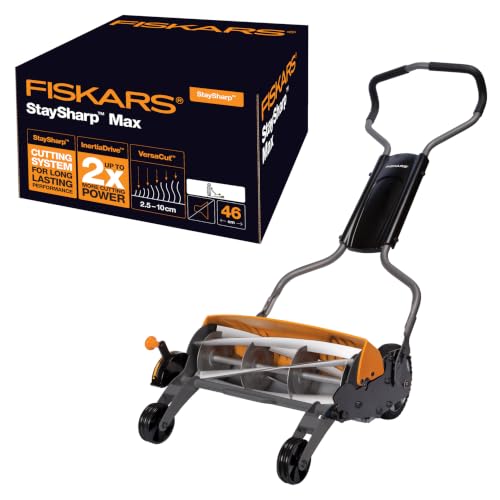
Best for Homeowners with a small-to-mid fine lawn who want the cleanest low-maintenance cut
- 18-inch, 5-blade cutting width for a mid-size lawn
- InertiaDrive reel that carries momentum through thicker patches
- StaySharp cutting system designed to mow without blade-to-reel contact
- Rear roller and cutting-height range of roughly 1 to 4 inches
- Owners report it powers through growth that stalls cheaper reels
- Taller height range than most reels handles a wider grass mix
- Rear roller helps keep the cut even and reduces scalping
- Heavier than budget reels, so more effort on slopes
- Higher upfront cost than a basic geared reel
Verdict: The all-round pick: a sharp, forgiving reel that handles a wider grass range than most while staying quiet and engine-free.
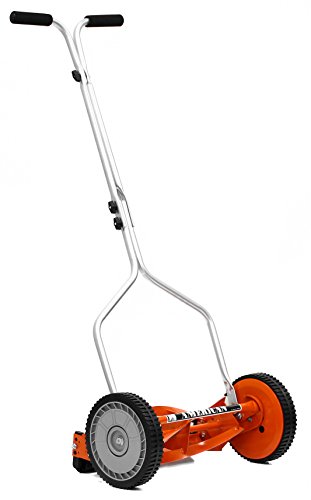
Best for Tiny, level, fine lawns and buyers on the tightest budget
- 14-inch, 4-blade reel for courtyards and small plots
- Lightweight steel build that is easy to lift and store
- Cutting height adjustable from roughly 0.5 to 1.75 inches
- Simple geared drive with tool-free height setting
- One of the lightest and lowest-cost reels sold
- Easy to push on short, dry grass
- Compact enough to hang on a garage wall
- Narrow 14-inch cut means more passes
- Low height range suits only short, fine grass
Verdict: The budget entry point for a small lawn: light, cheap, and simple, as long as you keep the grass short and mow often.
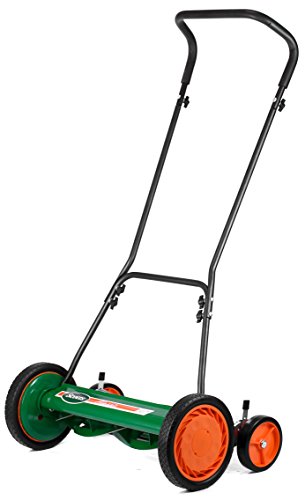
Best for Owners of a larger fine-bladed lawn who want the widest manual cut
- 20-inch, 5-blade reel — the widest in this lineup
- Heat-treated alloy blades for edge retention
- Cutting height adjustable from roughly 1 to 3 inches
- 10-inch wheels for easier rolling on a bigger yard
- Widest cut here, so fewer passes on a large lawn
- Taller wheels roll more easily than small-wheel reels
- Blades hold an edge well between sharpenings
- Heaviest and hardest to turn around obstacles
- Big lawns still make a manual reel hard work
Verdict: The choice when a manual reel has to cover more ground: the widest cut in the group, best on open, level turf.

Best for First-time reel-mower buyers with a small to mid-size lawn
- 16-inch, 5-blade reel — the all-round home size
- Cutting height from roughly 0.5 to 2.5 inches
- Cushioned T-style handle for comfort
- Straightforward assembly and height adjustment
- Middle-of-the-road width and weight suit most small yards
- Wide height range for a manual reel
- Long-running U.S. reel-mower brand with easy parts support
- Standard geared drive loads up on tall grass
- No rear roller, so a little more prone to scalping
Verdict: An easy first reel mower: the practical 16-inch size, a forgiving height range, and a price that lowers the risk of trying one.

Best for Owners chasing a manicured, golf-green finish on short turf
- 16-inch reel with a 7-blade cylinder for extra cuts per pass
- Cutting height from roughly 0.5 to 2.5 inches
- Dual-wheel design for steadier tracking
- Fine-cut geometry aimed at low, dense lawns
- Seven blades leave a smoother finish than five-blade reels
- Good fit for Bermuda, zoysia, and bentgrass kept short
- Even tracking on level ground
- More blades mean more effort and more frequent mowing
- Fine cut needs short grass to perform
Verdict: The pick for a showpiece short lawn: the seven-blade reel lays down a finer finish, provided you mow often and keep it low.

Best for A mid-size lawn owner who wants width without stepping up to 20 inches
- 18-inch, 5-blade reel for a mid-size yard
- Cutting height from roughly 1 to 2.5 inches
- T-style handle with cushioned grip
- Simple, serviceable geared drive
- 18-inch width covers more ground than a 16-inch reel
- Lighter and easier to turn than the 20-inch Scotts
- Backed by a long-standing reel-mower maker
- Lower top height than the Fiskars limits tall-grass use
- Basic geared drive, no momentum assist
Verdict: A sensible middle option between the 16-inch all-rounder and the wide 20-inch reel — extra width that is still manageable.
Frequently Asked Questions
Do reel mowers really cut better than rotary mowers?
On short, fine grass, yes — a sharp reel scissors each blade cleanly, while a rotary tears the tip by impact, which can brown and fray. But that edge only holds when the grass is kept short and the reel is sharp. Let the lawn grow tall or coarse and a rotary gives the better, more even result.
Is a reel mower good for a large lawn?
Not usually. Manual reels top out around a 20-inch cut and you supply all the power, so anything approaching a quarter-acre becomes hard work. For larger lawns a self-propelled rotary — battery or gas — finishes far faster with less effort, which is why most big-lawn owners go powered.
Are rotary mowers more dangerous than reel mowers?
Rotary mowers carry more risk because a single blade spins at high speed and can throw stones or debris. Reel mowers have no powered blade, so they are gentler, though the cylinder is still sharp. With either type, clear the lawn of debris first, wear closed shoes, and never reach near the blade while it can move.
Which is cheaper to own, a reel or rotary mower?
A manual reel is cheapest overall: no fuel, no oil, no battery, and decades of life with basic care. Battery rotary mowers cost more upfront but little to run, while gas mowers add ongoing fuel, oil, spark plugs, and air filters. For a small lawn, the reel is the clear low-cost winner.