
Best Manual Log Splitter
Best Manual Log Splitter, ranked from aggregated owner ratings and reviews, not first-hand testing. Real pros, cons, and who each pick is best for.

Our Top 3 Picks
Quick Comparison
| Product | Best for | Buy | |
|---|---|---|---|
| Sun Joe LJ10M | Best Overall | See Amazon | View (paid link) |
| Ryobi 40V Brushless Kinetic Log Splitter (RY40570) | Editor's Pick | See Amazon | View (paid link) |
| DR RapidFire Pro-XL Flywheel Log Splitter | Best Premium | See Amazon | View (paid link) |
| Powerhouse XM-380 Manual Log Splitter | Best Value | See Amazon | View (paid link) |
| Kindling Cracker King | Best Compact | See Amazon | View (paid link) |
| Logosol Smart-Splitter | Best for Beginners | See Amazon | View (paid link) |
How to choose a manual or kinetic log splitter
Pick a manual or kinetic splitter by matching its power method, force, and log capacity to how much wood you actually burn. The table below sets the shortlisted models side by side before the detail.
| Model | Type | Power source | Rated capacity (published) | Best suited to |
|---|---|---|---|---|
| Sun Joe LJ10M | Manual hydraulic | Two-speed hand pump | Around 10 tons | Regular firewood, no outlet |
| Ryobi RY40570 | Kinetic flywheel | 40V battery | Rounds to about 10 in | Fast cordless splitting |
| DR RapidFire Pro-XL | Kinetic flywheel | Gas engine | 20-plus-ton class (marketed) | High-volume, tough rounds |
| Powerhouse XM-380 | Manual hydraulic | Two-speed hand pump | Around 7 tons | Budget occasional use |
| Kindling Cracker King | Kindling splitter | Mallet strike | Kindling and offcuts | Safe kindling production |
| Logosol Smart-Splitter | Slide-hammer | Sliding weight | Small, straight rounds | Quiet, low-cost splitting |
What power method should you choose?
Choose the power method first, because it drives everything else. Manual hydraulic splitters need no fuel or outlet and stay near-silent, which suits renters, sheds without power, and light burners; the cost is effort and a slow cycle. Kinetic splitters trade that for a two-second cycle, but they need either gas or a charged battery and cost more up front.
Battery kinetic units such as the Ryobi remove fumes and pull-starts, so they park indoors and start on a trigger. Gas kinetic machines like the DR RapidFire keep going as long as you have fuel and handle bigger, tougher rounds, at the price of engine maintenance and noise. A gas hydraulic splitter is the alternative when you need maximum tonnage rather than speed.
How much force and log capacity do you need?
Size the machine to your worst logs, not your average ones. For clean, seasoned rounds up to about 10 inches, any unit here copes. For thicker or knottier wood, lean toward a gas kinetic machine or step up to hydraulic, because manual and battery units run out of dwell time under a stubborn knot.
The published tonnage on a manual hydraulic splitter assumes full pumping, so a 10-ton model like the Sun Joe LJ10M clears more than a 7-ton unit only if you keep working the lever. Kinetic ratings describe matched hydraulic class rather than pump force, so compare them on cycle time and maximum log size instead.
Which build and safety features matter?
Prioritise a stable stance, a fast ram return, and a guarded wedge. A low horizontal frame or a bench-mount design keeps a manual splitter steady, while kinetic machines should have two-hand or set-and-release operation so your hands are clear when the flywheel fires. Auto-return saves time on every cycle and is standard on the kinetic models here.
Look for solid wheels if you will move the unit, a log cradle or tray to stop split halves falling, and honest capacity claims. Pair any splitter with eye protection and gloves from our safety gear guide, and a sawhorse or log stand to keep rounds at a safe working height.
How much should you budget for a manual or kinetic splitter?
Budget by mechanism, because price tracks the power method more than the brand. A manual hydraulic splitter is the least expensive powered-feeling option, a slide-hammer or kindling tool costs less still, and a kinetic flywheel machine sits well above them because you are paying for the two-second cycle. Rough tiers are set out below.
| Tier | Typical example | What you are paying for |
|---|---|---|
| Lowest | Slide-hammer or kindling splitter | Simplicity, silence, near-zero upkeep |
| Low-mid | Manual hydraulic splitter | Mechanical advantage without an engine |
| Upper | Battery kinetic splitter | Fast cycle, fume-free, cordless convenience |
| Highest | Gas kinetic splitter | Speed plus capacity for high volume |
Spending more buys speed and capacity, not necessarily a cleaner split on any single round. If you burn lightly, the cheapest tool that clears your wood is the sensible buy; if you process cords, the faster machine repays its premium in hours saved.
Which splitter fits your annual firewood volume?
Match the machine to how much you burn, because volume is the clearest guide to the right tier. A face cord or two a year rarely justifies a kinetic machine, while several cords make its speed pay for itself. The guidance below pairs common volumes with a sensible pick.
- A wheelbarrow of kindling now and then: a splitting axe or maul or a kindling splitter is plenty.
- Under a cord a year: a manual hydraulic splitter such as the Sun Joe LJ10M or the budget Powerhouse (paid link) XM-380.
- One to three cords: a battery kinetic unit like the Ryobi RY40570 for quiet, fast, intermittent work.
- Three cords and up, or tough wood: a gas kinetic machine such as the DR RapidFire Pro-XL, or step across to a gas hydraulic splitter.
Buying well above your volume ties up money in speed you rarely use; buying below it leaves you fighting a slow tool through a big pile.
How do you match a splitter to softwood, hardwood, and knotty rounds?
Match force and dwell to the wood, because grain and dryness decide difficulty more than diameter alone. Straight, seasoned softwood splits easily on almost anything here, while dense hardwood and knotty or crotch pieces demand more force or the dwell only hydraulics provide. A quick guide follows.
- Seasoned softwood such as pine or fir: any manual, battery, or gas unit copes well.
- Straight seasoned hardwood such as oak or maple under about 10 inches: manual hydraulic and kinetic units handle it, kinetic faster.
- Large or knotty hardwood: favour a gas kinetic machine, or a high-tonnage hydraulic splitter for the worst crotch wood.
- Green or wet wood of any species: season it first, because wet fibres resist every splitter in this class.
Since kinetic drives cannot lean on a knot the way a hydraulic ram dwells under pressure, the honest rule is to season and sort your wood, and set the nastiest pieces aside for a maul or a bigger hydraulic machine.
What setup and accessories get the best results?
Good results come as much from the setup as the splitter. Work at a comfortable height on stable ground, keep rounds bucked square, and protect yourself, and any machine in this class performs to its rating. The essentials are listed below.
- A sawhorse or log stand to buck rounds square and save your back.
- Eye protection and work gloves every session, since split wood throws chips and slivers.
- Hearing protection for any gas kinetic machine, which is genuinely loud.
- Seasoned, dry rounds, plus the racks and moisture meters covered in our firewood tools guide.
- For battery units, a spare high-capacity pack on charge so you can swap and keep splitting.
None of this is expensive, and together it makes the difference between a frustrating afternoon and a tidy stack.
What buying mistakes should you avoid?
The costly mistakes are buying on tonnage alone and ignoring support. A published force figure means little without matching cycle speed and log capacity to your wood, and an unbranded flywheel clone can be impossible to service. Avoid the traps below.
- Chasing a big tonnage number when your rounds are small and seasoned, so you pay for force you never use.
- Buying an unbranded kinetic clone with no parts network; stick with names that carry spares.
- Ignoring the length limit, then finding your rounds do not fit the frame.
- Assuming a manual unit's rated tons appear without effort, when the figure assumes you keep pumping.
- Overlooking storage and PPE, which quietly shorten a machine's life and your patience.
Buy for the wood you actually cut, from a brand you can get parts for, and the rest of the decision is easy.
Manual, kinetic, or an axe?
Decide honestly how much you split. A splitting axe or maul beats any machine for a small kindling pile and costs the least. A manual hydraulic splitter earns its place once swinging gets tiring but you still burn modestly. A kinetic splitter is worth the premium only when you process cords and value speed. When in doubt, start smaller; you can always add a machine as your firewood habit grows, and the firewood tools guide covers the storage and seasoning gear that matters just as much.
Full Ranking, Reviewed
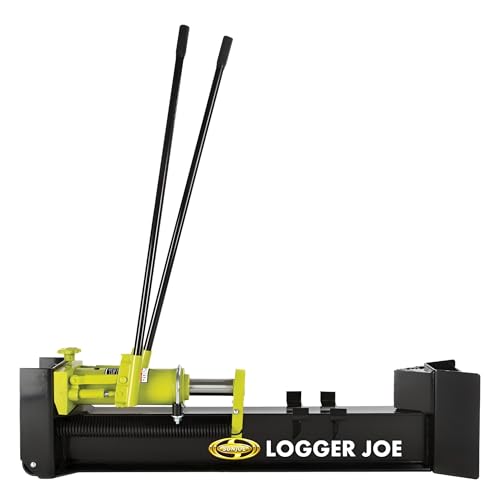
Best for Regular firewood burners with no power outlet nearby
- Around 10 tons of published splitting force from a two-speed hand pump
- No fuel, cords, or batteries, so it runs anywhere and stays silent
- Handles seasoned rounds up to roughly a foot in length and diameter
- Compact horizontal frame with wheels for shed-to-yard moves
- Strong force-to-price ratio for a hand-pumped unit
- Near-silent, fume-free operation for suburban yards
- Simple mechanicals with little to maintain
- Two-hand pumping is tiring over a big pile
- Slow next to any powered splitter
Verdict: The best all-round manual splitter for households that burn steadily but do not want an engine, based on its force rating and consistent owner feedback.

Best for Cordless splitting without fuel, fumes, or pull-starts
- 40V brushless motor drives a flywheel for a cycle of around two seconds
- Published to split rounds up to about 10 inches in diameter
- Runs on the Ryobi 40V battery platform many owners already have
- Auto-return ram and set-and-release operation for hands-clear use
- Fast kinetic cycle with no gas engine to maintain
- Quiet and clean enough to run in a garage
- Shares batteries with other Ryobi 40V tools
- Battery runtime limits long splitting sessions
- Less capacity than a gas kinetic or hydraulic machine
Verdict: A genuinely convenient cordless kinetic splitter for small to mid rounds, and our pick for anyone already invested in the Ryobi 40V line.

Best for High-volume splitting of larger, tougher rounds
- Twin flywheels store energy for a fast, repeatable split cycle
- Gas engine keeps working as long as you have fuel
- Marketed as matching hydraulic splitters in the 20-plus-ton class
- Two-handed operation and rapid auto-return between logs
- Very fast cycle for serious firewood volume
- Handles bigger and knottier rounds than battery kinetic units
- Backed by DR and Generac dealer parts support
- Premium price versus manual and battery options
- Gas engine adds noise and maintenance
Verdict: The heavy-duty flywheel choice when you process cords each season and want speed, chosen on its marketed capacity and DR's parts network.

Best for Budget-minded occasional splitting of smaller rounds
- Around 7 tons of published force from a two-speed manual pump
- Lightweight horizontal frame that stores easily in a shed
- No electricity or fuel required for operation
- Suited to seasoned rounds toward the smaller end of the range
- Among the lower-cost powered-feeling manual units
- Portable and simple to set up
- Quiet, fume-free operation
- Lower force rating than 10-ton manual units
- Struggles with large or knotty wood
Verdict: A sensible entry point for light users who want more mechanical advantage than an axe without paying for a powered machine.

Best for Producing kindling safely from offcuts and small splits
- Cast-iron ring holds the wood while a fixed blade does the splitting
- You strike the wood with a mallet rather than swinging a blade at a target
- King size accepts larger pieces than the standard model
- No moving parts, motor, or maintenance
- Much safer than swinging a hatchet for kindling
- Effectively indestructible cast-iron build
- Bolts down or sits in a stump for stability
- Only makes kindling, not full firewood
- Needs bolting or weighting to stay put
Verdict: The safest, simplest way to turn offcuts into kindling, which is why it stays a firewood-shed favourite despite its narrow job.
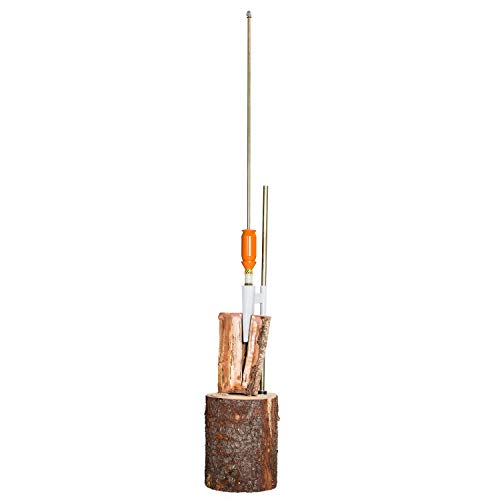
Best for Quiet, low-cost splitting of small straight rounds
- A sliding weight drives a wedge down through the round
- No engine, hydraulics, or electricity of any kind
- Folds down light enough to carry and store flat
- Works over a fixed base plate for a controlled, repeatable strike
- Very safe and controlled compared with an overhead swing
- Almost nothing to break or maintain
- Inexpensive and highly portable
- Effort climbs quickly with larger rounds
- Slow for anything more than modest volumes
Verdict: A beginner-friendly slide-hammer splitter that trades speed for control and safety, ideal for small straight rounds and light use.
Frequently Asked Questions
Is a manual log splitter easier than an axe?
Yes, for most people a manual hydraulic splitter is easier and safer than an axe because it multiplies your force through a pump and keeps your hands away from a swinging blade. The trade-off is speed, since each split takes several pumps rather than one strike.
Do kinetic log splitters need hydraulic fluid?
No. Kinetic splitters store energy in a spinning flywheel and release it through a rack-and-pinion drive, so there is no hydraulic pump or fluid to top up and no slow ram return. They still need power, either a gas engine or a battery, to keep the flywheel turning.
How big a log can a manual or kinetic splitter handle?
Most manual and battery kinetic splitters handle seasoned rounds up to about 10 to 12 inches across, based on published capacities. Gas kinetic machines such as the DR RapidFire take larger and tougher rounds. Green, knotty wood is harder on every machine in this class.
Are kinetic log splitters worth the extra cost?
A kinetic splitter is worth the premium when you split a cord or more each season and value the roughly two-second cycle. For occasional firewood, a manual hydraulic splitter or a maul does the same work for far less, so the value depends entirely on your volume.