


How does a manual log splitter work?
A manual log splitter works by multiplying the effort you put in, using either hydraulic pressure or the momentum of a moving weight. There is no engine; your muscles supply the energy, and the mechanism concentrates it into enough force to open a round along its grain.
How does a manual hydraulic model work?
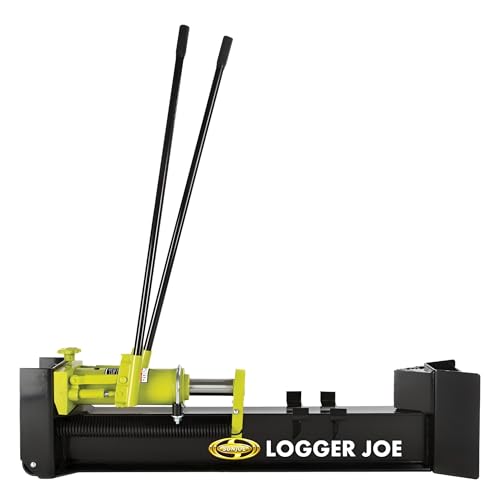
A manual hydraulic splitter uses a two-speed hand pump to push fluid into a small cylinder, which advances a ram and wedge against the log. Each pump adds pressure, so the ram moves in steps rather than one motion. The two-speed pump moves the ram quickly until it meets resistance, then shifts to a slower, higher-force mode for the split itself.
How does a slide-hammer model work?
A slide-hammer splitter, such as the Logosol Smart-Splitter, converts momentum into splitting force. You lift a heavy sliding weight and drop it against a stop, driving a wedge downward into the round below. Repeated strikes deepen the split until the wood opens, all without hydraulics or an engine.
Why choose a manual splitter?
Manual splitters trade speed for simplicity, silence, and low cost. They need no fuel, outlet, or fluid maintenance, which suits light burners and shed-based use. When volume grows, a kinetic or gas splitter becomes the better tool, but for occasional firewood a manual unit or a splitting maul is often enough.
What is a two-speed pump, and why does it matter?
A two-speed pump is what gives a manual hydraulic splitter its usable force. It moves the ram in two modes: a fast, low-force stage that closes the gap to the wood quickly, and a slow, high-force stage that builds the pressure needed to drive through the round. The pump shifts between them automatically as resistance rises, so you are not wasting effort forcing high pressure across empty travel. This is why a hand-pumped unit can develop several tons from muscle alone; the mechanism trades speed for force exactly when the split demands it.
How much force can a manual splitter really produce?
A manual splitter produces its rated force only while you keep working the mechanism. A published figure of, say, ten tons reflects the pressure the pump and cylinder can build with full strokes, not a push that appears on its own. Because the ram advances in steps, a knotty round does not defeat the machine outright; it simply asks for more strokes. The honest way to read the rating is as a ceiling you reach through effort, which is why a higher-rated unit only clears tougher wood if you are willing to pump for it.
How does a foot-pump splitter differ from a hand pump?
A foot-pump splitter uses your leg rather than your arm to drive the same kind of hydraulic cylinder. The mechanism is identical in principle, since a pump feeds fluid to a ram, but pedalling lets you use the stronger muscles of the leg and keeps both hands free to steady the setup between cycles. Hand-pump units are more common and more compact, while a foot pump can be less tiring over a long pile. Either way the two-speed principle and the step-by-step ram travel are the same.
When does a manual splitter reach its limit?
A manual splitter reaches its limit on green, oversized, or heavily knotted wood. Because it cannot dwell under load indefinitely and depends on your stamina, a round that a hydraulic ram would slowly crush can simply outlast your arms. That is the point to step up to a kinetic or gas splitter or reach for a splitting maul. Knowing the limit protects both you and the tool from a fight neither can win.
A worked example: a two-speed pump meeting a knot
Picture the wedge reaching a knot mid-round. In the fast stage the ram closes on the wood quickly; as the wedge bites and resistance climbs, the pump shifts to its slow, high-force stage, and each full stroke now advances the ram only a little but with much greater push. Keep the strokes smooth and let the split open before backing off. If the knot still holds after honest effort, set the round aside rather than forcing it, because that judgement is part of using a manual splitter well.