

Do lawn sweepers really work?
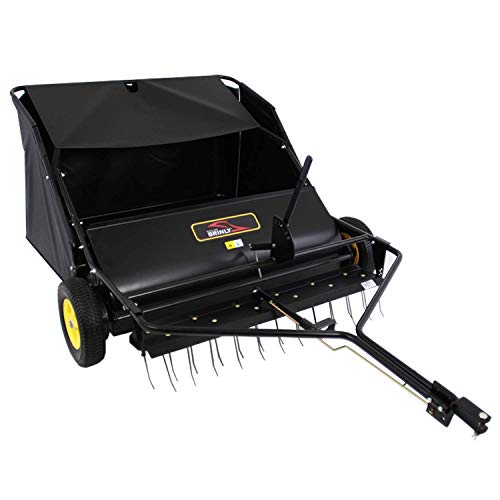
Lawn sweepers do work, and on the right material they clear a lawn faster and with far less effort than a rake. As the sweeper rolls, its wheels spin a set of brushes that sweep leaves, clippings, needles, and acorns backward into a hopper — no engine or battery required. The catch is that they only work well within their limits.Performance depends almost entirely on conditions, which sort out clearly below.
- Dry debris lifts easily, so sweep after the lawn has dried, not while it's damp.
- Loose material on top of the turf is collected; anything pressed into the soil is skipped.
- Correct brush height matters — bristles should just touch the grass tips.
- Light, even debris beats deep, matted piles, which overwhelm the brush.
Owners who are disappointed almost always tried to sweep wet leaves or expected a brush to lift material a vacuum is designed for. Used on dry leaves, grass clippings, and pine needles, a sweeper is one of the most efficient cleanup tools you can own, and it costs nothing to run. If your cleanup is mostly damp or matted, a powered leaf vacuum is the better match, and a leaf blower can gather scattered leaves into rows first to speed either tool. For models sized to different yards, see our best lawn sweeper picks.
Why do lawn sweepers work without a motor?
Lawn sweepers work without a motor because the road wheels themselves drive the brushes through a simple gear set. As you push or tow the sweeper forward, the wheels turn and spin the brushes several times faster, and that speed is what flicks debris up and back into the hopper.It is the same principle as a mechanical reel mower: your forward motion is the power source, geared up to do useful work. Because nothing is powered, there is no fuel, battery, or cord, and no throttle to manage — the faster the wheels roll, the faster the brushes spin, up to the steady pace that works best. This mechanical simplicity is also why sweepers are so reliable and cheap to run: there is very little to break, and the only real wear item is the brushes themselves.
When do lawn sweepers not work well?
Lawn sweepers fall short on wet, matted, heavy, or embedded debris, because the brush can only lift material light enough to be flicked backward into the hopper. Soaked leaves, thick sticks, deep leaf drifts, and anything pressed into the soil all defeat the sweeping action.The specific situations where a sweeper struggles are worth knowing before you rely on one. Wet leaves clump and cling to the turf, so the brush rides over them; large branches jam or wrap the bristles; and deeply matted thatch needs a dethatcher to lift it first. In each case the fix is a different tool — a powered leaf vacuum for wet material, a wood chipper for branches, a scarifier for embedded thatch — rather than forcing the sweeper past what it was built to do.
How much time does a lawn sweeper actually save?
A lawn sweeper can turn an afternoon of raking into a fraction of the time, though the exact saving depends on lawn size and debris. On a quarter-acre lot buried in autumn leaves, a job that might take a couple of hours with a rake often drops to well under an hour with a push sweeper, and far less again with a wide tow model.As a worked example, picture a half-acre lawn under a heavy leaf fall. Raking and bagging that by hand is a long, back-straining chore. A 42-inch tow sweeper behind a riding mower can clear the same ground in a loop or two, stopping only to empty a large hopper. The saving is not just time but effort — the machine does the collecting while you drive. The bigger the lawn and the heavier the debris, the more dramatic the difference, which is why acreage owners rate wide tow sweepers so highly.
What do disappointed lawn sweeper owners usually get wrong?
Disappointed owners almost always tried to sweep wet leaves or expected the brush to lift material a vacuum is designed for. Used outside its limits, any sweeper underperforms, and the fix is nearly always technique rather than a better machine.The recurring mistakes are sweeping damp turf, setting the brush too high so debris slides underneath, moving too fast for the brush to catch acorns and needles, and storing the sweeper outdoors where the bristles warp. Correct those four things — a dry lawn, a brush grazing the grass tips, a steady pace, and covered storage — and the same sweeper that frustrated its owner clears the lawn cleanly. When cleanup is genuinely mostly wet or matted, a powered leaf vacuum is simply the right tool, and there is no downside to owning both.


