Best Hedge Shears
Best Hedge Shears, ranked from aggregated owner ratings and reviews, not first-hand testing. Real pros, cons, and who each pick is best for.

Our Top 3 Picks
Quick Comparison
| Product | Best for | Buy | |
|---|---|---|---|
| Fiskars PowerGear2 Hedge Shears | Best Overall | See Amazon | View (paid link) |
| Okatsune 217 Hedge Shears | Best Premium | See Amazon | View (paid link) |
| Bahco P51H Hedge Shears | Best Heavy-Duty | See Amazon | View (paid link) |
| Fiskars Solid Hedge Shears | Best for Beginners | See Amazon | View (paid link) |
| Corona HS 3950 Extendable Hedge Shear | Best Value | See Amazon | View (paid link) |
| Spear & Jackson Razorsharp Telescopic Hedge Shears | Editor's Pick | See Amazon | View (paid link) |
How to choose the best hedge shears
The best hedge shears match your growth and your hedges: geared or lightweight, long or short blades, fixed or telescopic handles. Below are six manual shears that cover most gardens, from a keen Japanese topiary pair to a tough forged workhorse, followed by the attributes that should drive your pick.The comparison table lines up our picks by their standout strength so you can shortlist at a glance.
| Shears | Best for | Blade | Standout feature |
|---|---|---|---|
| Fiskars PowerGear2 | All-round trimming | ~10 in | Geared low-effort cut |
| Okatsune 217 | Topiary and fine hedges | ~7–8 in | Keen Japanese steel |
| Corona HS 3950 Extendable | Tall or wide hedges | ~8 in | Telescoping reach |
| Bahco P51H | Thick, heavy growth | ~8–9 in | Forged blades |
| Fiskars Solid | First-time buyers | ~8 in | Light and affordable |
| Spear & Jackson Telescopic | Varied hedge heights | ~8–9 in | Locking extendable handles |
What blade length suits your hedges?
Blade length should follow the shapes you cut. Blades around 8 to 10 inches handle general hedge faces and runs; shorter blades near 7 inches steer cleanly around topiary and box. Longer blades cover ground faster on straight boundaries but flex and wander on tight curves.If your hedges are mostly formal shapes — balls, cones, low box edging — a shorter, controllable pair like the Okatsune 217 rewards the choice with clean, accurate cuts. If you face long, flat privet or beech runs, a longer-bladed geared pair such as the Fiskars (paid link) PowerGear2 clears the work with fewer strokes. Growth that grips a wavy blade section, found on the Corona, stops springy twigs sliding out uncut.
Are geared hedge shears worth it?
Geared hedge shears are worth it if you cut thick or woody growth or trim for long stretches. A gear at the pivot multiplies your force where a twig resists most, so the blades close through stems that stall a plain pivot and your forearms tire less. The Fiskars PowerGear models are the clearest example.For light, soft hedges the answer flips: a simple non-geared shear like the Fiskars Solid is lighter, cheaper, and plenty capable, with less mechanism to keep clean. Match the tool to the toughest growth you regularly cut, not the easiest. If individual stems are thicker than roughly a pencil, you are past shear territory and into loppers.
How thick a branch can hedge shears cut?
Hedge shears cut soft leafy growth and twigs up to about the thickness of a pencil, and no more. The wide limb notch near the pivot takes the thickest twig a single pass can manage; push past that and you spring the blades and bruise the wood you are cutting.Gearing raises the effort you can apply, not the size of stem the shears are built for, so a Fiskars PowerGear2 closes through dense growth more easily but still should not be forced through a finger-thick branch. Once individual stems pass a pencil, switch tools rather than straining the shears: bypass hand pruners for single shoots, and loppers for branches up to about an inch and a half. Cutting within what shears are made for keeps the edge true and every cut clean.
Which blade steel holds an edge longest?
Blade steel decides how long a shear stays sharp and how much upkeep it asks for. Japanese high-carbon steel, as on the Okatsune 217, takes and holds the keenest edge but must be dried and oiled to fight rust; coated hardened steel, as on the Fiskars pairs, resists sap and corrosion with far less fuss.Three broad choices cover the picks in this guide. High-carbon steel sharpens to a very fine, long-lasting edge and is the choice for clean cuts on formal hedges, at the cost of careful drying after every use. Coated carbon steel — the low-friction finish on the Fiskars PowerGear2, Fiskars Solid, and Corona HS 3950 — sheds sap and shrugs off moisture, so it suits gardeners who want to wipe and hang the shears without ceremony. Forged steel, as on the Bahco (paid link) P51H, trades a little edge fineness for toughness that takes thicker, woodier growth without chipping. Whatever the steel, a keen edge kept clean beats a premium blade left blunt and sappy.
What makes a shear comfortable all afternoon?
Comfort comes from weight, balance, and handle grip together. Most two-handed shears weigh about 2 to 3.5 pounds; lighter aluminium-handled pairs suit overhead work, while forged shears feel planted on heavy growth. Shock-absorbing bumpers at the end of each stroke spare your wrists and elbows over a long session.Balance often matters more than the number on the scale — a shear that carries its mass toward the grips feels lighter in the swing. Telescopic handles, as on the Corona HS 3950 and the Spear & Jackson (paid link) pair, add reach for tall hedges but shift the balance forward and add weight when extended, so keep them retracted for detail work. Cushioned grips reduce blisters and slipping when your hands are damp.
Fixed or telescopic handles — which should you buy?
Buy fixed handles for control and lighter weight, telescopic handles for reach on tall or wide hedges. Fixed shears like the Fiskars PowerGear2 and Okatsune 217 keep the balance close and steady for shaping, while telescopic pairs like the Corona HS 3950 and the Spear & Jackson Razorsharp Telescopic extend to reach hedge tops from the ground.The trade-off with telescopic handles is weight and balance: extended, they carry their mass further from your hands and feel heavier through each stroke, so they suit clearing reach rather than fine detail. Lock them at the shortest length that reaches the work, and retract them fully for close shaping. The quick comparison below sets the two handle styles side by side.
| Handle style | Best for | Trade-off | Example pick |
|---|---|---|---|
| Fixed | Control, shaping, lighter swing | No extra reach | Fiskars PowerGear2, Okatsune 217 |
| Telescopic | Tall or wide hedges from the ground | Heavier, balance shifts when extended | Corona HS 3950, Spear & Jackson Razorsharp |
For height beyond a comfortable overhead reach, a manual pole pruner is safer than a fully extended shear on a step.
Which of these shears suits your garden?
Match the pick to your hedges and how often you cut. Formal box and topiary reward the short, keen Okatsune 217; long or overgrown runs suit the geared Fiskars PowerGear2; tall hedges call for the telescopic Corona HS 3950 or Spear & Jackson; and a first, occasional pair points to the light Fiskars Solid.Real gardens fall into a few patterns. A small courtyard with a couple of clipped shapes needs precision more than power, so a light, controllable pair earns its place. A suburban plot with a mix of boundary hedge and shaped specimens is happiest with a geared all-rounder that shrugs off thicker growth. An older, neglected hedge being brought back wants gearing and a bit of reach, though anything woodier than a pencil should go to loppers or a pruning saw. And a long boundary of privet or leylandii trimmed twice a year is really a job for a powered machine — see the powered hedge trimmers guide — with hand shears kept for the finishing touches.
How do you keep hedge shears cutting season after season?
Keep hedge shears cutting by cleaning, honing, and oiling them on a simple routine rather than waiting for them to fail. A wipe after every use, an edge touch-up when cuts start tearing, and a proper service before winter will carry a good pair for decades.The routine that keeps a pair sharp is set out below.
- Wipe sap and moisture off the blades after every session and dry them fully.
- Add a drop of oil to the pivot and work the shears open and closed a few times.
- Hone the bevelled outer edge with a mill file when the cut turns from a slice to a tear.
- Check the pivot bolt so the blades meet with a slight scissor drag along their length.
- Before storage, clean, sharpen, oil, and hang the shears in dry outdoor tool storage.
The files and stones for the job are covered in the sharpening files and tools guide.
How do you cut safely with hedge shears?
Keep both hands on the grips and behind the blades, wear eye protection, and use gloves for grip and against sap. Hedge shears are spring-loaded and sharp, so a clean, deliberate cut is safer than a rushed hack. Work bottom to top and taper the base slightly wider so light reaches the whole hedge face.The ladder is the real hazard. Never overreach from a step with shears in hand; reposition, or switch to a manual pole pruner for height. Pull on a pair of work gloves, then clean, dry, and oil the blades after use, and hone the edge when cuts start tearing. These picks are general buying guidance, not a substitute for training, and tall or leaning hedge work near structures or power lines belongs to a professional. For the wider range of hand tools, start at the outdoor hand and cutting tools hub.
Full Ranking, Reviewed
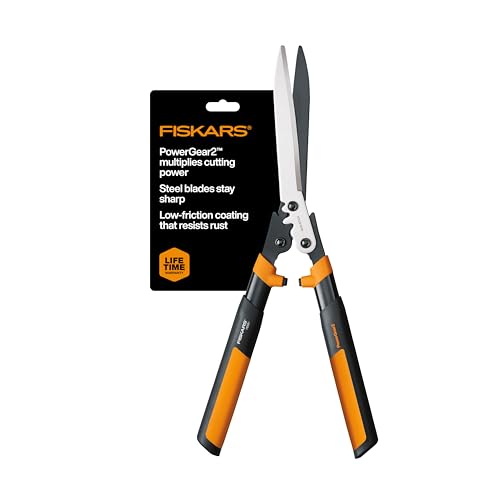
Best for Homeowners shaping medium hedges who want less strain per cut
- Geared PowerGear mechanism that multiplies cutting force on thicker twigs
- Coated steel blades around 10 inches that shed sap and clippings
- Overall length near 25 inches for two-handed reach
- Cushioned handle ends and a shock-absorbing bumper
- Geared action makes closing on tough growth noticeably easier
- Coated blades resist sap build-up and clean off quickly
- Well balanced and comfortable for longer trimming sessions
- Not a precision topiary tool for the finest detail
- Coating can scuff after years of heavy use
Verdict: A do-everything manual hedge shear whose geared action takes the sting out of thicker growth, making it the easiest all-round pick for most gardens.

Best for Detail gardeners shaping boxwood, topiary, and formal hedges
- Japanese high-carbon steel blades known for a keen, lasting edge
- Blade length around 7 to 8 inches for controlled, precise cuts
- White oak handles with a simple, balanced feel
- Bolt-through pivot that adjusts and services easily
- Cuts cleanly through green growth with little effort
- Holds its edge well and hones back quickly
- Light and precise for shaping and detail work
- High-carbon steel needs drying and oiling to avoid rust
- Shorter blades are slower on long, bulky runs
Verdict: A cult-favourite Japanese shear that rewards a light touch with clean, accurate cuts, ideal for topiary and fine hedges rather than brute-force clearing.

Best for Regular trimming of tougher, thicker hedge growth
- Forged steel blades built for demanding, repeated use
- Blade length around 8 to 9 inches with a wide cutting notch
- Lightweight tubular aluminium handles
- Shock-absorbing stops that reduce jarring at the end of each cut
- Robust blades handle thicker twigs than many rivals
- Light handles keep overall weight down for the strength
- Cushioned stops soften the end of each stroke
- Plainer finish than premium Japanese shears
- Edge benefits from regular touch-ups under heavy use
Verdict: A forged, no-nonsense workhorse for gardeners who cut thick growth often and want blades that keep taking it.

Best for First-time buyers and light, occasional hedge tidying
- Simple non-geared design that keeps weight and price down
- Coated steel blades that shed clippings
- Blade length around 8 inches for everyday trims
- Lightweight handles that ease overhead work
- Affordable and easy to pick up and use
- Light enough for occasional trims without fatigue
- Low-maintenance coated blades
- No gearing, so thick growth takes more effort
- Best kept to lighter, softer hedge material
Verdict: An honest, low-cost entry pair that covers light hedge tidying without fuss, and a sensible first shear before you commit to a premium tool.

Best for Reaching the tops and backs of tall hedges without a ladder
- Telescoping handles that extend for extra reach
- Wavy blade edge that grips and holds twigs while cutting
- Steel blades with a non-stick coating
- Bumper that cushions the end of each cut
- Extendable handles add reach for tall or wide hedges
- Gripping blade profile stops twigs sliding out uncut
- Solid, serviceable build for the price
- Longer and heavier when fully extended
- Extension joints need occasional tightening
Verdict: A well-priced extendable shear that buys real reach for tall hedges, letting you keep both feet on the ground more often.
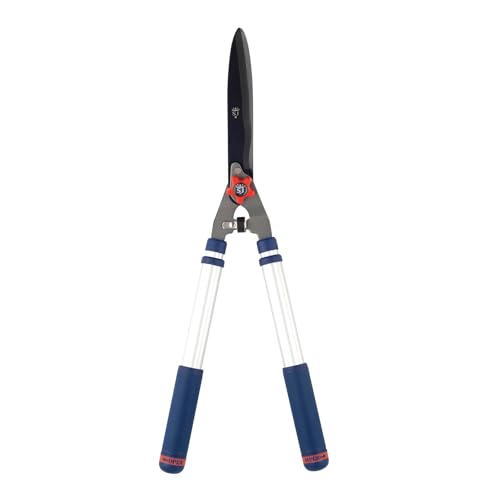
Best for Gardeners wanting adjustable reach and a keen factory edge
- Telescopic handles that lock at several lengths
- Razor-ground carbon steel blades with a non-stick coating
- Blade length around 8 to 9 inches
- Soft grips and end bumpers
- Locking telescopic handles suit varied hedge heights
- Arrives sharp and cuts green growth cleanly
- Comfortable grips for extended sessions
- Coating and grips less durable than premium tools
- Control drops off at full extension
Verdict: A flexible telescopic pair that adapts to different hedge heights and comes cutting cleanly out of the box, a strong mid-range all-rounder.
Frequently Asked Questions
What is the difference between garden shears and a hedge trimmer?
Garden and hedge shears are manual, two-handed tools that cut by a scissor action for quiet, precise shaping. A hedge trimmer is a powered machine with a reciprocating blade for long runs and thick regrowth. Shears win on control and detail; trimmers win on speed and volume.
Are geared hedge shears better than standard ones?
Geared hedge shears cut thick and woody growth with less effort because a gear at the pivot multiplies your hand force. For light, soft hedges a standard non-geared pair is lighter and cheaper. Match the gearing to the toughest growth you regularly cut.
What blade length should I choose for hedge shears?
Blades around 8 to 10 inches suit general hedge faces and runs, while shorter blades near 7 inches steer cleanly around topiary and box. Longer blades cover ground faster on straight boundaries but flex on tight curves, so choose by the shapes you cut most.
How do I keep hedge shears sharp?
Wipe the blades clean and dry after every use, add a drop of oil to the pivot, and hone the bevelled edge with a mill file or whetstone when cuts start tearing rather than slicing. Adjust the pivot bolt so the blades meet with a slight scissor drag along their length.