


What types of garden shears are there?
Garden shears split into a handful of clear types, each shaped for a different cutting job: long-handled hedge shears for facing hedges, single-hand grass and edging shears for lawns, small topiary and sheep shears for detail, and specialised trimming shears. Knowing which is which stops you forcing one tool to do another's work.The name "garden shears" gets used loosely, so it helps to sort them by how you hold them and what they cut. The table below lays out the main types and where each earns its place.
| Type | Held | Cuts | Typical use |
|---|---|---|---|
| Hedge shears | Two hands | Hedge faces, soft growth | Shaping and facing hedges |
| Grass / edging shears | One hand | Grass tufts, lawn edges | Tidying edges a mower misses |
| Topiary / sheep shears | One hand | Fine green growth | Box balls, small topiary |
| Long-reach / telescopic shears | Two hands | Tall hedge tops | Height without a ladder |
Which garden shears cut hedges?
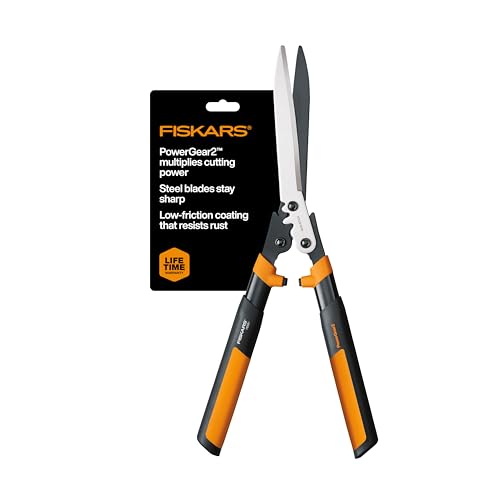
Long-handled hedge shears cut hedges. Held in both hands with blades around 8 to 10 inches, they face off a hedge with a scissor action, slicing soft leafy growth and thin twigs cleanly in broad, controlled strokes. They are the tool most people picture when they say "garden shears."Within hedge shears, blade length and gearing tune the tool to the hedge. Shorter blades near 7 inches shape topiary and box; longer geared blades clear thick or long runs with less effort. If your hedges are tall, telescopic-handled shears buy reach so you can keep both feet on the ground. The full line-up of picks lives in the best hedge shears guide.
What are grass and edging shears for?
Grass and edging shears tidy the lawn edges and tufts a mower cannot reach. Held in one hand, they come in two styles: horizontal-blade shears that skim across the turf, and vertical-blade or long-handled edging shears that snip a crisp line along a bed or path without you kneeling.These single-hand shears trade the reach and power of hedge shears for close control on the ground. Swivel-head models let you turn the blades to follow a curved edge, and long-handled versions save your back on long borders. Horizontal-blade grass shears skim across the turf to level tufts a mower left standing, while vertical-blade edging shears cut down through the turf line to keep a border crisp. They will not shape a hedge, and hedge shears will not edge a lawn neatly — this is a case where two tools genuinely beat one.
How do grass shears differ from a lawn edger?
Grass shears and lawn edgers both tidy the lawn edge, but they work differently. Grass shears are hand tools that snip standing tufts and follow a border by hand, while a lawn edger, powered or long-handled, cuts a clean vertical line where turf meets a bed or path. One finishes; the other defines the edge.Reach for grass shears to nip the odd tuft a mower left and to trim close around obstacles a machine cannot follow. For cutting and maintaining a crisp border line along a long bed, a dedicated lawn edger does it faster and straighter. In a small garden a pair of long-handled edging shears may be all you need, while larger plots lean on the powered tools in the trimmers, edgers and blowers range.
Which shears suit topiary and fine shaping?
Short-bladed topiary and sheep-style shears suit fine shaping. Small one-hand shears with blades around 3 to 6 inches, or short two-handed Japanese shears near 7 inches, give the control that box balls, cones, and cloud-pruned forms need, slicing tight curves without the flex a long blade brings.Clean, keen blades matter most here because formal shapes show every ragged cut. Japanese shears earn their following in this work for holding a fine edge that slices rather than tears. For single woody stems inside a shape, a pair of bypass hand pruners makes a cleaner job than forcing shears, and thicker stems belong to loppers.
What are one-hand shears — grass, sheep, and snips?
One-hand shears cover the small, precise jobs two-handed shears cannot: grass shears skim lawn tufts, sheep-style shears shape small topiary, and spring-loaded snips nip soft growth. All are held in one hand and squeezed shut, with a spring reopening the blades for the next cut.The family splits by blade shape and action. Horizontal-blade grass shears sit parallel to the turf to level tufts a mower left standing; sheep or topiary shears use a simple sprung loop for shaping small box balls; and compact snips handle deadheading and soft stems. Many have a rotating head so you can turn the blades to follow an edge or a curve without twisting your wrist. They trade the reach and power of hedge shears for close, fingertip control on the ground.
What are long-reach and telescopic shears for?
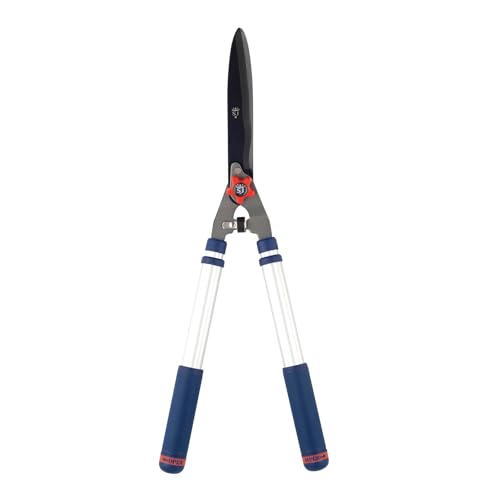
Long-reach and telescopic shears extend two-handed hedge shears so you can trim hedge tops and wide faces from the ground. Their handles pull out and lock at longer lengths, buying height and reach without a ladder, at the cost of extra weight and a balance that shifts forward when extended.They suit tall boundary hedges and the far side of a wide hedge, where a fixed shear would have you stretching. Keep them retracted for anything needing control, and extend only as far as the work demands, because a fully extended shear is slower and harder to steer. For height past what a telescopic shear comfortably reaches, a manual pole pruner keeps both feet on the ground more safely than a ladder.
What blade features matter across shear types?
A few blade features recur across shear types and are worth checking whatever you buy: bypass versus anvil action, blade length, edge steel, and a limb notch or sap groove. Reading these tells you more about how a shear will cut than the label on the box does.Nearly all quality garden and hedge shears use a bypass action, where two blades pass like scissors to slice living growth cleanly; anvil designs, which press a blade onto a flat plate, suit dead wood better. Longer blades cover ground on a run, while shorter ones steer tight shapes. Keener steel holds an edge but may need more rust care. A limb notch near the pivot grips the thickest twig, and a sap groove keeps the blades sliding. The full bypass-versus-anvil story is worth reading before you choose.
How do the shear types differ to maintain?
Maintenance follows the blade, not the shear type. Bare high-carbon steel, common on quality Japanese shears, takes the keenest edge but must be dried and oiled to fight rust; coated and chrome-plated blades shed sap and shrug off moisture with much less fuss. One-hand and two-hand shears otherwise ask for the same care.Whichever you own, the routine is the same: wipe off sap and moisture after use, hone the bevelled outer edge when cuts start to tear, and set the pivot so the blades pass with a slight drag. Spring-loaded one-hand shears have a spring to keep clean and free, while telescopic two-hand shears have extension joints that need occasional tightening. Keep the whole family in dry outdoor tool storage and each will last for years.
Where do powered tools fit alongside shears?
Powered tools take over from manual shears once a job is about volume rather than shape. A powered hedge trimmer clears long runs and thick yearly regrowth far faster than hand shears, while shears keep the detail work — shaping, squaring, and finishing — that a machine cannot match.Most gardens are best served by both: a machine for the bulk cutting on long faces, and a pair of hand shears for the shape and the tidy-up. If your searching led you to electric or cordless shears, you almost certainly want the powered category, covered in the powered hedge trimmers guide. This cluster stays on the manual shears that do the shaping and finishing.
How do you choose between shear types?
Choose by the job you do most, then fill gaps with a second tool. Facing hedges calls for two-handed hedge shears; crisp lawn edges call for one-hand grass or edging shears; formal shaping calls for short, keen topiary shears. Trying to cover all three with a single pair leaves every job half-done.Think about height and thickness too. Tall hedges favour telescopic shears or a manual pole pruner; stems thicker than a pencil are past shear territory and want loppers or a pruning saw. A useful starter kit for most gardens is one pair of two-handed hedge shears plus one pair of one-hand grass shears, adding topiary shears only if you grow formal shapes. Buy for the growth and shapes actually in your garden, keep the blades sharp and clean, and each tool will earn its place for years.