


How thick a branch can a hedge trimmer cut?
Most homeowner hedge trimmers cut soft, green stems up to about 3/8 to 3/4 inch thick, and professional gas models with a wider tooth gap reach roughly 1 inch. The real limit is the cutting capacity, which is set by the gap between the blade teeth rather than by the motor's power, and manufacturers publish it in inches or millimetres.Hedge trimmers are built to shear leafy regrowth, not to saw through wood, so the tooth gap decides the thickest stem the blade can grab and cut cleanly. Push a trimmer into a branch thicker than its rated capacity and the blade jams, the motor or engine stalls, and you risk bending teeth or burning out the tool. A useful rule of thumb is that a hedge trimmer handles anything up to about finger thickness, and no more.
For the occasional stem that is too thick, switch tools rather than force the trimmer. A pair of loppers handles branches up to an inch or two with a clean scissor or anvil cut, while a pruning saw tackles thicker wood. If a whole hedge has grown out into thumb-thick woody stems, a brush cutter fitted with a blade will clear it far better than any hedge trimmer.
What sets a hedge trimmer’s cutting capacity?
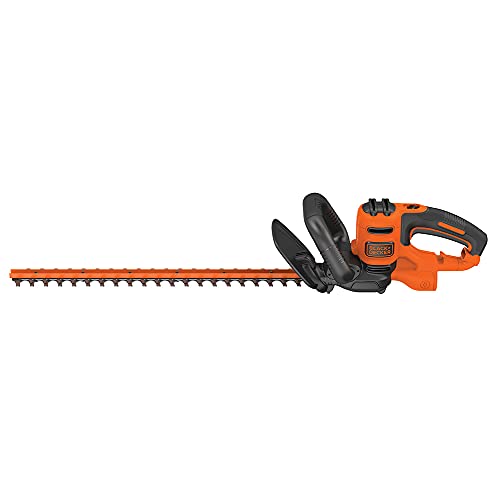
A hedge trimmer’s cutting capacity is set by the gap between its blade teeth, not by the power of its motor or engine, because a stem only cuts cleanly if it can seat fully in the gap where the moving teeth shear it. A wider tooth gap grabs a thicker stem, which is why professional gas blades cut more than lightweight homeowner ones.Manufacturers publish this figure as the cutting capacity in inches or millimetres, and it is the number to check before buying if you cut anything approaching woody growth. The table below gives the typical ranges by class of trimmer.
| Trimmer class | Typical cutting capacity |
|---|---|
| Light homeowner electric | About 3/8 to 1/2 inch |
| Mid-range cordless | About 1/2 to 3/4 inch |
| Professional gas | Up to roughly 1 inch |
More motor power does not lift this ceiling, because the limit is mechanical: the teeth simply cannot close around a stem wider than the gap between them, no matter how strong the drive behind them.
What happens if you cut a branch that is too thick?
Forcing a hedge trimmer into a branch thicker than its rated capacity jams the blade, stalls the motor or engine, and risks bending teeth, snapping the blade, or burning out the drive. The stem wedges between the teeth instead of shearing, and all the tool’s force goes into the jam rather than a clean cut.Beyond the damage to the tool, a jammed blade is a safety hazard, because a trimmer that binds and then suddenly frees can kick or throw material. If the blade does jam, stop the tool and disconnect the power before clearing it, never with the trimmer live. Repeatedly pushing a hedge trimmer past its limit is the quickest way to shorten a blade’s life, so the moment a stem resists the cut, it is a sign to switch tools rather than push harder.
What should you use for branches too thick for a hedge trimmer?
Switch to a cutting tool built for wood: loppers for stems up to an inch or two, a pruning saw for thicker branches, and a brush cutter with a blade for a whole hedge grown out into woody stems. Each is designed to shear or saw wood a hedge trimmer was never meant to touch.A worked example shows how to choose: a privet hedge with a few finger-thick stems poking above the soft growth is trimmed with the hedge trimmer and those few stems snipped with loppers. A neglected hedge full of thumb-thick woody growth is a job for a brush cutter or, for reduction, a pruning saw, after which regular hedge trimming keeps the fresh regrowth soft. Reaching for the right tool the moment a stem is too thick protects both the hedge and the trimmer.
Keeping your hedge trimmed once or twice a year keeps the regrowth soft and within the tool's capacity, which is easier on both the hedge and the trimmer. Blade length and cutting capacity are explained further in the main hedge trimmer guide. These figures reflect typical published specifications rather than first-hand testing.