Best Chainsaw File
Best Chainsaw File, ranked from aggregated owner ratings and reviews, not first-hand testing. Real pros, cons, and who each pick is best for.

Our Top 3 Picks
Quick Comparison
| Product | Best for | Buy | |
|---|---|---|---|
| Pferd Chain Sharp CS-X | Best Overall | See Amazon | View (paid link) |
| Oregon Universal Chainsaw Field Sharpening Kit | Best Value | See Amazon | View (paid link) |
| Pferd Round Chainsaw Files | Best Premium | See Amazon | View (paid link) |
| Stihl Complete Filing Kit | Best for Beginners | See Amazon | View (paid link) |
| Husqvarna Roller File Guide | Best Compact | See Amazon | View (paid link) |
| Oregon Depth Gauge Tool & Flat File | Editor's Pick | See Amazon | View (paid link) |
How to choose the best chainsaw file
The best chainsaw file is the one that matches your chain's pitch and the way you like to work: a round file for cheap, portable touch-ups, a 2-in-1 file for foolproof angles, or a bar-mounted guide for the steadiest hand filing. Match the pitch first, then pick the format.The picks above span every kind of file and file tool, from a single round file to a complete field kit. The sections below explain the types, how to match one to your chain, and what a file costs to keep running, so the ranking makes sense for your own saw.
What types of chainsaw file and file tool are there?
Chainsaw files and tools fall into a few families, each trading price against how much of the angle it sets for you. Knowing which family you want narrows the choice faster than comparing individual models.- Round files: the core tool, sharpening one cutter at a time; sold by diameter to suit the chain pitch.
- 2-in-1 file tools: hold two round files and a flat file to sharpen the top plate and lower the depth gauge together.
- Roller and bar-mounted guides: steer a round file at a repeatable angle for more consistency by hand.
- Flat files and depth-gauge tools: lower the rakers so each tooth bites the right amount.
- Complete kits: bundle a round file, flat file, guide, and depth-gauge tool in one pouch.
Which chainsaw file suits your saw and workload?
The right file tracks how often you cut and how confident you are with a free-hand stroke. Occasional users are well served by a single round file or a 2-in-1, regular cutters benefit from a guide or a full kit, and anyone with cutters filed to different lengths gains most from a bar-mounted guide. The table below lines up our picks by type, whether they are pitch-specific, and the buyer each suits.| File or tool | Type | Pitch-specific? | Best for |
|---|---|---|---|
| Pferd Chain Sharp CS-X | 2-in-1 file tool | Yes | Fast, accurate field sharpening |
| Oregon Universal Field Sharpening Kit | Complete kit | Yes (files included) | One kit for a whole saw |
| Pferd Round Chainsaw Files | Round file | Yes | Owners who want a precise, long-lasting file |
| Stihl Complete Filing Kit | Kit with guide | Yes | Beginners learning the angles |
| Husqvarna Roller File Guide | Roller guide + file | Yes | Steady, repeatable hand filing |
| Oregon Depth Gauge Tool & Flat File | Depth-gauge tool | Semi (fits common pitches) | Setting the rakers correctly |
Single-cut or double-cut — which file surface?
Choose a single-cut round file for chainsaw cutters, because its single row of angled teeth shears the hardened chrome edge cleanly, while a double-cut file is coarser and made for softer metals. Almost every purpose-made chainsaw file is single-cut, so this matters most if you are tempted to grab a generic hardware-store file.Quality of the steel matters as much as the cut. A hardened, chrome-cutting file from a name like Pferd (paid link), Stihl (paid link), Husqvarna (paid link), or Oregon (paid link) holds its bite for more teeth than a bargain file, which pays off across a chain's life. Match the diameter to your pitch using the pairing table in our chainsaw sharpening guide before you buy.
What separates a good chainsaw file from a cheap one?
A good chainsaw file is made from hardened, chrome-cutting steel machined to a consistent diameter, so it shaves the tooth cleanly and holds its bite across far more cutters than a soft bargain file. The steel and the accuracy of the cut, not the label, decide how long a file lasts.The differences that matter are listed below, and they explain why a specialist file from Pferd, Stihl, Husqvarna, or Oregon (paid link) costs more and lasts longer.
- Hardened chrome-cutting teeth: purpose-shaped to shear the hard chrome plating on a cutter without tearing it.
- Consistent diameter along the length: a true round file cuts the same hook on every tooth; a tapered or out-of-round file does not.
- Even, sharp file teeth: quality files bite from the first stroke, while cheap ones can burnish rather than cut.
- A proper tang: the pointed end takes a handle safely, instead of the bare stub some no-name files ship with.
A cheap file may sharpen one chain acceptably and then go blunt, so the saving is false once you count how few teeth it dresses before it skates.
Round file, roller guide, or bar-mounted jig — which holds the angle best?
A bar-mounted jig holds the filing angle most reliably, a roller guide comes close in a far smaller tool, and a bare round file is the most portable but leans hardest on your own eye. The more the tool sets the angle, the less practice a consistent edge takes. The table below lines the three up.| Tool | Angle control | Speed | Portability | Best for |
|---|---|---|---|---|
| Bare round file | You hold the angle | Fast once practised | Pockets anywhere | Experienced filers, quick touch-ups |
| Roller or clip-on guide | Guide sets the angle | Moderate setup | Small and packable | Owners who struggle free-hand |
| Bar-mounted jig | Jig fixes every angle | Slower to set up | Bulkier | Evening out cutters of different lengths |
None of the three files better steel than another; they differ only in how much of the angle they steer for you. If your cutters have drifted to different lengths after a rock strike, the jig's fixed angle is what pulls them back even. For routine upkeep, the roller guide or a 2-in-1 tool is the quicker daily choice.
What else belongs in your filing kit?
A full filing kit adds a flat file, a depth-gauge tool, a filing guide, and a handle to the round file, so you can set the angle and the raker height as well as the edge. Sharpening only the cutters and never the depth gauges leaves a chain that stops self-feeding, so the flat file earns its place.Many owners buy a complete kit rather than the parts separately, since a pouch keeps everything matched to one pitch and ready in the truck. A depth-gauge tool is the piece most people skip and most often need; ours sits in the picks above. For the wider set of accessories that keep a saw cutting, see our chainsaw maintenance guide.
How many chainsaw files should you buy at once?
Buy at least two files of your chain's diameter, because a file is a consumable that cannot be re-sharpened and a spare means a dull one never ends a job. Owners who file often, or who run more than one pitch, are better off with a multi-pack in each size they use.Round files are usually cheaper per file in packs of three, six, or a dozen, so a multi-pack lowers the running cost and keeps fresh files on hand. If you run several saws, check whether they share a pitch first; matching pitches let one file size cover the fleet, while mixed pitches mean a small stock of each diameter. The flat file, depth-gauge tool, and guide are one-time buys that outlast many round files, so you rarely need spares of those. Keeping the pitch-to-file pairing straight is easiest with the chart in our chainsaw sharpening guide.
What does a chainsaw file cost to run?
A chainsaw file is the cheapest sharpening tool to own and run, but it is a consumable that dulls after several chains and must be replaced. Buying files in a multi-pack lowers the cost per file and means a blunt one never ends a job early.Factor the extras into your budget: a flat file, a depth-gauge tool, and a guide are one-time buys, while round files wear out. A complete kit usually works out cheaper than the same parts bought singly. The files and tools here pair with the rest of our safety gear and accessories.
What mistakes do buyers make choosing a chainsaw file?
The most common buying mistake is picking a file by the saw's size instead of the chain's pitch, which leaves the file riding too high or hooking the tooth. Two saws of very different power can share a pitch, and one saw can run different chains, so the chain decides the file every time.The errors worth avoiding are listed below.
- Buying by bar length or engine size: file diameter follows chain pitch, nothing else.
- Grabbing a general hardware-store file: a coarse double-cut file tears the hardened edge; use a single-cut chainsaw file.
- Skipping the depth-gauge tool and flat file: sharp cutters over high rakers still will not self-feed.
- Owning only one file: a file cannot be re-sharpened, so a lone dull file ends the job.
- Ignoring the low-profile versus standard split on 3/8-inch chains: the two take different file sizes.
Confirming your pitch before you buy, using our chainsaw chains guide, heads off almost all of these.
What safety gear do you need to file a chain?
Filing a chain needs cut-resistant gloves and a still, powered-down saw, because the teeth cut skin even when they cut wood poorly. Remove the battery or pull the spark-plug boot, engage the chain brake or clamp the bar, and work on a stable surface before you start.Start with a good pair of work gloves, and keep your chainsaw chaps and PPE ready for the cutting afterwards. For the full filing method and the file-size chart, see our chainsaw sharpening guide.
Full Ranking, Reviewed

Best for Owners who want fast, accurate field sharpening
- Two round files and a flat file combined in one holder
- Sharpens the top plate and lowers the depth gauge in one stroke
- Built-in angle marks remove the guesswork on filing angle
- Sold in versions matched to specific chain pitches
- Sets the tooth and depth gauge together for even results
- Foolproof filing angles for beginners
- Compact enough to sharpen in the field
- Must buy the version that matches your chain pitch
- Files eventually wear and need replacing
Verdict: A precision 2-in-1 file from a specialist file maker that sets the edge and the depth gauge at once, which makes it the easiest way to a consistent edge without a machine.
Best for Owners who want one pouch that covers a whole saw
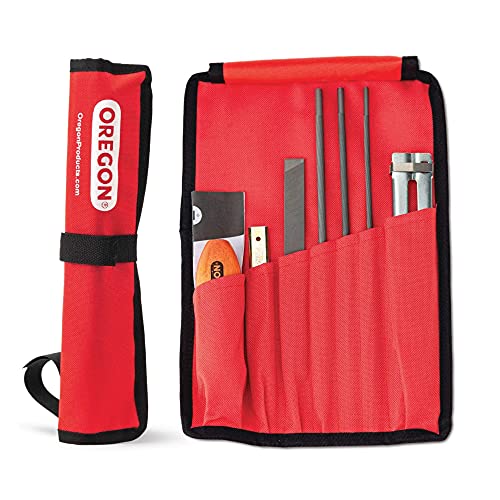
- Includes round files, a flat file, a filing guide, and a depth-gauge tool
- Round files sized for the most common chain pitches
- Filing guide sets both the angle and the depth-gauge height
- Rolls up in a compact pouch for the truck or shed
- Everything needed to file a chain in one kit
- Cheaper than buying the parts separately
- Covers several common pitches out of the box
- You still must use the round file that matches your pitch
- Included files wear like any consumable
Verdict: A complete, affordable field kit that pairs the round and flat files with a guide and depth-gauge tool, making it the easiest single purchase for a new saw owner.

Best for Owners who want a precise file that lasts
- Single-cut, chrome-cutting teeth shaped for hardened chain cutters
- Hardened steel holds its bite across more teeth than a bargain file
- Sold by diameter to match every common chain pitch
- Available singly or in multi-packs
- Cuts cleanly and keeps biting longer than cheap files
- Consistent diameter shapes the tooth accurately
- Trusted by professional saw filers
- Costs more than a generic hardware-store file
- Still a consumable that eventually dulls
Verdict: A premium single-cut round file from a specialist file maker that shaves the hardened edge cleanly and lasts longer, worth the extra outlay for anyone who files often.

Best for Beginners learning to hold the filing angle
- Two round files, a flat file, and a filing gauge in one kit
- Filing gauge sets the top-plate angle and the depth-gauge height
- Round files matched to a specific chain pitch
- Includes a handle for a safer, steadier stroke
- Teaches correct angles from the first stroke
- Everything for hand filing in one matched set
- Straightforward to use with a clamped bar
- Buy the version that matches your exact chain pitch
- Slower than a 2-in-1 tool for quick touch-ups
Verdict: A complete, guided filing kit that builds good habits, ideal for learning to sharpen by hand before moving to a quicker 2-in-1 tool.

Best for Owners who want steady angles from a packable guide
- Roller guide rides on the chain to hold the file at a set angle
- Depth marks help keep the file at the correct height
- Uses a standard round file sized to your chain pitch
- Small and light enough to carry into the field
- Steadier, more repeatable angle than free-hand filing
- Compact and quick to fit on the bar
- Uses ordinary round files you can replace anywhere
- Round file must match your chain pitch
- Slower to set up than a bare file
Verdict: A compact roller guide that brings much of a jig's consistency in a pocket-sized tool, a smart pick for owners who struggle to hold a free-hand angle.

Best for Owners who never set their depth gauges
- Slotted depth-gauge guide shows exactly how much raker to remove
- Paired flat file lowers the depth gauges after filing the cutters
- Fits the common chain pitches most owners run
- Marked for standard and hard-wood depth settings
- Fixes the step most owners skip
- Prevents over- or under-cutting the rakers
- Cheap insurance for a self-feeding chain
- Only lowers depth gauges; you still need a round file for the cutters
- Setting must suit your chain and wood type
Verdict: The tool most owners forget and most often need, this depth-gauge guide and flat file keep the rakers set so a freshly filed chain actually self-feeds.
Frequently Asked Questions
What is the best file for sharpening a chainsaw?
The best chainsaw file for most owners is a single-cut round file matched to the chain pitch, or a 2-in-1 file tool such as the Pferd Chain Sharp CS-X that sets the angle and depth gauge together. Choose the file diameter from your chain's pitch, not the saw's size.
Are 2-in-1 chainsaw files worth it?
Yes, 2-in-1 chainsaw files are worth it for most owners because they hold two round files and a flat file so the top plate and depth gauge are set together at built-in angles. That removes most of the guesswork and speeds up field sharpening, though you must buy the version for your pitch.
Do I need a file guide to sharpen a chainsaw?
You do not strictly need a file guide, but one makes consistent angles far easier, especially for beginners. A plain round file works if you follow the witness marks on each cutter, while a roller guide, angle plate, or 2-in-1 tool holds the file steady so every tooth ends up the same.
How many chains can one chainsaw file sharpen?
A chainsaw file is a consumable that typically sharpens several chains before it dulls, though the exact number depends on the file's quality and how much metal you remove. When the file skates across the tooth without shaving steel, it is finished, so keep a spare in your kit.