


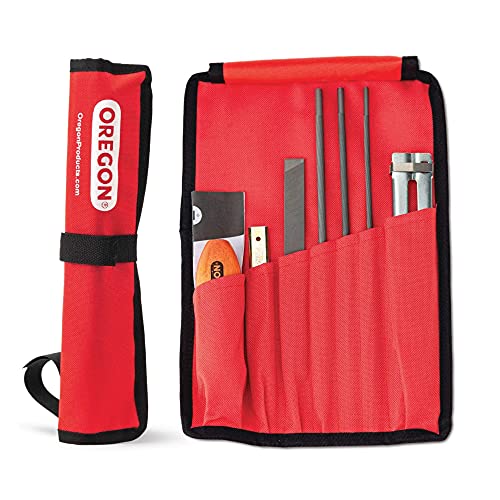

How do you file a chainsaw chain?
Filing a chainsaw chain takes a round file matched to your chain's pitch, a flat file and depth-gauge tool for the rakers, and cut-resistant gloves. A round file removes the least metal of any method, so a hand-filed chain lasts through more sharpenings, and the tools are cheap and portable enough to carry into the field. Follow the steps in order to keep every cutter even.- Stop the engine, remove the battery or pull the spark-plug boot, and engage the chain brake.
- Clamp the bar in a vise or wedge it firmly so the chain cannot move, and put on gloves.
- Choose the round file diameter that matches your chain pitch, from 5/32 inch on small chains to 7/32 inch on large ones.
- Seat the file in the first cutter at the top-plate angle marked on the tooth, usually about 30 degrees.
- Push the file across the tooth two or three times in one direction only, lifting on the return stroke.
- Move to the next cutter facing the same way and repeat with the same number of strokes.
- Turn the saw around and file the cutters facing the other direction.
- Every few filings, lay the depth-gauge tool over each raker and file any protruding fin flat with the flat file.
What angle do you file a chainsaw chain at?
Most chainsaw chains are filed to a top-plate angle of about 30 degrees, the angle scribed as a witness mark on each cutter. Softer general cutting uses that 30-degree mark, harder or frozen wood is sometimes filed closer to 25 degrees, and ripping chains for milling run much shallower, around 10 degrees.The witness mark stamped on the top of each tooth is your guide; line the file along it and every cutter ends up the same. Hold the file level, or with only the slight downward tilt the maker specifies, because raising or dropping the handle changes the side-plate angle and the hook. A filing guide or 2-in-1 tool fixes this angle for you, which is why beginners reach for one. Keeping the angle identical on every tooth is what stops the saw pulling to one side.
How many file strokes does each tooth need?
Give each cutter the same small number of strokes, usually two or three, and no more than it takes to bring back a clean edge. Counting strokes is what keeps every tooth the same length, and matched teeth are what make the chain cut straight.Start at the most worn or shortest cutter, bring it to a fresh edge, then match that number of strokes on every other tooth. File in one direction only, lifting the file clear on the return, and rotate it slightly each pass so it wears evenly. If one cutter is badly nicked, file all the others to match its new length rather than leaving it short.
What are common mistakes when filing a chain by hand?
The commonest hand-filing mistakes are letting the angle drift, giving teeth uneven strokes, and forgetting the depth gauges, all of which leave a chain that cuts slowly or crookedly. Each is easy to avoid once you know it.- Uneven strokes: teeth of different lengths make the saw pull and wander; match every cutter.
- A drifting angle: eyeballing without a mark or guide rounds the edge; follow the witness line.
- Skipping the rakers: sharp cutters over high depth gauges still will not bite; set them every few filings.
- Pushing a dull file: a file that skates only polishes the tooth; swap in a fresh one.
- Filing in the dirt: a chain touched down on soil dulls instantly, so keep the bar clear.
Mark your first tooth with a paint pen so you know when you have gone all the way around, and keep the strokes equal so no cutter ends up longer than the rest. If you struggle to hold the angle, a 2-in-1 file or roller guide from our file picks sets it for you. The full method and file-size chart are in our chainsaw sharpening guide. This is general guidance, not a substitute for the safety instructions in your saw's manual.

