Best Chainsaw Helmet
Best Chainsaw Helmet, ranked from aggregated owner ratings and reviews, not first-hand testing. Real pros, cons, and who each pick is best for.


Our Top 3 Picks
Quick Comparison
| Product | Best for | Buy | |
|---|---|---|---|
| Husqvarna Technical Forest Helmet | Best Overall | See Amazon | View (paid link) |
| Oregon Universal Safety Helmet System | Best Value | See Amazon | View (paid link) |
| Pfanner Protos Integral Forest | Best Premium | See Amazon | View (paid link) |
| 3M PELTOR G3001 Forestry Helmet Combination | Best Heavy-Duty | See Amazon | View (paid link) |
| Stihl Function Basic Helmet Set | Best for Beginners | See Amazon | View (paid link) |
| Ergodyne Skullerz 8974 Full-Brim Hard Hat | Editor's Pick | See Amazon | View (paid link) |
How to choose a chainsaw safety helmet
Choose a complete helmet system — shell, earmuffs, and visor certified together — sized to your head and matched to how risky your cutting is. A homeowner bucking logs needs less than an arborist working overhead, but everyone needs a rated shell, real hearing protection, and a debris screen.The picks below are ranked from summarised manufacturer specifications and aggregated owner feedback, not our own lab testing. No prices are shown here; use the buttons for current pricing.
What separates a forestry helmet from a plain hard hat?
A forestry helmet integrates hearing and face protection onto the shell, so all three parts move with you and can't be forgotten on the truck. A plain construction hard hat protects only against top impact and leaves your ears and face exposed to 100-plus dB noise and flying chips.The differences that matter most:
- Integrated mounts hold the earmuffs and visor without aftermarket clips.
- Vented and non-vented shells trade cooling against electrical protection.
- Forestry shells use a UV-resistant grade built for constant outdoor use.
- Hi-vis colours such as orange and yellow help a ground crew see the cutter.
How do our chainsaw helmet picks compare?
The table lines up all six systems by who they suit, the standard family they target, and their standout trait.| Helmet | Best for | Standard family | Standout trait |
|---|---|---|---|
| Husqvarna Technical Forest | All-round pro and prosumer use | EN 397 / ANSI Z89.1 | Balanced fit and airflow |
| Oregon Universal System | Budget-conscious firewood cutters | EN 397 | Complete kit, low cost |
| Pfanner Protos Integral Forest | Arborists wanting integrated cover | EN 397 / EN 12492 | Wrap-around integrated design |
| 3M PELTOR G3001 Forestry | Heavy ground-crew hours | EN 397 / EN 352 | Proven earmuff performance |
| Stihl Function Basic Set | First-time and occasional users | EN 397 | Simple, affordable entry set |
| Ergodyne Skullerz 8974 | A rated base shell to build on | ANSI Z89.1 Type I | Full-brim vented shell |
Which ratings should decide your choice?
Prioritise a shell rated to ANSI Z89.1 or EN 397, earmuffs with a Noise Reduction Rating suited to your saw, and a visor to EN 1731. For overhead or rope work, step up to an EN 12492 climbing-style helmet with a chin strap.Match the shell class to your surroundings: Class E (electrical) if you might work near live lines, Class G for general cutting, and a vented Class C only where there is no electrical or high side-impact risk. Because chainsaw noise sits around 100–115 dB, an earmuff NRR in the mid-20s dB is a sensible floor. Pair any mesh visor with sealed glasses from our hearing and eye protection guide, since mesh alone won't stop fine sawdust.
How much helmet does your work need?
Buy for your worst-case task, not your average one. Occasional bench-height cutting is the low end; felling standing timber, storm cleanup, and aerial pruning are the high end and justify a premium integrated system.- Occasional homeowner: a value combi like the Oregon or Stihl (paid link) set covers firewood and light limbing.
- Regular property owner: the Husqvarna or 3M systems reward heavier use with better comfort and seals.
- Arborist or climber: an integrated or retained helmet such as the Pfanner (paid link) Protos is worth the outlay.
Complete the outfit with chainsaw chaps and leg protection and cut-resistant gloves, and read the full helmets and face shields guide for fitting and replacement detail. The wider Safety Gear & Accessories hub covers the rest of the kit.
Vented or non-vented — which shell should you pick?
Pick a vented shell for comfort in general cutting, and a non-vented electrical-class shell only if you might work near live conductors. Vents move air across a hot scalp but disqualify the shell from any electrical rating, because the openings can admit contact.The trade-off is heat versus electrical protection. Storm cleanup around downed power drops, or any cutting near overhead lines, calls for a sealed Class E shell even though it runs warmer. For felling firewood well away from services, a vented shell such as the Husqvarna Technical Forest or a vented Ergodyne Skullerz keeps your head cooler through a long afternoon. Several models, including the Ergodyne, are sold in both vented and non-vented versions so you can match the shell to the hazard rather than compromising.
Mesh visor or clear visor — which suits your cutting?
Choose a steel-mesh visor for felling and bucking where airflow and fog-free vision matter, and a clear polycarbonate screen only where you need to stop fine spray or splinters a mesh would pass. Many operators keep a mesh visor on the helmet and add sealed glasses underneath rather than switching screens.Mesh wins in the woods because it never fogs on a cold morning, never mists with sweat, and won't scratch into a blur the way a clear screen does after a season of chips. Its weakness is the open weave, which lets fine sawdust and sap mist through — the reason a mesh visor is always paired with glasses rated to ANSI Z87.1 or EN 166, as covered in the hearing and eye protection guide. A clear visor earns its place in dusty milling or when you want maximum splash coverage, but expect to clean and eventually replace it more often.
How do earmuff noise ratings work?
Earmuff ratings estimate how much noise the cups remove: the US Noise Reduction Rating (NRR) and the European Single Number Rating (SNR) are both stated in decibels, with a higher figure meaning more attenuation. For chainsaw noise of around 100–115 dB, a rating in the mid-20s dB is a sensible floor.Two cautions matter more than chasing the biggest number. First, real-world reduction is always less than the label because no seal is perfect, so treat the rating as a guide, not a guarantee. Second, over-muffing can leave you deaf to a shouted warning, an approaching vehicle, or a cracking trunk, which is a hazard in itself. Choose enough reduction to protect your hearing while keeping situational awareness, and make sure the cushions seal fully — a gap under a glasses arm undoes the rating faster than a few decibels of label difference. Matching a rating to your specific saw is covered in the hearing and eye protection guide.
Is a complete system or a build-your-own setup better value?
A matched system is the better buy for most people because the shell, muffs, and visor are designed to seat and seal together with no guesswork. Building your own around a bare shell only pays off when you already own quality muffs or need a specific electrical rating the combos don't offer.Weigh it up by how much you cut and what you already have:
- Occasional and first-time cutters get more certainty from a complete combi like the Oregon Universal or Stihl Function set, where everything fits out of the box.
- Regular users who value comfort step up to an integrated system such as the Husqvarna Technical Forest or 3M PELTOR G3001 for better seals and spares support.
- Anyone who already owns premium PELTOR muffs, or needs a Class E shell, can build around a rated bare shell like the Ergodyne (paid link) Skullerz and add matched parts.
Buying the parts separately is rarely cheaper once you add a visor frame and clip-on muffs, and it puts the burden of checking compatibility on you.
What accessories and spares should you budget for?
Budget for the wear parts a helmet needs over its life: replacement ear cushions, a spare visor mesh, and a fresh sweatband, plus the suspension harness that is replaced yearly. These consumables keep a good shell sealing and comfortable long after the first cushions harden.- Ear-cushion hygiene kits restore the seal once the foam compresses and stops damping noise.
- A spare mesh or clear visor covers you when the first is bent, sap-caked, or scratched.
- A replacement suspension harness renews the part that ages fastest inside the shell.
- Wide-network brands such as Husqvarna, 3M, and Stihl make these spares easy to source, which is worth weighing at purchase.
Choosing a system with a strong spares supply, rather than the cheapest sealed box, is what keeps a helmet in safe service for its full life.
Which common mistakes should you avoid when buying?
Avoid three buying mistakes: paying for features you'll never use, ignoring the moulding date on old stock, and assuming a construction hard hat equals a forestry helmet. Any one of them wastes money or leaves you under-protected.- Over-buying an arborist climbing system for ground-only firewood work adds weight and cost you won't benefit from.
- Under-buying a bare bump-style shell for felling leaves your ears and face exposed to noise and chips.
- Skipping the certification check, so an unrated look-alike slips through without the ANSI Z89.1 or EN 397 testing behind it.
- Overlooking the size range, so the muffs never seal or the band never tightens enough on your head.
Match the helmet to your worst-case task, confirm the marks and the date, and the rest is comfort preference. Complete your kit with chainsaw chaps and leg protection and cut-resistant gloves.
What should you check before you buy?
Confirm the moulding date, the certification marks, and that the size range fits your head before anything else. A helmet near the end of its shelf life, or one that won't seal at the ears, is a poor buy at any price.Full Ranking, Reviewed
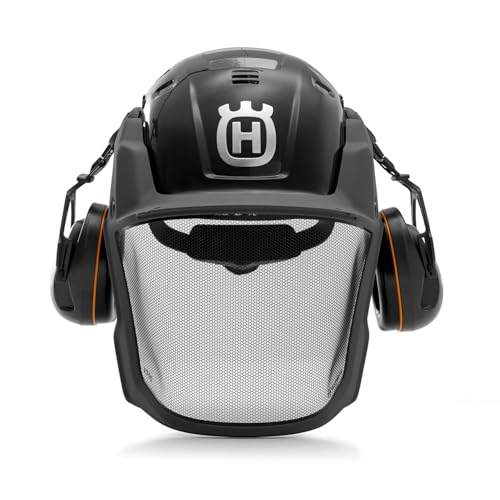
Best for All-day professional and prosumer felling, bucking, and limbing on the ground
- Hard hat shell, ear defenders, and mesh visor supplied as one forestry system
- Suspension with a rear ratchet adjuster for a stable, level fit
- Adjustable ventilation slots to cut heat build-up on long jobs
- Hi-vis orange shell with a UV indicator that flags age-related fade
- Well-balanced weight that stays comfortable across a full day
- Earmuffs and visor seal cleanly and stow out of the way
- Widely stocked spares and replacement cushions and mesh
- Costs more than a basic combi set
- Vented shell is not an electrical-class option
Verdict: A dependable all-rounder that most regular chainsaw users will be happy to wear from the first cut to the last.

Best for Budget-minded homeowners cutting firewood and clearing light storm damage
- Complete shell, earmuffs, and mesh visor supplied as one low-cost kit
- Simple pin-lock height and headband adjustment
- Flip-up mesh visor with detents to park it clear of your view
- Replaceable ear cushions and visor mesh
- Everything you need to get protected in one affordable box
- Light enough for occasional weekend users
- Fits with no tools straight out of the packaging
- Comfort and airflow trail the pricier systems
- Basic suspension feels its price over very long shifts
Verdict: The value pick that gets a first-time cutter fully protected without overspending on features they may not need.

Best for Arborists and pros who want hearing, face, and neck protection built into one shell
- One-piece integrated design with wrap-around ear and neck coverage
- Face and mesh visors that retract into the shell body
- Ventilation channels engineered through the shell
- Optional chin strap and communication accessories for climbing use
- Exceptional integrated protection and all-round coverage
- Comfortable balance on the head despite the extra cover
- Modular visors and add-ons adapt it to different work
- Premium price well above a standard combi
- Heavier and warmer than a simple vented open system
Verdict: The benchmark premium helmet for arborists who want everything integrated and are willing to pay for the coverage.

Best for Ground crews logging heavy hours who put hearing protection first
- G3001 vented shell paired with 3M PELTOR ear defenders
- Steel-mesh visor on a sprung, adjustable frame
- Ratchet or turn-to-fit headband options
- Broad range of interchangeable PELTOR muff cups by rating
- PELTOR earmuffs are a known quantity for noise control
- Huge accessory and spares ecosystem behind it
- Secure, comfortable visor action
- Sold in several sub-configurations that can confuse buyers
- Shell styling is purely functional
Verdict: A workhorse combination for people who want 3M's hearing-protection pedigree on their head through a full working day.

Best for First-time and occasional users buying their first forestry helmet
- Entry-level shell, earmuffs, and nylon-mesh visor as a matched set
- Lightweight build aimed at shorter jobs
- Straightforward headband adjustment
- Backed by the wide Stihl dealer network for spares
- Affordable route into proper head protection
- Light and easy for beginners to live with
- Dealer support makes replacement parts easy to source
- Fewer comfort and venting features than premium sets
- Nylon mesh is less rugged than a steel visor
Verdict: A sensible, low-cost first helmet for weekend cutters stepping up from no head protection at all.

Best for Cutters who want an ANSI-rated base shell to add their own earmuffs and visor
- ANSI Z89.1 Type I rated full-brim shell, offered in vented and non-vented versions
- Full brim sheds rain and debris off the shoulders
- Six-point suspension with a ratchet adjuster
- Accessory slots for clip-on earmuffs and face shields
- Certified base shell you can build a custom setup around
- Full brim adds useful sun and rain coverage
- Non-vented version available where an electrical rating is needed
- Earmuffs and visor bought separately add to the cost
- Not sold as a ready-to-go forestry combo
Verdict: The pick for anyone who wants a certified shell and prefers to choose their own earmuffs and mesh screen.
Frequently Asked Questions
Are cheap chainsaw helmets safe?
A cheap chainsaw helmet is safe if it carries the right marks — an ANSI Z89.1 or EN 397 shell, EN 352 earmuffs with a stated rating, and an EN 1731 mesh visor. Budget systems trade comfort and airflow for price, not protection, so check the certification stamps before the specification sheet.
Can I add earmuffs and a visor to a hard hat I already own?
You can, provided the hard hat has the standard accessory slots and you use clip-on earmuffs and a visor rated for it. A general-purpose shell like the Ergodyne Skullerz 8974 is designed for this. Match the parts to the shell brand or a universal-fit kit so they seat and seal correctly.
What Noise Reduction Rating do chainsaw earmuffs need?
Because a chainsaw produces around 100–115 dB at the operator's ear, aim for earmuffs with a Noise Reduction Rating in the mid-20s dB or higher. That brings sustained exposure down toward a safer level. Fit matters as much as the number — a gap under a glasses arm undoes the rating.
Do chainsaw helmets expire?
Yes. The shell should be retired about five years from the moulding date stamped inside, the suspension roughly every 12 months, and the whole helmet immediately after any real impact. UV light and heat weaken the plastic invisibly, so replace by date and after knocks, not by how it looks.