


What hard hat class suits chainsaw work?
For most ground-based chainsaw work, an ANSI Z89.1 Type I shell in Class G or Class E is the right choice, worn as part of a forestry system with earmuffs and a mesh visor. Type and Class describe two different protections that you should match to your job separately.What Type and Class mean
Type rates impact direction: Type I guards the top of the head, while Type II adds side-impact protection for slopes and rolling-log risk. Class rates electrical contact: Class G offers general protection, Class E offers the highest, and Class C is vented with no electrical rating at all.Which one to choose
Choose Class E if there is any chance of contact with live lines — storm cleanup near power drops is the classic case. Choose Class G for general felling and firewood work, and reserve vented Class C for hot conditions with no electrical hazard. Step up to Type II where logs could roll or swing into the side of your head.Why the class and type are chosen separately
Class and Type answer two independent questions, so you set them one at a time. Type is about which direction an impact comes from; Class is about electrical contact. A slope near power lines needs both a high Type and a high Class, while open firewood work far from services is well served by Type I, Class G. Deciding them separately stops you over-buying on one axis and under-buying on the other.Type I versus Type II — when side impact matters
Type I protects only the crown, which covers most cutting where hazards fall from directly above. Type II adds side-impact protection and earns its place on slopes, where a bucked log can roll into the side of your head, and in tight stands where a trunk can swing sideways off the stump. If your ground is level and open, Type I is enough; if logs roll or swing, step up to Type II.A worked example: storm cleanup near power lines
Picture clearing a limb that has fallen across a driveway near a sagging service drop. Because live conductors could be within reach, the right shell is Class E, the highest electrical rating, worn non-vented. General Class G would be wrong here even though it suits ordinary felling, and a vented Class C shell would be unsafe near the lines. Match the class to the worst hazard actually present, not the average job.Does the class change for a battery or small saw?
No — the power source doesn't change the struck-by or electrical hazard, so the same class logic applies to a battery, electric, or gas saw. A quiet battery chainsaw still needs a rated shell if a limb can fall on your head, and still needs Class E near live lines. Judge the hard-hat class by the environment and the falling-object risk, not by the saw in your hands.What to pair with the shell
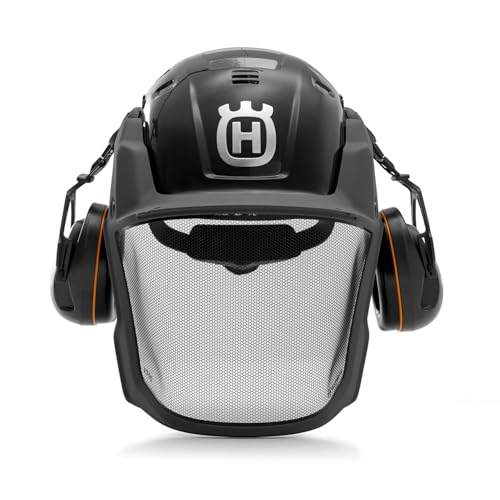
Whatever shell class you choose, it only becomes chainsaw-ready once you add rated hearing and face protection. Fit earmuffs to EN 352 with a Noise Reduction Rating in the mid-20s dB or higher, and a mesh visor to EN 1731 for chips and springback. Because mesh lets fine dust through, add sealed glasses from the hearing and eye protection guide underneath.The mistake to avoid: a plain construction hard hat
A bare construction hard hat meets the shell standard but leaves your ears and face unprotected against 100–115 dB noise and flying chips. On its own it is not a chainsaw helmet. Either add clip-on earmuffs and a mesh visor rated for the shell, or buy a matched forestry system where all three parts are certified to work together.How much protection does the shell alone give?
The shell is only one third of the answer. On its own, an ANSI Z89.1 or EN 397 hard hat stops impact from above but does nothing for the roughly 100–115 dB of saw noise or the chips and springback aimed at your face. The Type and Class you choose set the shell's protection; the earmuffs and visor you add to it complete the system.In Europe the equivalent shell mark is EN 397, or EN 12492 for climbing-style helmets with a chin strap. Whichever standard applies, pair the shell with rated earmuffs and a visor — see the full helmets and face shields guide and compare complete kits in our best chainsaw helmets roundup.

