
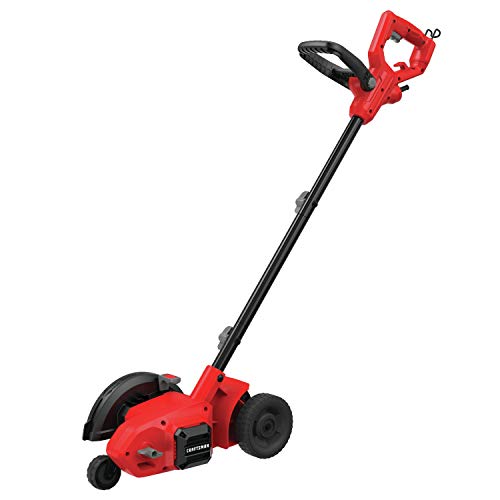


Are cordless grass edgers powerful enough?
Cordless grass edgers are more than powerful enough for routine lawn edging, and modern 40-volt and 56-volt models cut turf edges as cleanly as most corded and small gas machines. Grass edging is a low-torque task, so the real trade-off with battery power is runtime and up-front cost, not cutting ability.The gap between battery and gas has closed dramatically. Brushless motors on higher-voltage platforms deliver strong, steady blade speed, and because edging along a lawn does not demand the brute torque of cutting a fresh trench through hard soil, a good cordless edger handles the weekly job with ease. Where gas still leads is deep cuts, all-day work, and establishing brand-new edges — jobs most homeowners rarely face.
How much runtime do you get from a cordless edger?
A cordless edger typically runs long enough to edge an average residential lawn on a single charge, though exact runtime depends on the battery's amp-hours, the motor, and how deep you cut. A larger battery and a shallow maintenance depth stretch runtime considerably.Battery capacity, measured in amp-hours (Ah), is the number that matters. A small 2.0 Ah pack suits quick touch-ups, while a 4.0 Ah or larger pack comfortably edges a full yard. Because edging is intermittent — you pause at corners and obstacles — real-world runtime often beats the worst-case rating. If you are edging a big property, keeping a second charged battery on hand removes the runtime worry entirely, the same strategy that makes cordless mowers practical on larger lots.
Which battery platform should you choose for a cordless edger?
Choose your cordless edger by the battery platform you already own or plan to build around, because sharing batteries across tools is where cordless saves the most money. The major platforms differ mainly in voltage and how many tools they cover.| Platform | Voltage | Strength |
|---|---|---|
| Ryobi ONE+ | 18V | Huge tool range, budget-friendly |
| EGO Power+ | 56V | Near-gas power, premium tools |
| Greenworks 40V | 40V | Good power-to-price balance |
| Worx Power Share | 20V/40V | Light, affordable 2-in-1 tools |
If you already own batteries from one of these systems, the smart move is usually to add the matching edger rather than start a second platform. A single charger and a shared pool of batteries cut both cost and clutter. For a full shortlist of models across these platforms, see our best lawn edger picks.
What are the trade-offs of a cordless edger versus corded or gas?
Cordless, corded, and gas edgers each trade something for their main advantage, and knowing what you are giving up prevents buyer's remorse. The core trade-offs are listed below.- Cordless — trades higher up-front cost and finite runtime for total freedom of movement and quiet, no-fumes operation.
- Corded — trades range and a trailing cord for the lowest price and unlimited runtime.
- Gas — trades noise, fuel mixing, and maintenance for the most torque, depth, and all-day endurance.
For small and mid-size lawns edged on a regular schedule, cordless usually wins on convenience. For very large properties or the deepest cuts, gas still makes sense, and for a fixed budget with power near the house, corded is hard to beat.
How do you care for a cordless edger and its battery?
Caring for a cordless edger means looking after both the tool and the battery, and good battery habits matter as much as blade upkeep. Store lithium batteries at a partial charge in a cool, dry place rather than fully drained or baking in a hot shed.Keep the blade clean and replace it when cuts turn ragged; clear packed grass and soil from the guard and wheel after each use; and avoid forcing the tool into cuts deeper than it is set for, which drains the battery fast and stresses the motor. Charge batteries indoors at moderate temperatures, and remove the pack before you swap a blade or clear a jam. Treated well, a battery platform serves an edger, a trimmer, and a leaf blower for years.
A brushless cordless edger asks very little beyond that. With no engine, there is no fuel to stabilize, no air filter to clean, no spark plug to change, and no carburetor to gum up over winter — the maintenance list that follows a gas edger simply disappears. That lower upkeep, as much as the quiet and the lack of fumes, is why many homeowners who switch to a cordless edger never go back.
How do voltage and amp-hours affect a cordless edger?
Voltage sets a cordless edger's power and amp-hours set its runtime, so the two numbers answer different questions: volts decide how hard it cuts, amp-hours decide how long it runs. A higher-voltage tool with a larger-capacity pack both cuts stronger and lasts longer.Voltage — 18V, 20V, 40V, 56V — roughly tracks how much cutting force the motor can deliver, which is why 40V and 56V platforms handle hard soil and dense turf that stall smaller tools. Amp-hours (Ah) measure the fuel in the tank: a 2.0 Ah pack suits quick touch-ups, while a 4.0 Ah or 5.0 Ah pack edges a whole yard. The two are independent, so a 40V 2.0 Ah battery is powerful but short-lived, while the same platform's 5.0 Ah pack runs far longer at the same power. Watt-hours (volts multiplied by amp-hours) give the truest single measure of total energy if you want to compare packs across a platform.
How long do cordless edger batteries last before they need replacing?
A quality lithium-ion battery lasts several years, or roughly 300 to 500-plus full charge cycles, before its capacity noticeably fades, and good storage habits push that further. You replace a pack when its runtime drops well below new, not on a fixed schedule.Lithium batteries age from both use and abuse: deep-draining them to empty, leaving them fully charged in heat, or freezing them all shorten their life. Treated well — stored at a partial charge in a cool, dry place and charged at moderate temperatures — a pack serves an edger, a trimmer, and a leaf blower across many seasons. When a battery that once edged the whole yard now fades halfway through, its cells have worn and a fresh pack restores full runtime. Because the battery is the priciest part of a cordless system, that lifespan is central to the tool's real cost of ownership.
Should you buy the bare tool or a battery kit?
Buy the bare tool if you already own compatible batteries, and buy the kit if this is your first tool on the platform — the kit bundles a battery and charger you would otherwise pay for separately. Matching an existing platform is where cordless quietly saves the most money.Manufacturers sell most cordless edgers two ways: as a bare tool for owners of the platform, and as a kit with a battery and charger for newcomers. If you already run Ryobi ONE+, EGO Power+, or Greenworks 40V tools, the bare edger drops into your existing pool of packs at the lowest cost. If you are starting fresh, the kit is the honest price of entry — and a bare-tool sticker that looks cheap is misleading until you add $80 to $200 for a battery and charger. This is also why starting a second platform for one tool rarely pays; a single charger and shared batteries cut both cost and clutter.
Is a cordless or corded edger better for your lawn?
A cordless edger is better for freedom of movement and quiet operation, while a corded edger is better for lowest cost and unlimited runtime — the right pick depends on your lawn's size and how close an outlet sits to its edges. Neither is universally superior.Choose corded when every border sits within a cord's reach of an outlet and you want the cheapest reliable edge; the only real downsides are the tether and a cord that can snag on beds and trees. Choose cordless when a cord would constantly catch, when your edges are spread around a larger lot, or when you already own the batteries — accepting a higher up-front cost and finite runtime in exchange for going anywhere quietly. The table below sums up the split.
| Factor | Corded electric | Cordless battery |
|---|---|---|
| Up-front cost | Lowest | Higher (battery included) |
| Runtime | Unlimited | Limited by amp-hours |
| Freedom | Tethered to an outlet | Go anywhere |
| Best lawn | Small, near an outlet | Small to large, spread out |
For most small and mid-size lawns the decision comes down to how much a trailing cord annoys you; both cut a clean grass edge, so let convenience, not power, be the deciding factor.