


How do you transport and store a chainsaw safely?
Transport and store a chainsaw with the chain brake on, the bar covered by a scabbard or hard case, and the fuel and oil managed so nothing leaks. Secure the saw so it can't slide in a vehicle, and lay it up drained and clean for any storage longer than a few weeks.
A chainsaw is heavy, sharp, and full of flammable liquid, so the way you move and store it matters as much as how you cut with it. The steps below take a running saw from the job to safe storage, whether that is overnight in the garage or a full off-season lay-up.
What should you do before putting a chainsaw in a vehicle?
Before loading a chainsaw, engage the chain brake, let the muffler cool, and slide a bar scabbard over the full length of the bar and chain. Set the saw bar-down or flat on an absorbent mat so any residual bar oil drips into the mat rather than across your load bed.
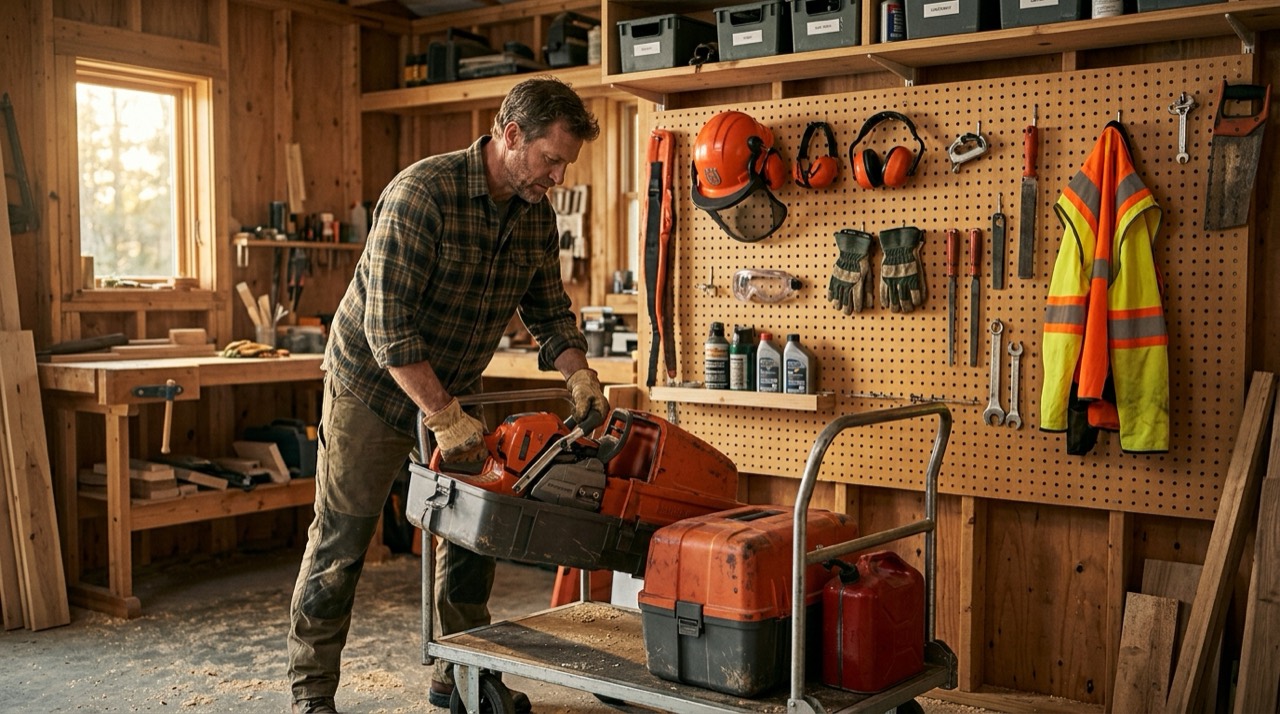
Then stop the saw from moving. A loose chainsaw becomes a projectile in a hard stop, so wedge it against a bulkhead, strap it down, or carry it inside a latched hard case. Keep spare fuel in a sealed, approved can well away from the passenger cabin, and never carry a saw loose on a car seat.
Should you use the maker's kit case or buy your own?
Use the maker's case if your saw came with one — many mid-range Stihl and Husqvarna gas saws and some battery kits ship in a molded case that fits perfectly. If your saw arrived in a cardboard box with only a plastic bar scabbard, add a hard case or padded bag sized to your bar.
The case does three jobs: it covers the chain, contains oil, and stores the scrench, spare chain, and bar and chain oil in one place. Buying your own hard case also lets you standardise storage across several saws, so a mixed gas and battery collection travels the same way every time.
How do you store a chainsaw between jobs?
Between jobs, store the chainsaw cool, covered, and upright or bar-down on a shelf or in its case, out of a child's reach. For a short gap of a few days to a couple of weeks, you can leave fuel in a gas saw, but keep the tank cap tight and the bar covered.
Clean the saw first. Brush chips and sawdust out of the bar groove and chain-brake band, wipe the bar, and top up the oil reservoir only if you will use the saw again soon — a full tank left for weeks is more likely to weep. A quick clean also lets you spot a loose chain or worn bar before the next maintenance check.
How do you lay a chainsaw up for the off-season?
For long storage, empty or stabilize the fuel, drain the bar oil, clean the saw, and store it in a latched case in a dry space. Run a gas saw dry, or fill it with stabilized or ethanol-free fuel, so the carburetor can't varnish over months of standing.
Finish with a light lay-up routine: remove and clean the chain and bar, wipe them with light oil to stop rust, and store a battery saw's packs indoors at a partial charge. A saw put away clean, dry, and fuel-safe starts the next season without a carburetor rebuild.
What should you keep in the case with the saw?
Keep the case as a complete cutting kit, not just a box for the saw. Alongside the powerhead, the molded compartments are made for the scrench, a spare chain, a small round file and flat file, and a bottle of bar and chain oil, so everything you need to run and touch up the saw travels in one grab.
Group the consumables sensibly. A spare loop of chain matched to your bar, a scrench for the bar nuts and chain tension, and a sharpening file kit turn a full case into a field-ready set. Add a folded rag and a pair of gloves, and keep the case latched so none of the sharp contents shift onto small hands when it is stored on a shelf. A stocked case also means you are less likely to leave a loose chain or file rattling around the garage where someone can catch an edge.
How do you secure a chainsaw in different vehicles?
Secure a chainsaw so it cannot slide or tip: strap it flat in a truck bed against the bulkhead, box it in the cargo area of an SUV, and never let it ride loose on a seat where a hard stop turns it into a projectile. The bar stays covered in every case.
Each vehicle needs a slightly different approach:
- Pickup bed — lay the saw flat in a latched case against the front bulkhead and run a strap through the handle so it cannot shift when you brake, with an absorbent mat underneath to catch drips.
- SUV or wagon — a cargo area shares air with the cabin, so use a sealed hard case, keep the tank low, and wedge it so it cannot roll into the seat backs.
- Trailer — an open trailer exposes the saw to weather and bounce, so a gasketed case or modular box is worth it, strapped down at two points.
- Sedan trunk — fine for a scabbarded saw with a low tank on a mat; keep spare fuel in a sealed can, never in the trunk long-term.
Wherever it rides, keep the gas saw upright or flat, not on its side, so fuel cannot seep past the cap.
What are the common mistakes when transporting a chainsaw?
The frequent transport mistakes are carrying the saw with the chain uncovered, laying a full-tank gas saw on its side, and leaving spare fuel in the passenger cabin. Each risks a cut, a fuel leak, or fumes in an enclosed space.
The errors that turn a routine trip into a hazard are avoidable:
- Skipping the scabbard for a "quick" trip — an uncovered chain snags bags, cuts hands, and marks the load bed.
- Standing a gas saw on its side with a full tank, so fuel weeps past the cap and pools.
- Carrying loose fuel in the cabin instead of a sealed, approved can in the load area away from people.
- Setting the saw on a seat or in a footwell where it can slide into a passenger under braking.
- Loading a hot saw straight after cutting, so the muffler scorches the case or mat — let it cool first.
Fixing these takes seconds: cover the bar, keep the tank low and the saw flat, and stow fuel separately. The chainsaw maintenance guide covers the pre-trip checks in more detail.
How do you store a chainsaw in a cold or damp climate?
In a cold or damp climate, store the saw in a latched case up off the floor, keep the battery indoors, and wipe every bare metal surface with light oil so condensation cannot rust the chain and bar. Airflow and a raised shelf matter as much as the roof over it.
Damp is harder on a stored saw than cold alone. A sealed shed that warms by day and cools at night pulls moist air across cold steel, so a bar left bare rusts even under cover. Wipe the bar, chain, and exposed metal with a light machine oil, stand the cased saw on a shelf rather than the slab, and add a tub of desiccant in a wet shed. A battery saw's pack should always come indoors, because cold robs its capacity and damp corrodes the terminals faster than it does the saw.
How do you get a stored chainsaw running again after lay-up?
Bring a stored saw back by reversing the lay-up: check the chain tension and bar oil, add fresh fuel to a gas saw or a charged pack to a battery saw, and run it briefly before you cut. A saw put away clean starts in a few pulls; a neglected one may need the carburetor cleared.
Run through a short recommissioning routine before the first cut of the season:
- Inspect the bar and chain for rust, wipe them, and confirm the chain tension is correct.
- Top up the bar-oil reservoir and check the oiler feeds when you rev the saw.
- Fill a gas saw with fresh fuel — old fuel drained at lay-up should not go back in — or fit a fully charged pack to a battery saw.
- Set the choke, start the saw on the ground with the brake on, and let it warm before loading it.
- Make a test cut on scrap to confirm the chain pulls straight and the oiler is throwing oil.
If a gas saw will not fire after a winter of untreated fuel, a gummed carburetor is the usual cause, and the maintenance guide covers clearing it.