Best Splitting Maul
Best Splitting Maul, ranked from aggregated owner ratings and reviews, not first-hand testing. Real pros, cons, and who each pick is best for.

Our Top 3 Picks
Quick Comparison
| Product | Best for | Buy | |
|---|---|---|---|
| Fiskars X27 Super Splitting Axe | Best Overall | See Amazon | View (paid link) |
| Fiskars IsoCore 8 lb Splitting Maul | Best Value | See Amazon | View (paid link) |
| Gransfors Bruks Splitting Maul | Best Premium | See Amazon | View (paid link) |
| Estwing Fireside Friend E3FF4 | Best Compact | See Amazon | View (paid link) |
| Council Tool 8 lb Sledge-Eye Splitting Maul | Best Heavy-Duty | See Amazon | View (paid link) |
| Husqvarna S1600 Splitting Axe | Best for Beginners | See Amazon | View (paid link) |
How do you choose a splitting maul or axe?
Choose a splitting tool by matching head weight to your dominant wood, handle length to your height, and handle material to how roughly you split. A 6-pound maul or splitting axe handles most home firewood; big, green, knotty hardwood justifies an 8-pound maul, while kindling only needs a light hatchet.
The picks below are chosen from manufacturer specs and aggregated owner feedback, not first-hand lab testing. Prices are not shown here because they move constantly through the Amazon listing.
What head weight splits firewood without wearing you out?
Head weight sets the trade-off between splitting power and accuracy. A 6-pound head, like the Fiskars X27 or a Gransfors Bruks maul, splits seasoned hardwood in one or two strokes while staying controllable for a full session. An 8-pound maul such as the Council Tool or Fiskars IsoCore wins on big, twisted, or green rounds but tires most people faster and lands less precisely.
If you mainly split softwood or already-seasoned rounds, a lighter 4- to 6-pound splitting axe accelerates faster and feels less punishing over a stack. Reserve the heaviest heads for the wood that genuinely needs them.
What handle length suits your height and the wood?
Handle length should track your height and the weight of the head: most adults split best with a 31- to 36-inch handle, taller users and 8-pound mauls favour the longer end, and shorter splitters or lighter axes can drop toward 28 inches. A longer handle multiplies force but is harder to place precisely.
A long handle does two useful things at once. It adds swing speed, since the head travels a longer arc, and it gives a missed strike room to pass the round and bury in the block instead of your shin. The trade-off is control: a 36-inch tool can feel unwieldy in tight spaces or for a shorter person, which is where a 28-inch axe like the Husqvarna (paid link) S1600 or Fiskars X25 earns its place. If you are between sizes, choose the length that lets you stand comfortably upright with the head reaching the top of the round, because a handle that forces you to stoop puts your legs in the swing path.
Wood handle or composite: which lasts longer?
Handle material is a durability-versus-repairability choice. Composite handles (Fiskars FiberComp, fibreglass) shrug off the overstrikes that snap wooden handles and never rot, making them the low-maintenance pick. Hickory absorbs shock beautifully and can be re-hung when it wears, which is why premium forged mauls from Gransfors Bruks and Council Tool still use it.
The three handle traits that matter most are listed below.
- Overstrike resistance: composite tolerates glancing hits; hickory can crack.
- Repairability: a hickory head can be re-hung; most composite tools are replaced whole.
- Shock feel: hickory and shock-control composites like Fiskars IsoCore soften the jolt to your joints.
How does head geometry change splitting performance?
Head geometry decides whether a tool pops rounds apart or buries and sticks. A maul's broad convex cheeks act as a moving wedge that keeps forcing the split open, while a splitting axe's slimmer face penetrates faster on smaller rounds. Both are far blunter than a cutting axe on purpose.
The Fiskars X27 and X25 owe their reputation to this: their convex bevel and head-heavy balance make a relatively light head split like a heavier tool, because the geometry does the work the mass would otherwise have to. A maul such as the Council Tool or Fiskars IsoCore adds sheer weight behind broad cheeks for the rounds that a thinner axe face sinks into and jams. When you compare models, look at how quickly the cheeks widen behind the edge rather than at edge sharpness, since a keen edge on a splitting tool only makes it stick.
How do the top splitting axes and mauls compare?
The table below compares the picks by head weight, handle, and the wood each suits, so you can shortlist before reading the verdicts.
| Model | Type | Head weight | Handle | Best for |
|---|---|---|---|---|
| Fiskars X27 Super Splitting Axe | Splitting axe | ~4 lb head (~6.3 lb total) | FiberComp, ~36 in | All-round home firewood |
| Fiskars IsoCore 8 lb Splitting Maul | Maul | ~8 lb | Shock-control composite, ~36 in | Big, knotty hardwood |
| Gransfors Bruks Splitting Maul | Maul | ~5.5 lb | Hickory, ~31 in | Buy-it-for-life hardwood splitting |
| Estwing Fireside Friend E3FF4 | Axe/hammer | ~4 lb | One-piece forged steel, ~14 in | Kindling and small rounds |
| Council Tool 8 lb Sledge-Eye Maul | Maul | ~8 lb | Hickory, ~36 in | Heavy, green, twisted rounds |
| Husqvarna S1600 Splitting Axe | Splitting axe | ~3.3 lb | Hickory, ~28 in | Beginners and lighter swings |
Which tool fits your wood, your body, and your workload?
Match the tool to three things at once: the wood you actually burn, your own strength and joints, and how much you split a year. A weekend homeowner splitting seasoned rounds needs a different tool from someone processing a woodshed of green hardwood on acreage.
Use these scenarios as a guide.
- Small suburban yard, seasoned softwood or clean hardwood: a 4- to 6-pound splitting axe like the Fiskars X27 or Husqvarna S1600 is faster and less tiring than a maul.
- Acreage with large, green, or knotty hardwood: an 8-pound Council Tool or Fiskars IsoCore maul plus steel wedges earns its weight.
- A bad back, shoulder, or elbow: favour a lighter axe or move straight to a powered splitter, since swinging a maul is a whole-body strain.
- Several cords a season: keep a splitting axe for easy rounds, a maul for stubborn ones, and compare a manual or kinetic log splitter for volume.
Buying the heaviest tool for the worst wood you will ever meet is a common mistake; a head you can place accurately for an hour outperforms one that wins three strokes and then wears you out.
What should you budget, and what does a splitting tool cost to own?
Budget for the tool once and the upkeep for years: a capable composite splitting axe or maul is inexpensive, a hand-forged hickory maul costs several times more, and the real long-run cost is handles and your time, not the head. Cost of ownership favours durable, repairable tools.
A mass-market Fiskars or Husqvarna tool is cheap to buy and, with a composite handle, effectively maintenance-free until it eventually fails as a unit. A hand-forged Gransfors Bruks or Council Tool maul costs far more up front but can be re-handled and re-sharpened indefinitely, spreading its price across decades and holding resale value that plastic-handled tools do not. Wooden-handled tools add the small ongoing cost of the occasional replacement handle and a bottle of linseed oil. Against a powered splitter, any hand tool is trivially cheap; the question is whether your volume and your joints can afford the swing.
What mistakes do buyers make choosing a splitting tool?
The most common buying mistakes are over-weighting the head, ignoring handle length, and skipping the safety gear. Each one shows up as fatigue, poor accuracy, or an injury within the first season, and each is easy to avoid before you spend.
Buyers routinely reach for an 8-pound maul when a 6-pound tool would split the same wood with better aim and far less fatigue. Others buy on head weight alone and end up with a 36-inch handle that is too long for their height or their splitting space. A third group spends carefully on the tool and nothing on eye protection, boots, or a proper block, then splits on the ground and dulls the edge on soil. Decide your dominant wood first, size the handle to your body second, and set aside a little of the budget for gear and a stable sawhorse or log stand.
Which splitting maul is right for you?
Pick the Fiskars X27 as a do-everything splitter for most homes, the Gransfors Bruks maul if you want a repairable tool for life, and an 8-pound Council Tool or Fiskars IsoCore for the biggest, knottiest hardwood. Choose the Estwing Fireside Friend for kindling and the Husqvarna S1600 if you are new to splitting.
Whatever you choose, pair it with proper work gloves, eye and hearing protection, and a stable sawhorse or log stand. If you split several cords a year, compare hand tools against a manual or kinetic log splitter.
If you are still torn between two picks, buy the lighter, more accurate one first; you can always add a heavier maul later for the rounds that defeat it. Owners who process a full woodshed usually end up with a splitting axe for easy rounds, a maul for stubborn ones, and a set of steel wedges for the worst pieces.
Full Ranking, Reviewed

Best for All-round home firewood and taller users
- Around a 36-inch shaft that suits taller splitters and adds swing speed
- Forged, hardened blade geometry designed to pop rather than stick in the round
- Virtually unbreakable FiberComp handle that shrugs off overstrikes
- Head-heavy balance that concentrates force at the edge
- Splits seasoned hardwood in one or two strokes for most users
- Handle survives the overstrikes that snap wooden shafts
- Long shaft improves accuracy and keeps missed swings clear of your legs
- The 36-inch length can feel long for shorter splitters
- A bonded composite handle cannot be re-hung if it ever fails
Verdict: The most broadly recommended splitting tool for home firewood, blending reach, power, and a near-indestructible handle.

Best for Big, knotty hardwood without the wooden-handle upkeep
- Roughly an 8-pound head for heavy splitting and driving wedges
- IsoCore shock-control system that reduces the jolt reaching your hands
- Flat hammer poll for striking steel splitting wedges
- Composite shaft with a textured, overstrike-resistant grip
- Heavy head powers through large, green, or knotty rounds
- Shock-control noticeably softens the impact on wrists and elbows
- Doubles as a wedge-driving hammer thanks to the flat poll
- At around 8 pounds it tires most people faster than a 6-pound tool
- Overkill for small, seasoned, straight-grained firewood
Verdict: A hard-hitting maul that delivers heavy-duty splitting and wedge driving with far less hand shock than a bare hickory maul.
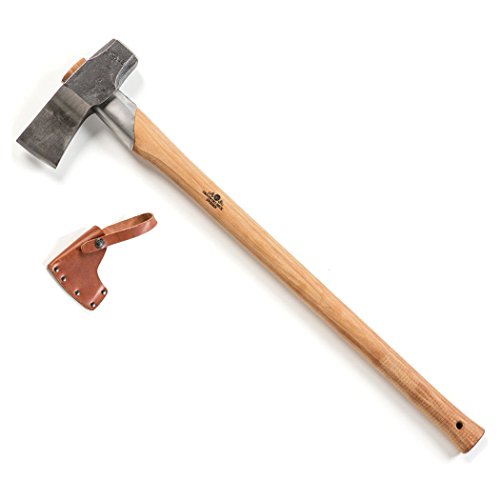
Best for A repairable, buy-it-for-life hardwood splitter
- Hand-forged Swedish head, around 5.5 pounds, with each smith's mark
- Curved American hickory handle that can be re-hung when worn
- Convex splitting geometry that forces halves apart cleanly
- Long-established craftsmanship reputation among serious wood processors
- Hand-forged head and hickory handle can be maintained for decades
- Balanced weight makes it accurate as well as powerful
- Holds resale and heirloom value in a way plastic-handled tools do not
- Premium price sits well above mass-market mauls
- Hickory handle demands more care and is vulnerable to overstrike
Verdict: The pick for buyers who want a hand-forged, fully repairable maul that will outlast several composite tools.

Best for Kindling and small rounds near the wood stove
- One-piece forged steel construction with no handle joint to fail
- Around a 14-inch length for controlled, close-in work
- Dual-purpose head that splits with the blade and drives with the poll
- Shock-reduction grip moulded onto the steel shaft
- Indestructible one-piece build handles years of kindling duty
- Compact size gives precise control for small splits
- Works as both a small splitter and a driving tool
- Too short and light for full-size firewood rounds
- All-steel build transmits more shock than a composite maul on hard hits
Verdict: A near-unbreakable kindling splitter that lives by the stove and shrugs off the abuse that destroys hatchets.

Best for Heavy, green, and twisted hardwood rounds
- Roughly an 8-pound American-made forged head
- Sledge-eye pattern rated for driving wedges with the poll
- Around a 36-inch straight hickory handle
- Thick convex cheeks built to force stringy grain apart
- Serious mass splits the biggest, greenest rounds
- Sledge-eye poll takes wedge driving in stride
- Hickory handle can be replaced rather than binning the head
- Heavy swing weight is fatiguing over a long session
- Wooden handle needs overstrike care to survive
Verdict: An American-forged workhorse maul for people who routinely split large, difficult hardwood and drive wedges.

Best for New splitters and lighter, controlled swings
- Lighter forged head, around 3.3 pounds, for manageable swings
- Curved hickory handle roughly 28 inches long
- Splitting geometry aimed at seasoned, straight-grained rounds
- Leather edge guard included for safe storage
- Lighter head is easier to aim while you build technique
- Shorter handle suits smaller splitters and tight spaces
- Quality forged head at an approachable price
- Lacks the mass for big or knotty hardwood
- Hickory handle can be overstruck by inexperienced users
Verdict: A forgiving, well-made splitting axe that lets beginners learn accuracy before moving up to a heavier maul.
Frequently Asked Questions
Is a maul or a splitting axe better for firewood?
A maul is better for large, green, or knotty hardwood because its 6- to 8-pound wedge head forces stubborn rounds apart. A lighter splitting axe is better for small, seasoned, straight-grained wood because it swings faster and lands more accurately. Many people who split a lot of wood keep both.
How heavy should my splitting maul be?
Six pounds suits most home firewood and stays accurate for a full session. Choose an 8-pound maul only for big, twisted, or green hardwood, and only if you can swing that mass on target repeatedly. A heavier head splits faster but tires you sooner and lands less precisely.
Are composite handles better than wood for a splitting maul?
Composite handles resist the overstrikes that snap wooden shafts and never rot, making them the low-maintenance choice. Hickory absorbs shock well and can be re-hung when it wears, which is why premium forged mauls still use it. Pick composite for durability, hickory for repairability.
Do splitting mauls need sharpening?
A splitting maul works by wedging wood apart, so it needs only a moderately blunt, burr-free edge, not a razor edge. File off dings and re-establish the original bevel a few times a year with a coarse file. A splitting axe benefits from a slightly keener edge than a maul.