


What is a splitting maul?
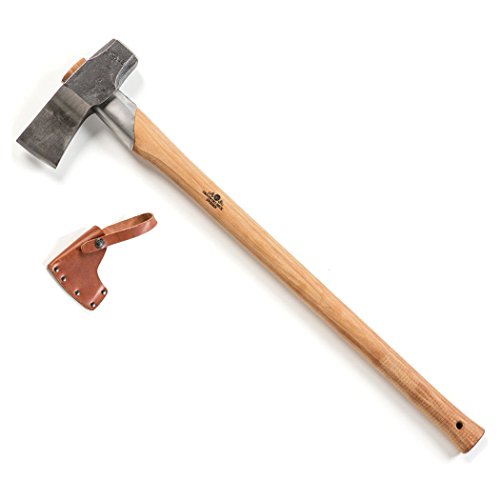
A splitting maul is a heavy hand tool with a blunt, wedge-shaped head, usually 6 to 8 pounds, on a long 31- to 36-inch handle, made to burst firewood rounds apart along the grain. It splits by wedging the wood open with mass and momentum, not by slicing like a sharp axe.
The maul's design is all about force. Its broad, convex cheeks spread the split as the head sinks in, and many mauls carry a flat hammer poll on the back so you can drive steel splitting wedges through the toughest rounds. The head is deliberately blunter than an axe because a keen edge would only bury and stick in the wood instead of popping it apart.
What are the parts of a splitting maul?
A splitting maul has five working parts: the wedge-shaped head, its broad convex cheeks, a flat hammer poll, the eye that holds the handle, and a long 31- to 36-inch handle of hickory or composite. Each part is shaped for force rather than fine cutting.
The head carries the mass, usually 6 to 8 pounds, and its blunt edge starts the split. The convex cheeks behind the edge act as a moving wedge, widening the crack and forcing the halves apart so the head does not bury and stick. The poll, on many mauls, is a flat hardened face for driving steel splitting wedges. The eye is the opening the handle passes through; on a hickory-handled maul it can be re-hung when the handle wears, while composite and one-piece forged tools bond or forge the two together. The handle sets both the swing speed and the leverage.
How is a maul different from a splitting axe?
A maul is heavier and blunter than a splitting axe, trading swing speed for raw splitting power. A splitting axe carries a lighter 3- to 6-pound head that accelerates faster and lands more accurately, which suits small, seasoned, straight-grained rounds. A maul's extra mass muscles through big, green, or knotty hardwood that a slim axe sticks in.
Both differ from a felling or chopping axe, which is designed to cut across the grain rather than split with it. Using the right tool for the grain direction is what makes splitting efficient.
When should you use a maul?
Use a maul for large rounds, green timber, and knotty or twisted grain, and whenever you need to drive steel wedges. For kindling and small seasoned wood, a lighter axe or a compact tool like the Estwing Fireside Friend is faster and less tiring. Many people who process a lot of wood keep both a maul and an axe.
For picks and technique, see the best splitting axes and mauls roundup and the main splitting axes and mauls guide.
How heavy is a splitting maul, and how long is the handle?
A splitting maul typically weighs 6 to 8 pounds in the head, on a 31- to 36-inch handle. Six pounds suits most home firewood and stays accurate over a long session, while 8 pounds is reserved for large, green, or knotty hardwood, and only for splitters who can place that mass on target every swing.
Handle length tracks height and head weight: taller users and heavier mauls favour the longer end of the range, while shorter splitters can drop toward 28 inches. A longer handle multiplies the same head's force and gives a missed swing room to pass the round. For a fuller breakdown of how to size weight and length to your wood and body, see the main splitting axes and mauls guide.
How long does a splitting maul last?
A well-made splitting maul lasts decades, because its blunt head takes little wear and a wooden handle can be replaced when it fails. The head is effectively a lifetime component; the handle is the wear part on traditional tools, and the whole unit is the wear part on composite ones.
A hand-forged hickory-handled maul from a maker like Gransfors Bruks or Council Tool can be re-sharpened and re-handled indefinitely, which is why such tools hold heirloom and resale value. A composite maul such as the Fiskars IsoCore is effectively maintenance-free until the bonded handle eventually fails, at which point the tool is replaced as a unit. Either way, the limiting factor is rarely the head. Keep the edge filed, the handle protected from overstrike, and the steel dry, and one maul will process firewood for many seasons. For the ranked picks, see the best splitting axes and mauls roundup.