Wood Splitting Axe Vs Maul
Wood Splitting Axe Vs Maul, ranked from aggregated owner ratings and reviews, not first-hand testing. Real pros, cons, and who each pick is best for.

Our Top 3 Picks
Quick Comparison
| Product | Best for | Buy | |
|---|---|---|---|
| Fiskars X27 Super Splitting Axe | Best Overall | See Amazon | View (paid link) |
| Fiskars IsoCore 8 lb Splitting Maul | Best Value | See Amazon | View (paid link) |
| Gransfors Bruks Splitting Maul | Best Premium | See Amazon | View (paid link) |
| Estwing Fireside Friend E3FF4 | Best Compact | See Amazon | View (paid link) |
| Council Tool 8 lb Sledge-Eye Splitting Maul | Best Heavy-Duty | See Amazon | View (paid link) |
| Husqvarna S1600 Splitting Axe | Best for Beginners | See Amazon | View (paid link) |
Splitting axe vs maul: which should you swing?
Choose a splitting axe for small, seasoned, straight-grained rounds where swing speed and accuracy matter, and a maul for large, green, or knotty hardwood where sheer mass and a wedge shape do the work. The two tools solve different halves of the same job, and heavy users often own one of each.
A splitting axe carries a thinner, lighter head (3 to 6 pounds) that accelerates quickly and pops manageable rounds with less effort. A maul carries a blunt, broad 6- to 8-pound head that muscles through the wood a slim axe would stick in, and its flat poll can drive steel wedges. The picks below span both tool types so you can match the wood you actually burn. Selections come from manufacturer specs and aggregated owner feedback, not first-hand testing.
How do head weight and geometry differ between the two tools?
The core difference is a heavier, blunter maul head versus a lighter, slimmer axe head: a maul carries 6 to 8 pounds behind broad convex cheeks that muscle through the wood, while a splitting axe carries 3 to 6 pounds behind a thinner face that accelerates and bites faster. Weight and shape, not sharpness, separate them.
A maul's mass gives it momentum to keep driving a split open, and its broad cheeks stop it burying and sticking the way a thin blade would in tough grain. Its flat poll doubles as a hammer for steel wedges. A splitting axe trades that mass for speed: the lighter head reaches the round sooner and more often, so on manageable rounds you simply split more wood per minute with less strain. Both are deliberately blunter than a felling axe, because a keen edge on either tool would sink in and jam instead of popping the round. Judge each by how fast the cheeks widen behind the edge.
When does a splitting axe win?
A splitting axe wins on speed, control, and fatigue for everyday firewood. Its lighter head lets you swing faster and more often, place strikes accurately, and split a stack of seasoned hardwood or softwood without the joint-jarring weight of a maul. Modern convex axes like the Fiskars (paid link) X27 split far better than their weight suggests.
Reach for an axe when your rounds are already seasoned, mostly straight-grained, and under roughly 12 inches across. If a round keeps swallowing the axe without cracking, that is your cue to switch to a maul or wedges.
When does a maul win?
A maul wins on the wood an axe cannot handle: big rounds, green timber, and twisted or knotty grain. Its 6- to 8-pound wedge head keeps driving the split open instead of burying and sticking, and the flat poll lets you hammer steel wedges through the worst pieces.
A maul also earns its keep if you would rather trade a few extra strokes of a lighter axe for one decisive blow. The trade-off is fatigue and slightly lower accuracy, so most people who own a maul keep a lighter axe alongside it for the easy rounds.
How does each tool handle different wood?
Wood species and moisture decide the winner more than any spec: an axe clears seasoned, straight-grained, modest rounds quickly, while a maul is the tool for large, green, knotty, or stringy wood that an axe sticks in. Read the round before you choose the swing.
The tool each common wood favours is set out below.
| Wood | Condition | Axe or maul |
|---|---|---|
| Pine, fir, cedar | Seasoned | Splitting axe |
| Oak, ash, maple | Seasoned, straight grain | Either; axe if under ~12 in |
| Oak, ash, maple | Large or green rounds | Maul |
| Elm, sweet gum, sycamore | Any | Maul plus wedges |
| Knotty or crotch wood | Any | Maul, or a powered splitter |
The practical test is simple: if the axe keeps sinking in without cracking the round, the wood has outgrown it, and you should switch to a maul or start a steel wedge in the crack. Stringy species such as elm rarely yield to any swing and are the clearest case for wedges.
How do a splitting axe and a maul compare at a glance?
The table below sets the two tool types side by side on the attributes that decide the job.
| Attribute | Splitting axe | Splitting maul |
|---|---|---|
| Typical head weight | 3–6 lb | 6–8 lb |
| Swing speed | Faster, less fatiguing | Slower, more tiring |
| Best wood | Small, seasoned, straight grain | Large, green, knotty grain |
| Drives steel wedges | No (thin poll) | Yes (flat hammer poll) |
| Accuracy | Higher | Lower |
| Example models | Fiskars X27, Fiskars X25, Gransfors axe | Council Tool 8 lb, Fiskars IsoCore |
Which tool suits your body and your workload?
Choose with your body and your volume in mind, not just the wood: swinging a maul is a whole-body effort that rewards accuracy over strength, an axe rewards technique and stamina, and a machine removes the swing entirely. If your joints or your workload are the limit, that should steer the buy.
Weigh these factors.
- Strength and fitness: a fit splitter can place an 8-pound maul accurately for a session; most people stay more accurate, longer, with a 6-pound maul or a lighter axe.
- Existing injuries: a bad back, shoulder, or elbow is a reason to favour a light axe or move to a powered splitter, since a maul loads the whole body on every stroke.
- Volume: an afternoon of seasoned rounds suits an axe; several cords of difficult hardwood a year justify a maul, wedges, or a gas hydraulic splitter.
- Space: a 36-inch tool needs room to swing; tight woodsheds suit a shorter axe.
Most people who split seriously end up owning both and reaching for whichever the round in front of them calls for.
How do steel wedges fit between an axe and a maul?
Steel wedges are the bridge between the two tools: driven by a maul's flat poll, they open the large, knotty, and stringy rounds that defeat any axe and stall even a bare maul. Owning a pair effectively extends a maul's reach into the worst wood.
Start a wedge in an existing surface crack, tap it until it bites, then drive it home with the maul's hammer poll; a second wedge placed further along the crack lets you leapfrog through a round that will not open in one line. This is the standard fix for elm, gum, and big crotch pieces. An axe cannot do this safely, because its thin poll is not made for hammering and can mushroom or crack. If you find yourself reaching for wedges on most of your pile, the wood has outgrown hand tools altogether, and an electric log splitter will save your shoulders.
What mistakes do buyers make choosing between an axe and a maul?
The usual mistakes are buying both at once, over-weighting the maul, and treating the two as interchangeable. Most people need only one tool to start, and the wrong first choice usually means a tool that is too heavy or too light for the wood they actually burn.
Buying an axe and a maul together is rarely necessary at first; one well-matched tool splits a full season for most homes. Reaching straight for an 8-pound maul when a 6-pound tool or a splitting axe would do leaves buyers fatigued and inaccurate. And expecting an axe to drive wedges or a maul to nimbly reduce kindling ignores what each is built for. Decide your dominant wood, buy the single tool that matches it, and add the second only when a real round defeats the first.
Which splitting tool should you buy first?
Buy a splitting axe first if your firewood is mostly seasoned and modest in size, and add a maul when big or knotty rounds start defeating it. If you already know you burn large green hardwood, start with a maul and a set of steel wedges. Owners with a full woodshed usually run both.
For the full ranked shortlist, see our best splitting axes and mauls roundup, and read the splitting axes and mauls guide for technique and safety. When volume outgrows hand tools, compare an electric log splitter or gas hydraulic splitter.
One more factor tips the choice: your body. Swinging a maul is a whole-body workout that can aggravate a bad back, shoulder, or elbow, so if any of those apply, favour a lighter splitting axe or move straight to a powered splitter. A splitting axe rewards technique and stamina; a maul rewards accuracy over strength; and a machine removes the swing entirely. Whichever route you take, keep a sawhorse or log stand handy for cutting rounds to a consistent, splittable length first, because uniform rounds make either hand tool far easier to aim.
Full Ranking, Reviewed

Best for All-round home firewood and taller users
- Around a 36-inch shaft that suits taller splitters and adds swing speed
- Forged, hardened blade geometry designed to pop rather than stick in the round
- Virtually unbreakable FiberComp handle that shrugs off overstrikes
- Head-heavy balance that concentrates force at the edge
- Splits seasoned hardwood in one or two strokes for most users
- Handle survives the overstrikes that snap wooden shafts
- Long shaft improves accuracy and keeps missed swings clear of your legs
- The 36-inch length can feel long for shorter splitters
- A bonded composite handle cannot be re-hung if it ever fails
Verdict: The most broadly recommended splitting tool for home firewood, blending reach, power, and a near-indestructible handle.

Best for Big, knotty hardwood without the wooden-handle upkeep
- Roughly an 8-pound head for heavy splitting and driving wedges
- IsoCore shock-control system that reduces the jolt reaching your hands
- Flat hammer poll for striking steel splitting wedges
- Composite shaft with a textured, overstrike-resistant grip
- Heavy head powers through large, green, or knotty rounds
- Shock-control noticeably softens the impact on wrists and elbows
- Doubles as a wedge-driving hammer thanks to the flat poll
- At around 8 pounds it tires most people faster than a 6-pound tool
- Overkill for small, seasoned, straight-grained firewood
Verdict: A hard-hitting maul that delivers heavy-duty splitting and wedge driving with far less hand shock than a bare hickory maul.
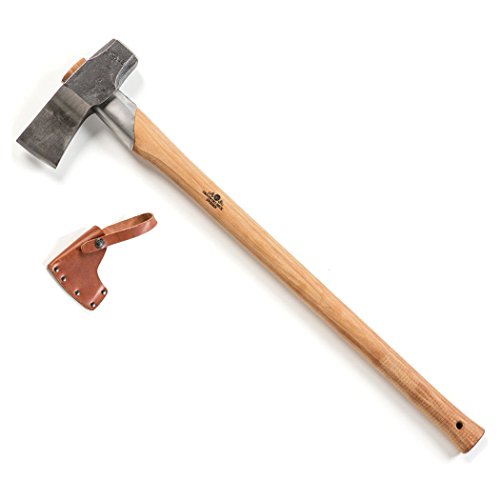
Best for A repairable, buy-it-for-life hardwood splitter
- Hand-forged Swedish head, around 5.5 pounds, with each smith's mark
- Curved American hickory handle that can be re-hung when worn
- Convex splitting geometry that forces halves apart cleanly
- Long-established craftsmanship reputation among serious wood processors
- Hand-forged head and hickory handle can be maintained for decades
- Balanced weight makes it accurate as well as powerful
- Holds resale and heirloom value in a way plastic-handled tools do not
- Premium price sits well above mass-market mauls
- Hickory handle demands more care and is vulnerable to overstrike
Verdict: The pick for buyers who want a hand-forged, fully repairable maul that will outlast several composite tools.

Best for Kindling and small rounds near the wood stove
- One-piece forged steel construction with no handle joint to fail
- Around a 14-inch length for controlled, close-in work
- Dual-purpose head that splits with the blade and drives with the poll
- Shock-reduction grip moulded onto the steel shaft
- Indestructible one-piece build handles years of kindling duty
- Compact size gives precise control for small splits
- Works as both a small splitter and a driving tool
- Too short and light for full-size firewood rounds
- All-steel build transmits more shock than a composite maul on hard hits
Verdict: A near-unbreakable kindling splitter that lives by the stove and shrugs off the abuse that destroys hatchets.

Best for Heavy, green, and twisted hardwood rounds
- Roughly an 8-pound American-made forged head
- Sledge-eye pattern rated for driving wedges with the poll
- Around a 36-inch straight hickory handle
- Thick convex cheeks built to force stringy grain apart
- Serious mass splits the biggest, greenest rounds
- Sledge-eye poll takes wedge driving in stride
- Hickory handle can be replaced rather than binning the head
- Heavy swing weight is fatiguing over a long session
- Wooden handle needs overstrike care to survive
Verdict: An American-forged workhorse maul for people who routinely split large, difficult hardwood and drive wedges.

Best for New splitters and lighter, controlled swings
- Lighter forged head, around 3.3 pounds, for manageable swings
- Curved hickory handle roughly 28 inches long
- Splitting geometry aimed at seasoned, straight-grained rounds
- Leather edge guard included for safe storage
- Lighter head is easier to aim while you build technique
- Shorter handle suits smaller splitters and tight spaces
- Quality forged head at an approachable price
- Lacks the mass for big or knotty hardwood
- Hickory handle can be overstruck by inexperienced users
Verdict: A forgiving, well-made splitting axe that lets beginners learn accuracy before moving up to a heavier maul.
Frequently Asked Questions
Do I need both a splitting axe and a maul?
Not to start. Most people can split a full season with one well-chosen tool. Buy a splitting axe if your wood is mostly seasoned and modest in size, or a maul if you burn large, green, knotty hardwood. Heavy wood processors eventually keep both plus a set of wedges.
Can a splitting axe do everything a maul does?
No. A splitting axe handles small, seasoned, straight-grained rounds faster and more accurately, but it lacks the mass to burst large or knotty wood and its thin poll cannot drive steel wedges safely. For big green hardwood, a maul or wedges are the right tools.
Is a heavier maul always better?
No. A heavier head splits stubborn wood in fewer strokes but lands less accurately and tires you sooner. Six pounds suits most home firewood; reserve 8 pounds for big, twisted, or green hardwood. The best tool is the heaviest head you can still place accurately every swing.
What about steel splitting wedges?
Steel wedges plus a maul with a flat poll open rounds that defeat any axe, especially stringy species like elm and gum. Start a wedge in a surface crack, tap it to bite, then drive it home. Two wedges let you leapfrog through a difficult round.