


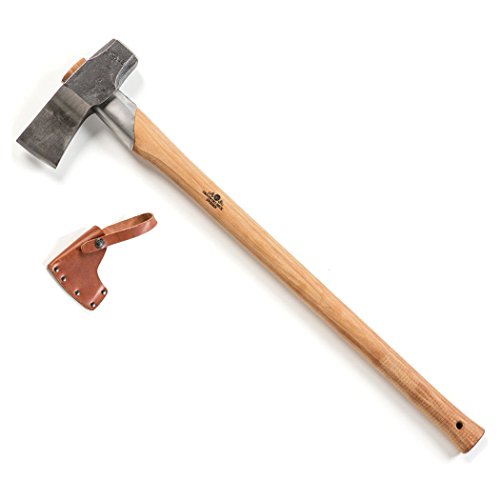


How do you split a round of firewood with a maul?
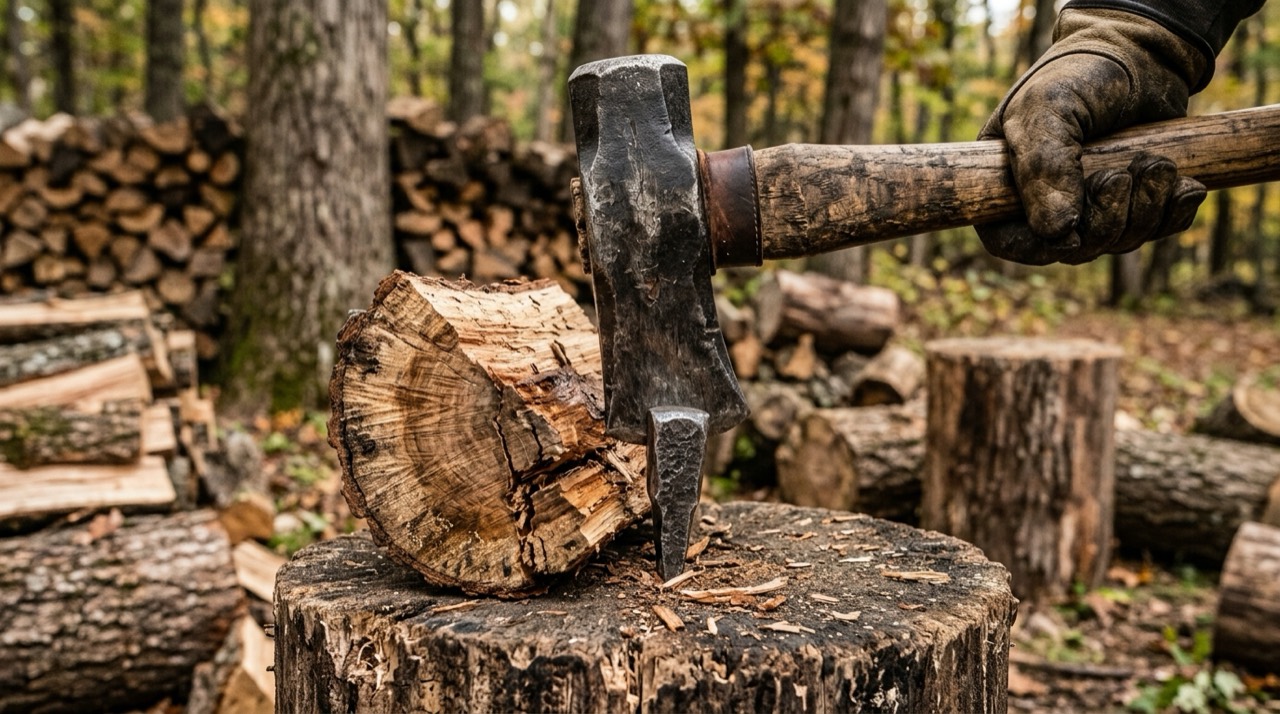
Stand the round on a low, solid block, set your feet shoulder-width apart, raise the maul overhead with both hands, and let its weight fall while sliding your top hand down the handle to add speed. Aim, timing, and letting the head do the work matter far more than muscling the swing.
Good splitting is a controlled drop, not a violent chop. Grip the handle near its end for maximum leverage, keep your eyes fixed on the exact spot you want to hit, and bend at the knees and hips as the maul comes down so your whole body drives the blow. If the head buries without splitting, rock it free rather than levering hard sideways, which can crack a wooden handle. The general safety and gear basics live in the splitting axes and mauls guide; this page focuses on technique.
How do you swing a maul with good form?
Good maul form is a full-body drop, not an arm-powered chop: grip near the handle's end, raise the maul overhead with a slight bend at the knees and hips, keep your eyes locked on the target, and let gravity plus a downward slide of your top hand accelerate the head into the wood. Technique beats strength on every stroke.
Build the swing in this order.
- Set your feet shoulder-width apart, square to the round, with the block a comfortable arm's-length away.
- Grip the handle with your dominant hand near the head and your other hand at the end, ready to slide together.
- Raise the maul straight overhead, hinging at the hips rather than leaning back.
- Drive downward by dropping your body weight and sliding your top hand down to meet the bottom one, snapping the head into the target.
- Keep your back straight and let the legs and core, not the arms, supply the power.
Aim to place the edge on the exact spot you were watching. A controlled, repeatable drop that lands accurately will out-split a violent heave every time, and it keeps the handle and your shins out of harm's way.
Where should you aim on the round?
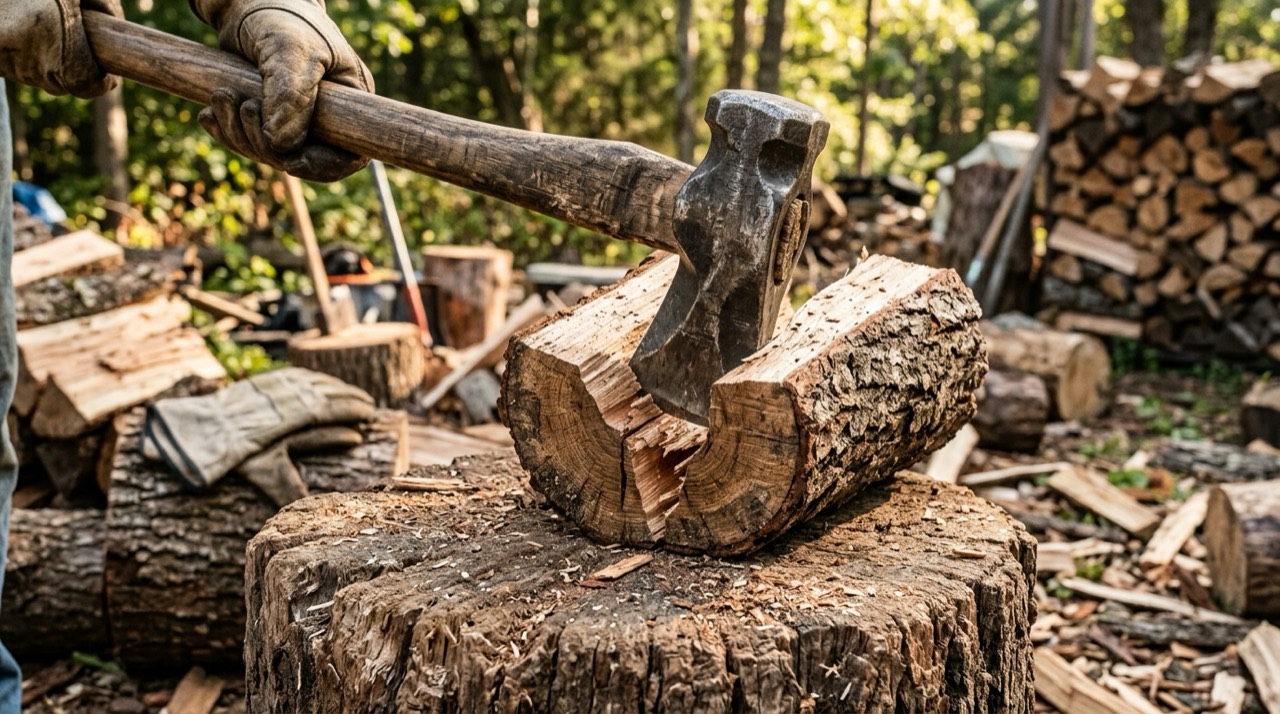
Aim for the edge of a large round, working inward in slabs, and target any existing crack or check in the end grain rather than the dead centre. Big rounds rarely halve cleanly down the middle, but they shed manageable pieces from the outside quickly.
The places to aim, in order of ease, are listed below.
- Existing radial cracks, which the maul only has to open wider.
- The outer edge of oversized rounds, taking off slabs before working in.
- The centre of small, clear, straight-grained rounds, which split in one blow.
- Around knots, never straight through them, since knots deflect and stick the head.
Reading the end grain before you swing saves effort. Straight, even grain splits from the middle; wild or knotty grain splits better from the edges or with wedges. A stable sawhorse or log stand helps you cut rounds to a consistent, splittable length in the first place.
How do you get through knots and twisted grain?
Attack knots and twisted grain from the edges with a maul, and switch to steel wedges and the maul's flat poll when a round refuses to open. Knots are interlocked fibre that a single blade cannot cleave, so the goal is to work around them or split the wood apart mechanically.
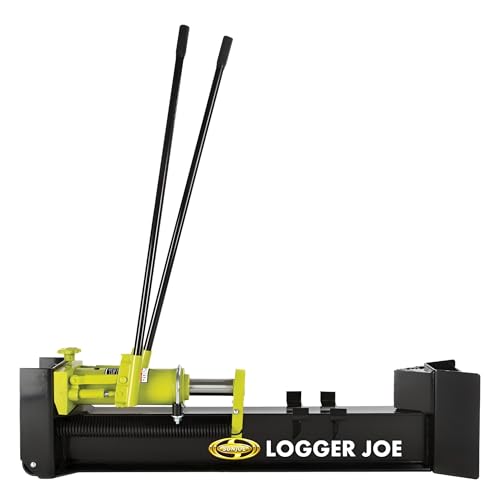
Start a steel wedge in a surface crack, tap it until it bites, then drive it home with the maul's hammer poll; a second wedge placed further along the crack lets you leapfrog through the toughest pieces. Green and stringy species such as elm and gum almost always need this approach. If a whole season of wood fights you like this, a manual or kinetic splitter or an electric log splitter will save your shoulders.
How do you free a maul that is stuck in a round?
Free a stuck maul by rocking it straight back and forth in line with the crack, or by lifting the whole round and striking it, head and all, down onto the block. Never lever the head hard sideways, which is the fastest way to snap a wooden handle.
If the head is buried but the round has started to crack, a firm forward-and-back rock along the split usually walks it free. If it is jammed solid, lift the maul with the round attached and bring it down onto the block so the round's own momentum drives the head deeper and splits it, or drive a steel wedge into the opened crack beside the head to release it. To avoid sticking in the first place, aim for the edge of large rounds rather than dead centre, and switch to a maul and wedges early on knotty or stringy wood instead of burying a lighter tool. A maul that sticks repeatedly is usually a sign the wood needs wedges or a manual or kinetic splitter.
How does wood moisture and species change your technique?
Adjust your technique to the wood: many species split most easily green and cool, straight from the tree, while seasoned rounds can bind and knotty or interlocked species need edges, wedges, and patience rather than force. The same maul asks for a different approach on different wood.
Split green wood soon after cutting where you can, because fresh fibres have not yet locked together and often part in a single blow. Cold weather helps too, since frozen moisture makes many rounds more brittle and easier to crack. Seasoned hardwood can be tougher, so target existing checks in the dried end grain. For interlocked species such as elm and gum, stop swinging and reach for wedges early rather than pounding a stuck head. Reading the end grain before each swing, straight grain from the middle and wild grain from the edges, saves more effort than any amount of extra muscle.
How do you set up a safe splitting station?
Set up on firm, level ground with a stable chopping block that raises the round so the split ends well above the soil, and keep a clear zone around you free of people, pets, and trip hazards. A good station protects both your body and your tool edge.
- Use a low, wide chopping block or an old car tyre laid flat; the tyre holds rounds upright and catches the halves.
- Keep the block low enough that the maul travels down past the round, never toward your shins.
- Clear at least a maul's length of space around you before every swing.
- Wear wrap-around eye protection, sturdy boots, and work gloves; add hearing and eye protection if powered tools are running nearby.
- Stop the moment fatigue starts to spoil your aim, because tired swings are where injuries happen.
An old tyre is the single most useful upgrade for a home splitter: stand the round inside it and the split pieces stay put instead of scattering, so you reset far less between swings. Batch your rounds, keep a steady rhythm, and let the tool rest when your accuracy fades.
How do you keep from tiring out over a big pile?
Pace yourself by working in short, focused sets rather than swinging flat out until you are exhausted, because accuracy fades long before strength does and tired, inaccurate swings are where handles break and shins get hit. Splitting a woodshed is a marathon, not a sprint.
Split the easy, straight-grained rounds first while you are fresh, then tackle the knotty ones, and set aside anything that clearly needs wedges rather than fighting it with the maul. Take a breather every dozen or so rounds, keep water nearby, and stop for the day the moment your aim starts drifting. A steady, sustainable rhythm processes far more wood over an afternoon than short bursts of maximum effort followed by long recoveries, and it keeps both you and your tool in one piece. If the pile is genuinely large or the wood is consistently difficult, that is the honest signal to bring in a manual or kinetic splitter and save the hand tools for touch-up work.
What are the most common maul splitting mistakes?
The most common mistakes are splitting without a block, aiming at the centre of oversized rounds, swinging while tired, and forcing a stuck head sideways. Each one costs you accuracy, an edge, a handle, or a shin, and each is easy to correct.
The errors to watch for are listed below.
- Splitting on the ground, which sends the head toward your legs and dulls the edge on soil and stone.
- Halving big rounds down the centre instead of shedding slabs from the edge, which just buries the head.
- Swinging past fatigue, when accuracy fades and most injuries and handle breaks happen.
- Levering a stuck head sideways, which cracks wooden handles at the neck.
- Skipping eye protection and work gloves, so a flying chip or a blister ends the session.
Fix these and the job gets faster and safer at once, without any change of tool. When the pile is genuinely large or the wood is consistently difficult, an electric log splitter removes the swing altogether.